
Downloads · 30 days
9
6% of all-time downloads
yosepyossi/mvrag
mvrag is a text-to-3d model from yosepyossi. Use it for the text-to-3d task on the model card, and read the license before you ship it in a product. It is set up for diffusers. The card lists the license as cc-by-4.0.
Downloads · 30 days
9
6% of all-time downloads
All-time downloads
154
Public
Parameters
893M
10.4 GB on disk
Likes
1
Public
Click a slice to open those files.
.safetensors7.1 GB · 100%
From the Hugging Face model README
| Project Page | Paper | GitHub | Weights | Benchmark (OOD-Eval) |
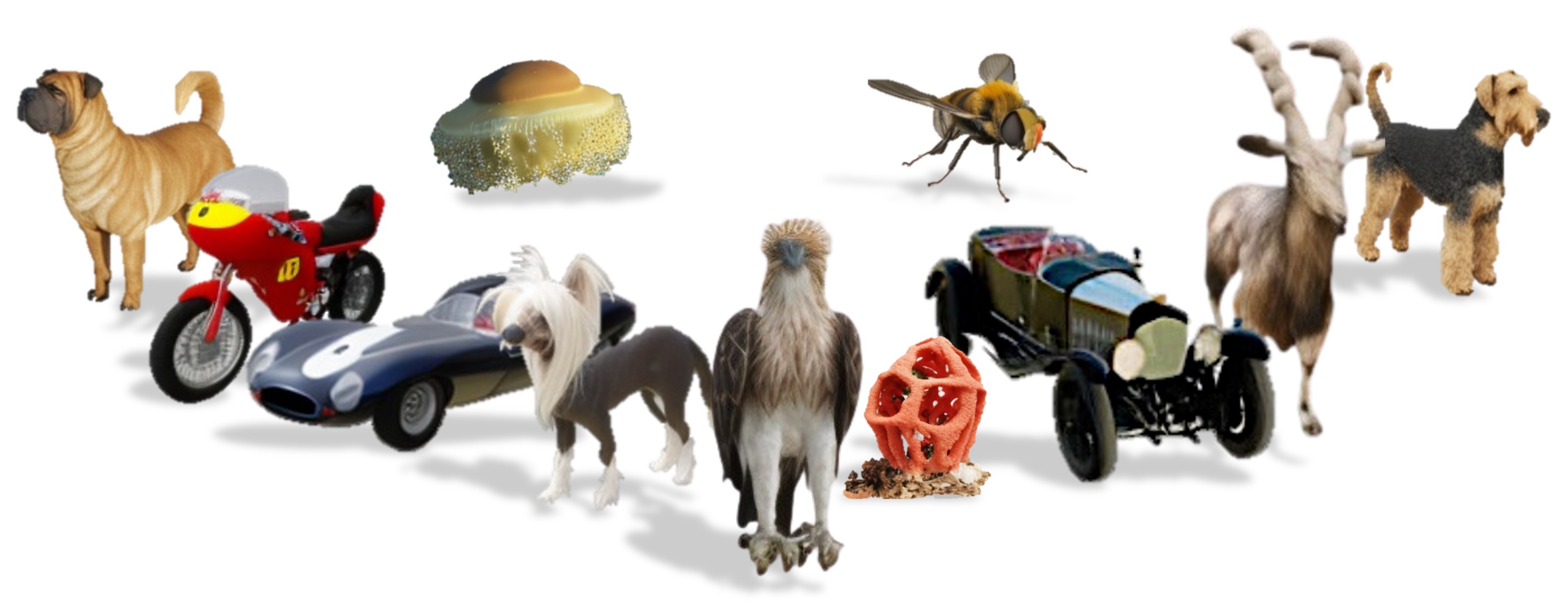
Text-to-3D generation approaches have advanced significantly by leveraging pretrained 2D diffusion priors, producing high-quality and 3D-consistent outputs. However, they often fail to produce out-of-domain (OOD) or rare concepts, yielding inconsistent or inaccurate results. To this end, we propose MV-RAG, a novel text-to-3D pipeline that first retrieves relevant 2D images from a large in-the-wild 2D database and then conditions a multiview diffusion model on these images to synthesize consistent and accurate multiview outputs. Training such a retrieval-conditioned model is achieved via a novel hybrid strategy bridging structured multiview data and diverse 2D image collections. This involves training on multiview data using augmented conditioning views that simulate retrieval variance for view-specific reconstruction, alongside training on sets of retrieved real-world 2D images using a distinctive held-out view prediction objective: the model predicts the held-out view from the other views to infer 3D consistency from 2D data. To facilitate a rigorous OOD evaluation, we introduce a new collection of challenging OOD prompts. Experiments against state-of-the-art text-to-3D, image-to-3D, and personalization baselines show that our approach significantly improves 3D consistency, photorealism, and text adherence for OOD/rare concepts, while maintaining competitive performance on standard benchmarks.
MV-RAG is a text-to-3D generation method that retrieves 2D reference images to guide a multiview diffusion model. By conditioning on both text and multiple real-world 2D images, MV-RAG improves realism and consistency for rare/out-of-distribution or newly emerging objects.
We recommend creating a fresh conda environment to run MV-RAG:
# Clone the repository
git clone https://github.com/yosefdayani/MV-RAG.git
cd MV-RAG

# Create new environment
conda create -n mvrag python=3.9 -y
conda activate mvrag

# Install PyTorch (adjust CUDA version as needed)
# Example: CUDA 12.4, PyTorch 2.5.1
conda install pytorch==2.5.1 torchvision==0.20.1 torchaudio==2.5.1 pytorch-cuda=12.4 -c pytorch -c nvidia

# Install other dependencies
pip install -r requirements.txt
MV-RAG weights are available on Hugging Face.
# Make sure git-lfs is installed (https://git-lfs.com)
git lfs install

git clone https://huggingface.co/yosepyossi/mvrag
Then the model weights should appear as MV-RAG/mvrag/...
You could prompt the model on your retrieved local images by:
python main.py \
--prompt "Cadillac 341 automobile car" \
--retriever simple \
--folder_path "assets/Cadillac 341 automobile car" \
--seed 0 \
--k 4 \
--azimuth_start 45  # or 0 for front view
To see all command options run
python main.py --help
This repository is based on MVDream and adapted from MVDream Diffusers. We would like to thank the authors of these works for publicly releasing their code.
@misc{dayani2025mvragretrievalaugmentedmultiview,
      title={MV-RAG: Retrieval Augmented Multiview Diffusion},
      author={Yosef Dayani and Omer Benishu and Sagie Benaim},
      year={2025},
      eprint={2508.16577},
      archivePrefix={arXiv},
      primaryClass={cs.CV},
      url={https://arxiv.org/abs/2508.16577},
}