
Downloads · 30 days
1.2K
1% of all-time downloads
weqweasdas/RM-Gemma-2B
RM-Gemma-2B is a text classification model from weqweasdas. Use it when you need a label for a piece of text. It is set up for transformers.
The reward model is trained from the base model google/gemma-2b-it. See the 7B version RM-Gemma-7B.
Downloads · 30 days
1.2K
1% of all-time downloads
All-time downloads
101K
Public
Parameters
2.5B
5 GB on disk
Likes
25
Public
Click a slice to open those files.
.safetensors5 GB · 100%
From the Hugging Face model README
The reward model is trained from the base model google/gemma-2b-it. See the 7B version RM-Gemma-7B.
The training script is available at https://github.com/WeiXiongUST/RLHF-Reward-Modeling .
If you have any question with this reward model and also any question about reward modeling, feel free to drop me an email with [email protected]. I would be happy to chat!
The model is trained on a mixture of
The total number of the comparison pairs is 250K, where we perform the following data selection and cleaning strateges:
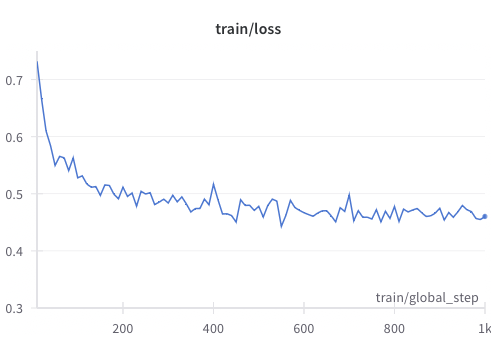
We train the model for one epoch with a learning rate of 1e-5, batch size 256, cosine learning rate decay with a warmup ratio 0.03. We present the training curve as follows.
  from transformers import AutoTokenizer, pipeline
  rm_tokenizer = AutoTokenizer.from_pretrained("weqweasdas/RM-Gemma-2B")
  device = 0 # accelerator.device
  rm_pipe = pipeline(
      "sentiment-analysis",
      model="weqweasdas/RM-Gemma-2B",
      #device="auto",
      device=device,
      tokenizer=rm_tokenizer,
      model_kwargs={"torch_dtype": torch.bfloat16}
  )

  pipe_kwargs = {
      "return_all_scores": True,
      "function_to_apply": "none",
      "batch_size": 1
  }

  chat = [
   {"role": "user", "content": "Hello, how are you?"},
   {"role": "assistant", "content": "I'm doing great. How can I help you today?"},
   {"role": "user", "content": "I'd like to show off how chat templating works!"},
  ]

  test_texts = [tokenizer.apply_chat_template(chat, tokenize=False, add_generation_prompt=False).replace(tokenizer.bos_token, "")]
  pipe_outputs = rm_pipe(test_texts, **pipe_kwargs)
  rewards = [output[0]["score"] for output in pipe_outputs]
We collect the existing preference datasets and use them as a benchmark to evaluate the resulting reawrd model.
Note that for MT-Bench dataset (lmsys/mt_bench_human_judgments), we delete the samples with tie as the comparison results. The Alpaca data is from Here.
| Model/Test set | HH-RLHF-Helpful | SHP | Helpsteer helpful + correctness | Helpsteer All | MT Bench Human | MT Bench GPT4 | Alpaca Human | Alpaca GPT4 | Alpca Human-crossed |
|---|---|---|---|---|---|---|---|---|---|
| UltraRM-13B | 0.71 | 0.73 | 0.72 | 0.72 | 0.78 | 0.9 | 0.65 | 0.83 | 0.62 |
| Pair-RM | 0.65 | 0.56 | 0.62 | 0.6 | 0.74 | 0.82 | 0.62 | 0.75 | 0.59 |
| RM-Gemma-2B | 0.68 | 0.73 | 0.68 | 0.72 | 0.77 | 0.87 | 0.63 | 0.78 | 0.59 |
To be added. The reward model may be readily used for rejection sampling finetuning (
@article{dong2023raft,
  title={Raft: Reward ranked finetuning for generative foundation model alignment},
  author={Dong, Hanze and Xiong, Wei and Goyal, Deepanshu and Pan, Rui and Diao, Shizhe and Zhang, Jipeng and Shum, Kashun and Zhang, Tong},
  journal={arXiv preprint arXiv:2304.06767},
  year={2023}
}