
Downloads · 30 days
0
sup-computer/shakespeare-nanogpt-1
shakespeare-nanogpt-1 is a text generation model from sup-computer. Use it when you need the model to write or continue text. It is set up for nanogpt. The card lists the license as mit.
A sup computer release — a small language model studio. Model page · monorepo (frozen code: projects/shakespeare/models/shakespeare-nanogpt-1/, tag shakespeare-nanogpt-1) · run it in your terminal with the repo's sup…
Downloads · 30 days
0
Access
Public
Updated Jul 4, 2026
Repo size
184 MB
Likes
0
Public
Click a slice to open those files.
.pt129 MB · 70%
From the Hugging Face model README
shakespeare-nanogpt-1 (v1)<div class="takeaways"> <p class="takeaways-label">Key takeaways</p> <ul> <li>The original baseline: a ~10.7M-param char-level GPT on Tiny Shakespeare (validation loss 1.46).</li> <li>This is the controlled, <strong>data-starved baseline</strong> (held-out <code>BPC 2.395</code>) that the LLM-assisted experiment set out to improve on.</li> <li>Stylistic mimicry only — locally plausible, globally nonsense; it overfits, the regime later versions fix with more data.</li> </ul> </div>A sup computer release — a small language model studio. Model page · monorepo (frozen code:
projects/shakespeare/models/shakespeare-nanogpt-1/, tagshakespeare-nanogpt-1) · run it in your terminal with the repo'ssupCLI.
A character-level GPT trained from scratch on Tiny Shakespeare — the original
baseline. It sets the line every later version is measured against: held-out
BPC 2.395. Prompt it with a few characters and it continues them in
convincingly-styled (but semantically nonsensical) Early Modern English, one
character at a time. First model in the
shakespeare-nanogpt series.
Series note. This is one checkpoint in a living, versioned series refined over time.
shakespeare-nanogpt-2is the successor; see its card andMODELS.md.
| Version / git tag | shakespeare-nanogpt-1 |
| Architecture | original nanoGPT — Transformer decoder, LayerNorm, learned positional embeddings, biases |
| Size | 6 layers · 6 heads · 384 embedding dim · 256 context · ~10.7M params |
| Tokenizer | character-level, 65-char vocabulary (direct char↔int lookup, no BPE) |
| Checkpoint | models/shakespeare-nanogpt-1/ckpt.pt (weights not committed — rebuild below) |
| Built on | nanoGPT by Andrej Karpathy (MIT), vendored unchanged |
| Developed with | Claude Opus 4.8 (Claude Code) |
| License | MIT |
A learning project — its purpose is to make the whole pipeline (data → training → checkpoint → sampling) legible and reproducible on a laptop. Good for understanding how a small GPT is trained and how character-level generation works. Generated text is stylistic mimicry, not coherent prose.
Out of scope: any real use of the text. The model has no knowledge, no factual grounding, and produces grammatically Shakespeare-flavored gibberish. Do not use it to generate content presented as Shakespeare or as fact.
Tiny Shakespeare — 1,115,394 characters (~40k lines, vocab 65), the classic
concatenation of Shakespeare's plays, via Karpathy's char-rnn. Split 90/10 into
~1.0M training / ~111k validation characters.
torch.compile disabled (unreliable on macOS)Final validation loss 1.46 (train loss 1.08), down from 4.28 at initialization. The checkpoint is saved only when validation loss improves.
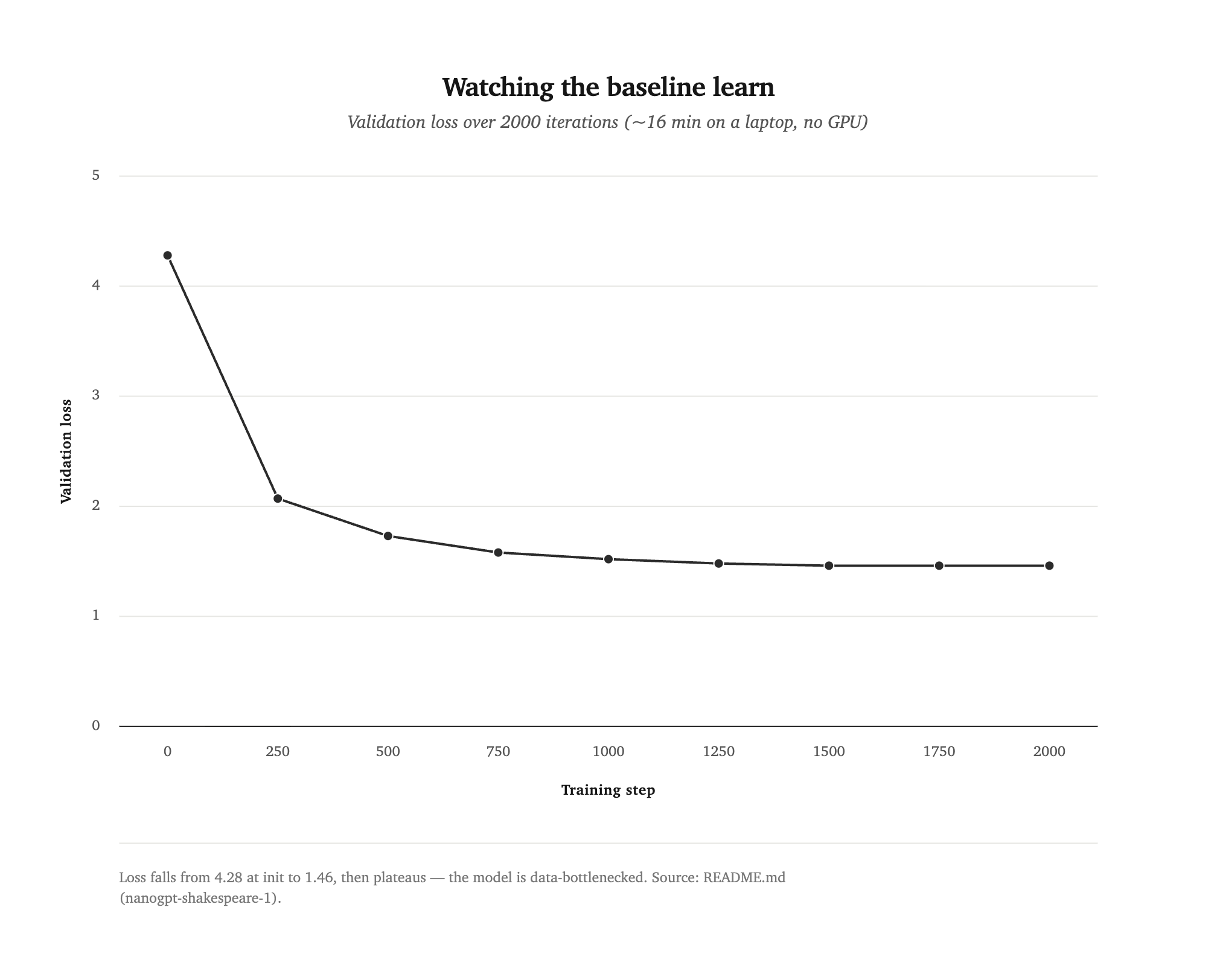
Loss falls steeply, then plateaus around 1.46 — the model is data-bottlenecked.
Chart generated by dataviz/.
Comparability. v1's headline figure (val 1.46 on Tiny Shakespeare's own split) is not directly comparable to v2's, which uses a different tokenizer and test set. The rigorous, tokenizer-agnostic metric is bits-per-character (BPC) on the fixed held-out test (
projects/shakespeare/test.txt); this data-starved char-level regime scores BPC 2.395 there, the controlled baseline the LLM-assisted research experiment improved on. See the v2 card.
# self-contained v1 folder (weights are gitignored — rebuild them)
cd models/shakespeare-nanogpt-1
python prepare.py     # downloads Tiny Shakespeare, builds the dataset here
python train.py       # -> ./ckpt.pt
python sample.py --start="ROMEO:" --num_samples=1 --max_new_tokens=1000
char-rnn.Added in the site-standardization pass (ADR-0015). The card above was unchanged by that pass; this is a tracked addendum. (A later house-style pass, 2026-07-04, edited the card's prose — emphasis and sentence structure only, no facts.) Site-wide fixes — repo links now resolve to GitHub/site routes, code blocks render within the column — apply automatically.