
Downloads · 30 days
120
5% of all-time downloads
stefan-it/xlstm-german-wikipedia
xlstm-german-wikipedia is a text generation model from stefan-it. Use it when you need the model to write or continue text. It is set up for transformers. The card lists the license as cc-by-sa-3.0.
Downloads · 30 days
120
5% of all-time downloads
All-time downloads
2.6K
Public
Parameters
111M
1.4 GB on disk
Likes
11
Public
Click a slice to open those files.
.safetensors445 MB · 100%
From the Hugging Face model README

Research & development of an xLSTM model trained on German Wikipedia.
The Flair team is currently working on the integration of xLSTM (both LM training and fine-tuning models for downstream tasks).
For pretraining this xLSTM model, we this fork (from Patrick Haller) of the awesome Helibrunna library from Tristan.
Initially, we integrated xLSTM model training into Flair - for more information about this, please refer to the archived flair-old branch of this repository.
The current model was trained with commit a1b3772 from the main branch of the forked Helibrunna repo.
The xlstm library needs to be installed manually - also check that pip3 install Ninja is installed.
The German Wikipedia dump from this repository is used.
The following training configuration is used:
description: "Train a wikipedia xLSTM"

training:
  model_name: "german_wikipedia"
  batch_size: 10
  lr: 6e-4
  lr_warmup_steps: 4584
  lr_decay_until_steps: "auto"
  lr_decay_factor: 0.001
  weight_decay: 0.1
  amp_precision: bfloat16
  weight_precision: float32
  enable_mixed_precision: true
  num_epochs: 1
  output_dir: "./output"
  save_every_step: 2000
  log_every_step: 10
  generate_every_step: 5000
  wandb_project: "xlstm"
  max_grad_norm: 0.25
  # wandb_project: "lovecraftxlstm"

model:
  num_blocks: 24
  embedding_dim: 768
  mlstm_block:
    mlstm:
      num_heads: 4
  slstm_block: {}
  slstm_at: []
  context_length: 512

dataset:
  output_path: "./output/german-wikipedia-dataset"
  hugging_face_id: ["stefan-it/dewiki-20230701"]
  split: "train" # Also subsetting is possible: "train[:100000]"
  shuffle: False
  seed: 42

tokenizer:
  type: "pretrained"
  pretrained_class: "LlamaTokenizer"
  pretrained_id: "meta-llama/Llama-2-7b-hf"
The training loss curve can be seen here:
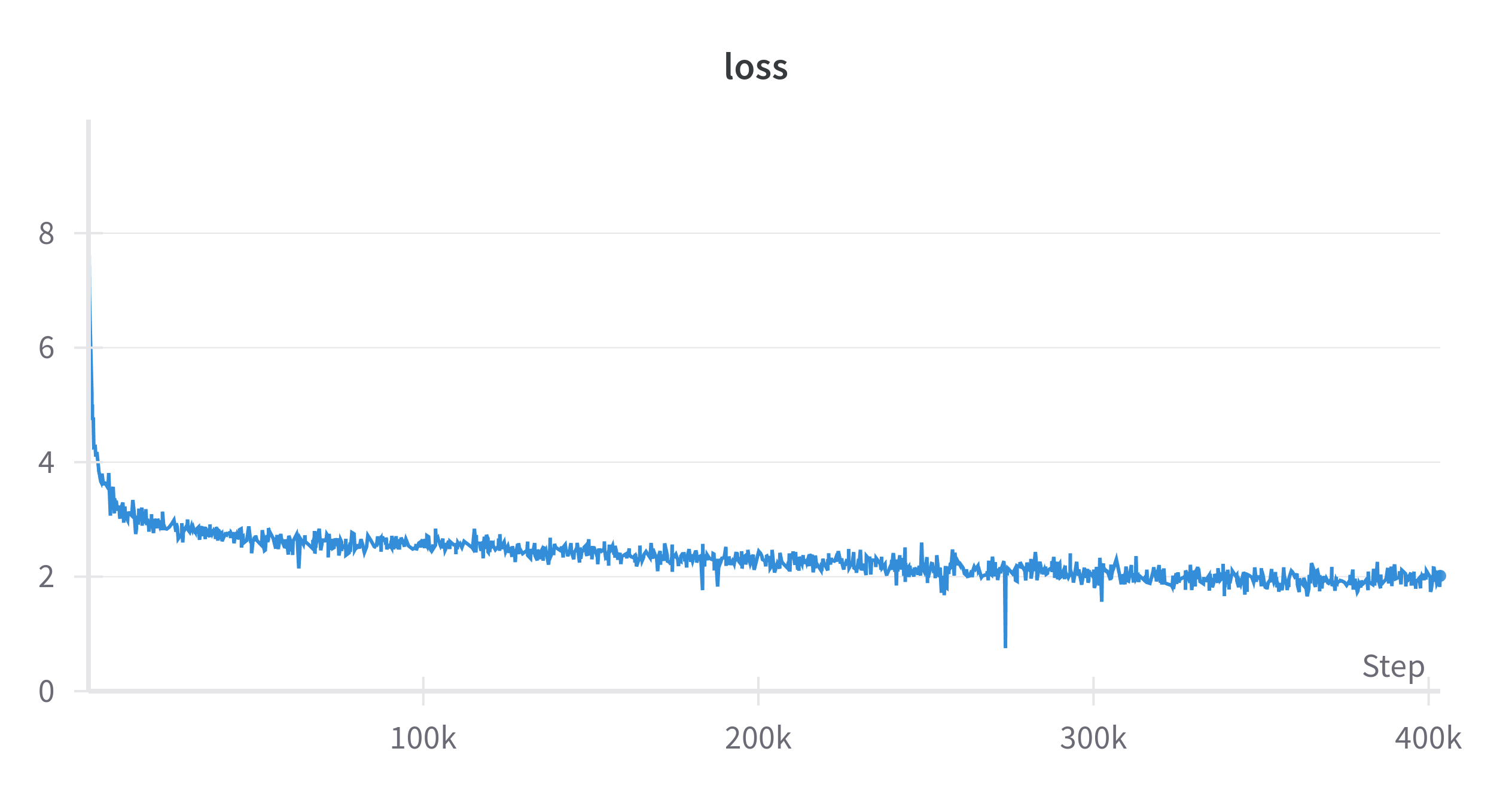
The uploaded model checkpoint is from 403,460 steps (1 epoch over corpus). Training took 1d 42m 52s on a single RTX 4090.
It is possible to use the model to generate some text:
from transformers import AutoModelForCausalLM, AutoTokenizer

model_name_or_path = "stefan-it/xlstm-german-wikipedia"

model = AutoModelForCausalLM.from_pretrained(model_name_or_path)
tokenizer = AutoTokenizer.from_pretrained(model_name_or_path)

input_ids = tokenizer.encode("Heute ist schönes Wetter in", return_tensors="pt")
output = model.generate(input_ids, max_length=100, temperature=0.7, do_sample=True)
generated_text = tokenizer.decode(output[0], skip_special_tokens=True)

print(generated_text)
Notice: this model integration is heavily under development. And in the process of finding good hyper-parameters. Also downstream experiments are coming very soon.