
Downloads · 30 days
364
0% of all-time downloads
stanfordnlp/backpack-gpt2
backpack-gpt2 is a text generation model from stanfordnlp. Use it when you need the model to write or continue text. It is set up for transformers. The card lists the license as apache-2.0.
The Backpack-GPT2 language model is an instance of the Backpack architecture, intended to combine strong modeling performance with an interface for interpretability and control. Most details about this model and its t…
Downloads · 30 days
364
0% of all-time downloads
All-time downloads
107K
Public
Repo size
1.4 GB
Likes
16
Public
Click a slice to open those files.
.bin684 MB · 100%
From the Hugging Face model README
The Backpack-GPT2 language model is an instance of the Backpack architecture, intended to combine strong modeling performance with an interface for interpretability and control. Most details about this model and its training should be accessed in the paper, Backpack Language Models.
See also backpackmodels.science.
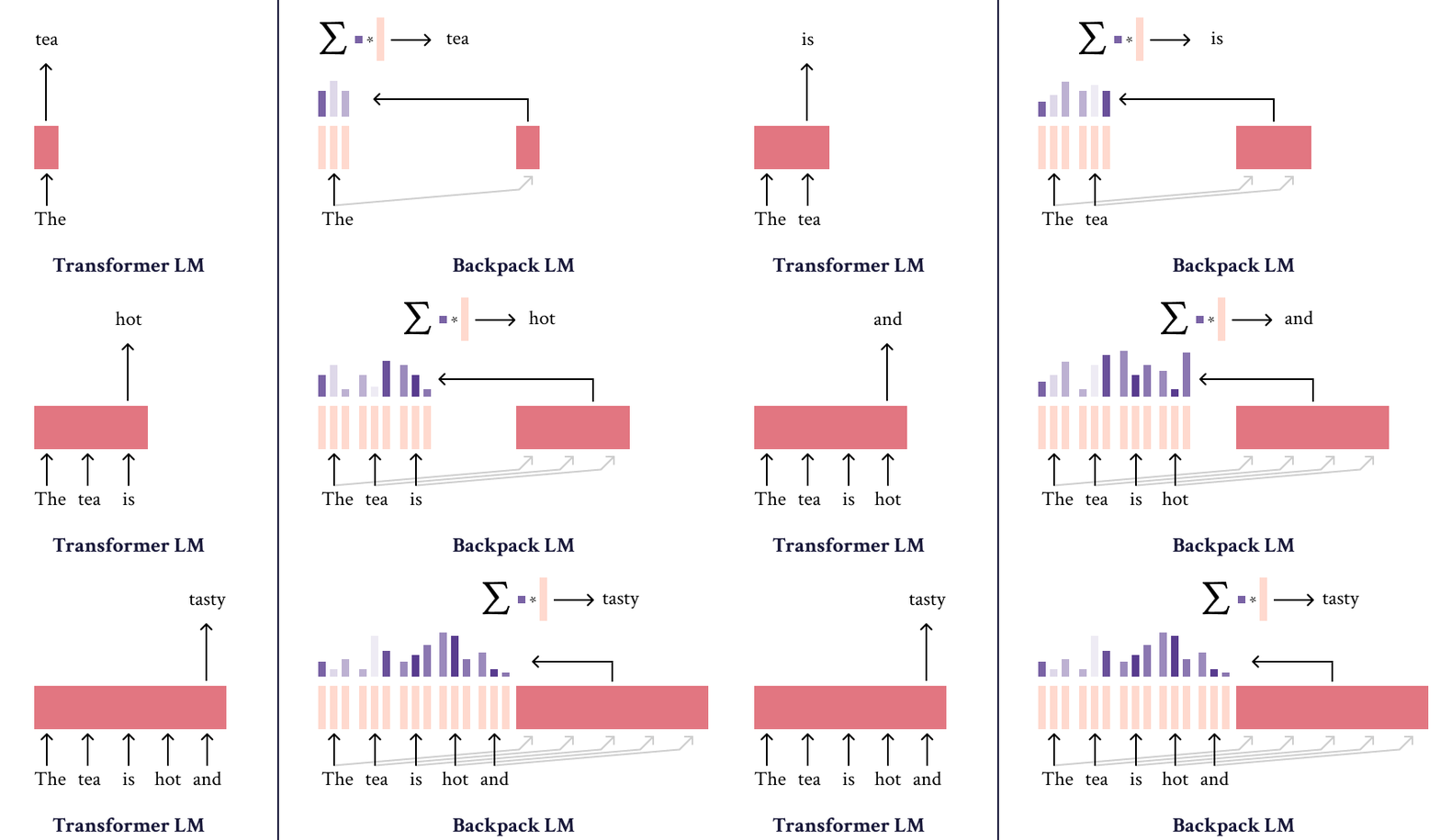
The Backpack-GPT2 is a Backpack-based language model, an architecture intended to combine strong modeling performance with an interface for interpretability and control.
This model is intended for use in the study and development of increasingly interpretable methods in natural language processing. It is not directly fit for any production use.
Significant research has explored bias and fairness issues with language models (see, e.g., Sheng et al. (2021) and Bender et al. (2021)). Predictions generated by the model may include disturbing and harmful stereotypes across protected classes; identity characteristics; and sensitive, social, and occupational groups. This model in particular is limited in its capabilities, and with a brand new architecture, less is known about its biases than, e.g., Transformer-based models.
import torch
from transformers import AutoConfig, AutoModelForCausalLM

model_id = "stanfordnlp/backpack-gpt2"
config = AutoConfig.from_pretrained(model_id, trust_remote_code=True)
torch_model = AutoModelForCausalLM.from_pretrained(model_id, config=config, trust_remote_code=True)
torch_model.eval()

input = torch.randint(0, 50264, (1, 512), dtype=torch.long)
torch_out = torch_model(
    input,
    position_ids=None,
)
torch_out = torch.nn.functional.softmax(torch_out.logits, dim=-1)
print(torch_out)
This model was trained on the OpenWebText corpus.
This model was trained for 100k gradient steps with a batch size of 512k tokens and a linearly decaying learning rate from 6e-4 to zero, with a linear warmup of 5k steps.
This model was trained to minimize the cross-entropy loss, and is a Backpack language model.
This model was trained on a slurm cluster.
This model was trained on 4 A100s.
This model was trained with FlashAttention and PyTorch
BibTeX:
@InProceedings{hewitt2023backpack,
  author =      "Hewitt, John and Thickstun, John and Manning, Christopher D. and Liang, Percy",
  title =       "Backpack Language Models",
  booktitle =   "Proceedings of the Association for Computational Linguistics",
  year =        "2023",
  publisher =   "Association for Computational Linguistics",
  location =    "Toronto, Canada",
}
John Hewitt