
Downloads · 30 days
61
1% of all-time downloads
snowkidy/stable-diffusion-xl-base-0.9
stable-diffusion-xl-base-0.9 is a text-to-image model from snowkidy. Use it when you need an image from a text prompt. It is set up for diffusers. The card lists the license as other.
Downloads · 30 days
61
1% of all-time downloads
All-time downloads
6.6K
Public
Parameters
2.6B
61 GB on disk
Likes
5
Public
Click a slice to open those files.
.safetensors40.2 GB · 66%
From the Hugging Face model README

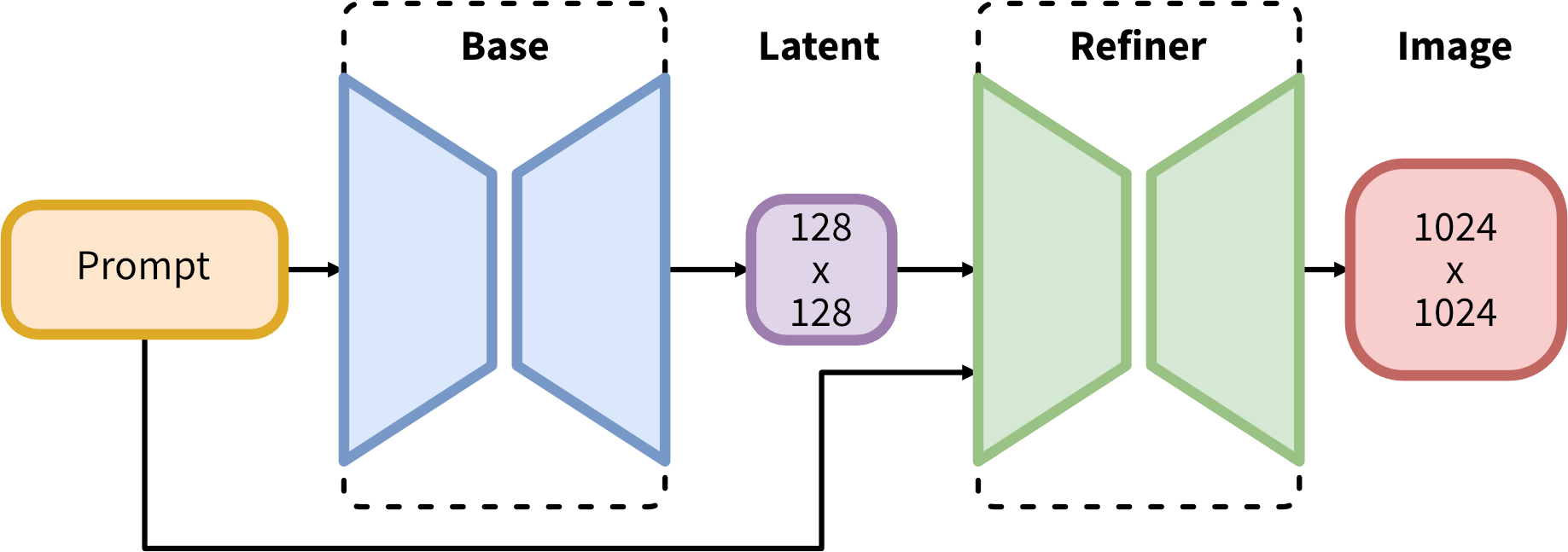
SDXL consists of a two-step pipeline for latent diffusion: First, we use a base model to generate latents of the desired output size. In the second step, we use a specialized high-resolution model and apply a technique called SDEdit (https://arxiv.org/abs/2108.01073, also known as "img2img") to the latents generated in the first step, using the same prompt.
Make sure to upgrade diffusers to >= 0.18.0:
pip install diffusers --upgrade
In addition make sure to install transformers, safetensors, accelerate as well as the invisible watermark:
pip install invisible_watermark transformers accelerate safetensors
You can use the model then as follows
from diffusers import DiffusionPipeline
import torch

pipe = DiffusionPipeline.from_pretrained("stabilityai/stable-diffusion-xl-base-0.9", torch_dtype=torch.float16, use_safetensors=True, variant="fp16")
pipe.to("cuda")

# if using torch < 2.0
# pipe.enable_xformers_memory_efficient_attention()

prompt = "An astronaut riding a green horse"

images = pipe(prompt=prompt).images[0]
When using torch >= 2.0, you can improve the inference speed by 20-30% with torch.compile. Simple wrap the unet with torch compile before running the pipeline:
pipe.unet = torch.compile(pipe.unet, mode="reduce-overhead", fullgraph=True)
If you are limited by GPU VRAM, you can enable cpu offloading by calling pipe.enable_model_cpu_offload
instead of .to("cuda"):
- pipe.to("cuda")
+ pipe.enable_model_cpu_offload()
The model is intended for research purposes only. Possible research areas and tasks include
Excluded uses are described below.
The model was not trained to be factual or true representations of people or events, and therefore using the model to generate such content is out-of-scope for the abilities of this model.
While the capabilities of image generation models are impressive, they can also reinforce or exacerbate social biases.
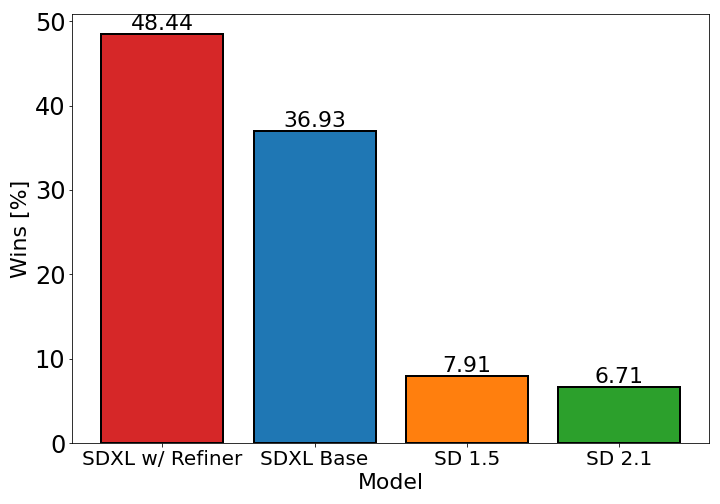 The chart above evaluates user preference for SDXL (with and without refinement) over Stable Diffusion 1.5 and 2.1.
The SDXL base model performs significantly better than the previous variants, and the model combined with the refinement module achieves the best overall performance.
The chart above evaluates user preference for SDXL (with and without refinement) over Stable Diffusion 1.5 and 2.1.
The SDXL base model performs significantly better than the previous variants, and the model combined with the refinement module achieves the best overall performance.