
Downloads · 30 days
17
3% of all-time downloads
shi-labs/dinat-large-in22k-in1k-384
dinat-large-in22k-in1k-384 is a image classification model from shi-labs. Use it when you need a label for an image. It is set up for transformers. The card lists the license as mit.
DiNAT-Large with a 7x7 kernel pre-trained on ImageNet-21K at 224x224, and fine-tuned on ImageNet-1K at 384x384 with increased dilation values. It was introduced in the paper Dilated Neighborhood Attention Transformer…
Downloads · 30 days
17
3% of all-time downloads
All-time downloads
680
Public
Repo size
2.4 GB
Likes
0
Public
Click a slice to open those files.
.bin804 MB · 100%
From the Hugging Face model README
DiNAT-Large with a 7x7 kernel pre-trained on ImageNet-21K at 224x224, and fine-tuned on ImageNet-1K at 384x384 with increased dilation values. It was introduced in the paper Dilated Neighborhood Attention Transformer by Hassani et al. and first released in this repository.
DiNAT is a hierarchical vision transformer based on Neighborhood Attention (NA) and its dilated variant (DiNA). Neighborhood Attention is a restricted self attention pattern in which each token's receptive field is limited to its nearest neighboring pixels. NA and DiNA are therefore sliding-window attention patterns, and as a result are highly flexible and maintain translational equivariance.
They come with PyTorch implementations through the NATTEN package.
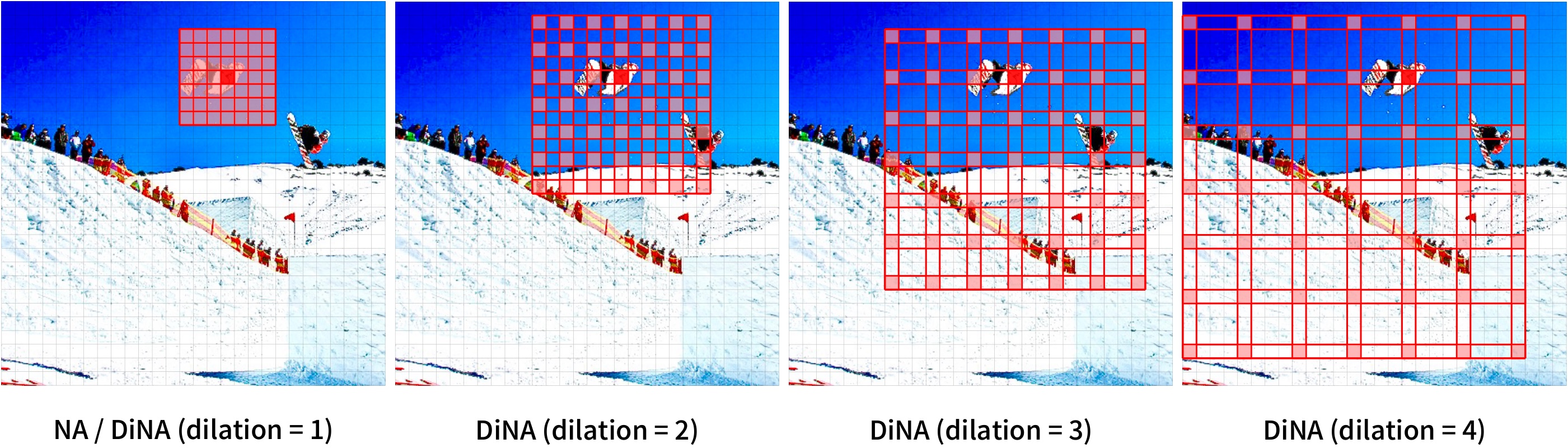
You can use the raw model for image classification. See the model hub to look for fine-tuned versions on a task that interests you.
Here is how to use this model to classify an image from the COCO 2017 dataset into one of the 1,000 ImageNet classes:
from transformers import AutoImageProcessor, DinatForImageClassification
from PIL import Image
import requests

url = "http://images.cocodataset.org/val2017/000000039769.jpg"
image = Image.open(requests.get(url, stream=True).raw)

feature_extractor = AutoImageProcessor.from_pretrained("shi-labs/dinat-large-in22k-in1k-384")
model = DinatForImageClassification.from_pretrained("shi-labs/dinat-large-in22k-in1k-384")

inputs = feature_extractor(images=image, return_tensors="pt")
outputs = model(**inputs)
logits = outputs.logits
# model predicts one of the 1000 ImageNet classes
predicted_class_idx = logits.argmax(-1).item()
print("Predicted class:", model.config.id2label[predicted_class_idx])
For more examples, please refer to the documentation.
Other than transformers, this model requires the NATTEN package.
If you're on Linux, you can refer to shi-labs.com/natten for instructions on installing with pre-compiled binaries (just select your torch build to get the correct wheel URL).
You can alternatively use pip install natten to compile on your device, which may take up to a few minutes.
Mac users only have the latter option (no pre-compiled binaries).
Refer to NATTEN's GitHub for more information.
@article{hassani2022dilated,
	title        = {Dilated Neighborhood Attention Transformer},
	author       = {Ali Hassani and Humphrey Shi},
	year         = 2022,
	url          = {https://arxiv.org/abs/2209.15001},
	eprint       = {2209.15001},
	archiveprefix = {arXiv},
	primaryclass = {cs.CV}
}