
Downloads · 30 days
28
12% of all-time downloads
real-jiakai/SmolLM2-1.7B-TLDR
SmolLM2-1.7B-TLDR is a summarization model from real-jiakai. Use it when you need a shorter version of a longer text. It is set up for transformers.
This model is a fine-tuned version of SmolLM2-1.7B-Instruct, optimized for generating concise summaries of long texts (TL;DR - Too Long; Didn't Read). It was trained using Group Relative Policy Optimization (GRPO) to…
Downloads · 30 days
28
12% of all-time downloads
All-time downloads
226
Public
Parameters
1.7B
3.4 GB on disk
Likes
0
Public
Click a slice to open those files.
.safetensors3.4 GB · 100%
From the Hugging Face model README
This model is a fine-tuned version of SmolLM2-1.7B-Instruct, optimized for generating concise summaries of long texts (TL;DR - Too Long; Didn't Read). It was trained using Group Relative Policy Optimization (GRPO) to improve the model's ability to extract key information from longer documents while maintaining brevity.
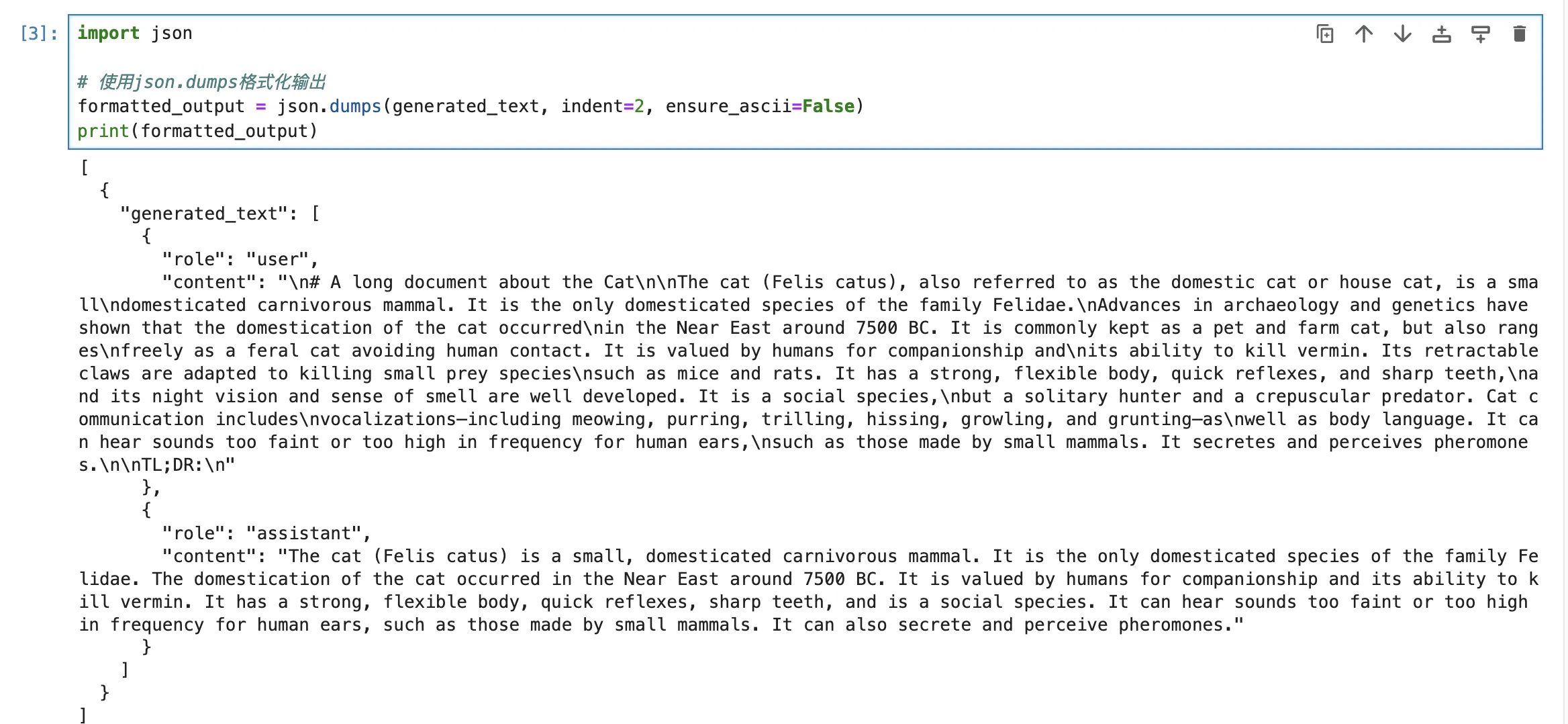
This model is specifically designed for text summarization tasks, particularly producing TL;DR versions of longer documents. The model works best when prompted with a long text followed by "TL;DR:" to indicate where the summary should begin.
Example usage:
from transformers import pipeline

generator = pipeline("text-generation", model="real-jiakai/SmolLM2-1.7B-TLDR")

messages = [
    {"role": "user", "content": "Your long text here...\n\nTL;DR:"}
]

generate_kwargs = {
    "max_new_tokens": 256,
    "do_sample": True,
    "temperature": 0.5,
    "min_p": 0.1,
}

generated_text = generator(messages, **generate_kwargs)

print(generated_text)
The model was fine-tuned on the mlabonne/smoltldr dataset, which contains 2000 training samples of long-form content paired with concise summaries. Each sample consists of a prompt (long text) and a completion (summary).
The model was trained using the TRL (Transformer Reinforcement Learning) library's GRPOTrainer with the following configuration:
The training process utilized LoRA (Low-Rank Adaptation) for parameter-efficient fine-tuning with the following configuration:
Training showed a progression of loss values from near-zero to approximately 0.01 over 125 steps, indicating gradual learning of the summarization task through reinforcement. The complete training process took approximately 1 hour on two NVIDIA RTX 4090 GPUs.
@misc{allal2025smollm2smolgoesbig,
      title={SmolLM2: When Smol Goes Big -- Data-Centric Training of a Small Language Model},
      author={Loubna Ben Allal and Anton Lozhkov and Elie Bakouch and Gabriel Martín Blázquez and Guilherme Penedo and Lewis Tunstall and Andrés Marafioti and Hynek Kydlíček and Agustín Piqueres Lajarín and Vaibhav Srivastav and Joshua Lochner and Caleb Fahlgren and Xuan-Son Nguyen and Clémentine Fourrier and Ben Burtenshaw and Hugo Larcher and Haojun Zhao and Cyril Zakka and Mathieu Morlon and Colin Raffel and Leandro von Werra and Thomas Wolf},
      year={2025},
      eprint={2502.02737},
      archivePrefix={arXiv},
      primaryClass={cs.CL},
      url={https://arxiv.org/abs/2502.02737},
}