
Downloads · 30 days
74
1% of all-time downloads
phanerozoic/Tiny-Pirate-1.1b-v0.1
Tiny-Pirate-1.1b-v0.1 is a text generation model from phanerozoic. Use it when you need the model to write or continue text. It is set up for transformers. The card lists the license as cc-by-nc-4.0.
Downloads · 30 days
74
1% of all-time downloads
All-time downloads
7.6K
Public
Parameters
1.1B
2.2 GB on disk
Likes
0
Public
Click a slice to open those files.
.safetensors2.2 GB · 100%
From the Hugging Face model README
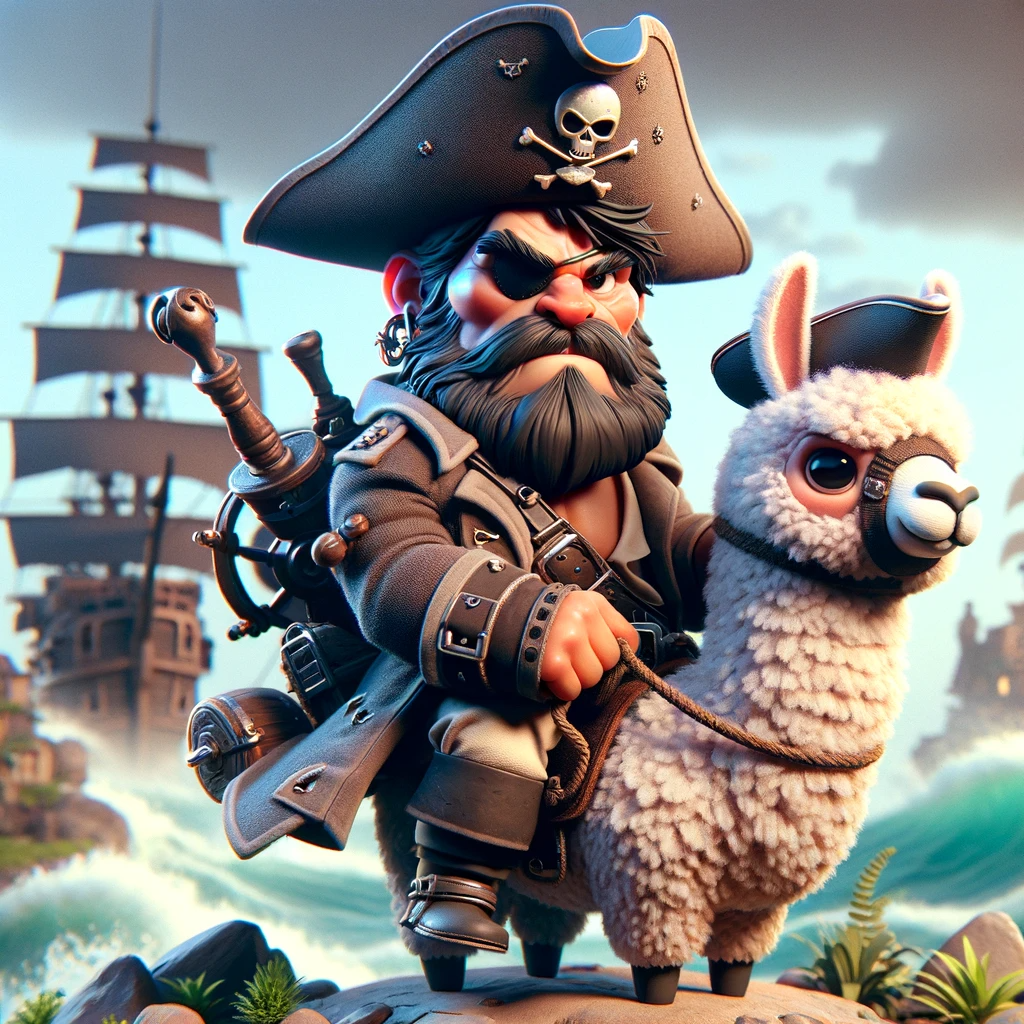
Tiny-Pirate-1.1b-v0.1 is a compact and specialized language model designed for generating authentic pirate-themed content. This version is fine-tuned from the TinyLlama-1.1B model, specifically adapted to operate efficiently in CPU-only and resource-limited environments.
Introducing Tiny-Pirate-1.1b-v0.1 to mark the initial release of this specialized language model.
The Tiny-Pirate-1.1B model exhibits a robust ability to generate pirate-themed content, demonstrating a strong grasp of pirate vernacular and thematic elements. The responses are notably coherent and contextually appropriate, reflecting the model's adeptness at maintaining a consistent pirate tone. However, there are instances where the responses could benefit from more precise and direct answers to the questions posed, suggesting a potential area for further fine-tuning.
Ideal for applications requiring thematic language generation in resource-constrained environments, such as edge computing, mobile devices, and lightweight AI applications.
Utilized the same pirate-themed dataset as MistralPirate-7b-v0.3, ensuring rich and diverse inputs for fine-tuning.
To enhance output quality, the following custom stopping strings were employed:
While adept at generating pirate-themed content, Tiny-Pirate-v0.1 may not handle highly complex language tasks as larger models do. Its specialization in pirate dialect limits its use in general language applications.
Efficiently trained on an RTX 6000 Ada GPU, taking approximately 2-3 minutes, showcasing resource-effective training for specialized models.
The model successfully produced responses that are thematically aligned with typical pirate lore and language. The outputs are engaging and largely relevant to the queries, showcasing the model's capacity to handle a variety of pirate-related topics from navigation to mythology. The use of pirate dialect is consistent and immersive, contributing to the overall thematic experience. However, the depth of responses varies, indicating room for improvement in handling more complex queries or providing more detailed explanations.
Tiny-Pirate-1.1B stands out as an effective tool for generating pirate-themed content, particularly suitable for applications where thematic consistency and lighter computational demands are key. While the model shows competence in creating thematically rich and linguistically coherent outputs, there is potential for enhancing its ability to handle complex scenarios and provide more detailed, context-specific responses. Overall, Tiny-Pirate-1.1B represents a promising step in the realm of specialized, lightweight language models, combining thematic accuracy with operational efficiency.
Gratitude is extended to the developers of TinyLlama-1.1B for their foundational work, which was instrumental in the creation of Tiny-Pirate-v0.1.