
Downloads · 30 days
39
32% of all-time downloads
onnx-community/wav2vec-LnNor-IPA-ft-ONNX
wav2vec-LnNor-IPA-ft-ONNX is a automatic speech recognition model from onnx-community. Use it when you need speech turned into text. It is set up for transformers.js. The card lists the license as cc-by-4.0.
This is an ONNX version of MultiBridge/wav2vec-LnNor-IPA-ft. It was automatically converted and uploaded using this Hugging Face Space.
Downloads · 30 days
39
32% of all-time downloads
All-time downloads
123
Public
Repo size
808 MB
Likes
0
Public
Click a slice to open those files.
.onnx808 MB · 100%
From the Hugging Face model README
This is an ONNX version of MultiBridge/wav2vec-LnNor-IPA-ft. It was automatically converted and uploaded using this Hugging Face Space.
See the pipeline documentation for automatic-speech-recognition: https://huggingface.co/docs/transformers.js/api/pipelines#module_pipelines.AutomaticSpeechRecognitionPipeline
This model is built for phoneme recognition tasks. It was developed by fine-tuning the wav2vec2 base model on TIMIT and LnNor datasets. The predictions are in IPA.
Automatic phonetic transcription: Converting raw speech into phoneme sequences.
Speech processing applications: Serving as a component in speech processing pipelines or prototyping.
data specificity: By excluding recordings shorter than 2 seconds or longer than 30 seconds, and labels with fewer than 5 phonemes, some natural speech variations are ignored. This might affect the model's performance in real-world applications. The model's performance is influenced by the characteristics of TIMIT and LnNor datasets. This can lead to potential biases, especially if the target application involves speakers or dialects not well-represented in these datasets. LnNor contains non-native speech and automaticly generated annotations that don't reflect true pronunciation rather canonical pronunciation. This could result in a model that fails to accurately predict non-native speech.
frozen encoder: Freezing the encoder retains useful pre-learned features but also prevents the model from adapting fully to the new datasets.
Evaluate the model's performance for your specific use case.
Use the code below to get started with the model.
from transformers import Wav2Vec2Processor, Wav2Vec2ForCTC
from datasets import load_dataset
import torch

# load model and processor
processor = Wav2Vec2Processor.from_pretrained("MultiBridge/wav2vec-LnNor-IPA-ft")
model = Wav2Vec2ForCTC.from_pretrained("MultiBridge/wav2vec-LnNor-IPA-ft")

# load dummy dataset and read soundfiles
ds = load_dataset("hf-internal-testing/librispeech_asr_dummy", split="validation")

# tokenize
input_values = processor(ds[0]["audio"]["array"], return_tensors="pt").input_values

# retrieve logits
with torch.no_grad():
    logits = model(input_values).logits

# take argmax and decode
predicted_ids = torch.argmax(logits, dim=-1)
transcription = processor.batch_decode(predicted_ids)

# => should give ['mɪstɝkwɪltɝɪzðəəpɑslʌvðəmɪdəlklæsəzændwiɑəɡlædtəwɛlkəmhɪzɡɑspəl'] for MISTER QUILTER IS THE APOSTLE OF THE MIDDLE CLASSES AND WE ARE GLAD TO WELCOME HIS GOSPEL
The training data comes from two key sources:
TIMIT: A widely-used dataset for phonetic transcription, providing a standard benchmark in speech research.
LnNor: A multilingual dataset of high-quality speech recordings in Norwegian, English, and Polish. The dataset compiled from non-native speakers with various language proficiencies. The phoneme annotations in LnNor were generated using the WebMAUS tool, meaning they represent canonical phonemes rather than the true pronunciations typical of spontaneous speech or non native pronunciation.
The original, pre-trained encoder representations were preserved - the encoder was kept frozen during fine-tuning in order to minimizes training time and resource consumption. The model was trained with CTC loss and AdamW optimizer, with no learning rate scheduler.
The training dataset was filtered. Recordings shorter than 2 seconds or longer than 30 seconds were removed. Any labels consisting of fewer than 5 phonemes were discarded.
Training regime:
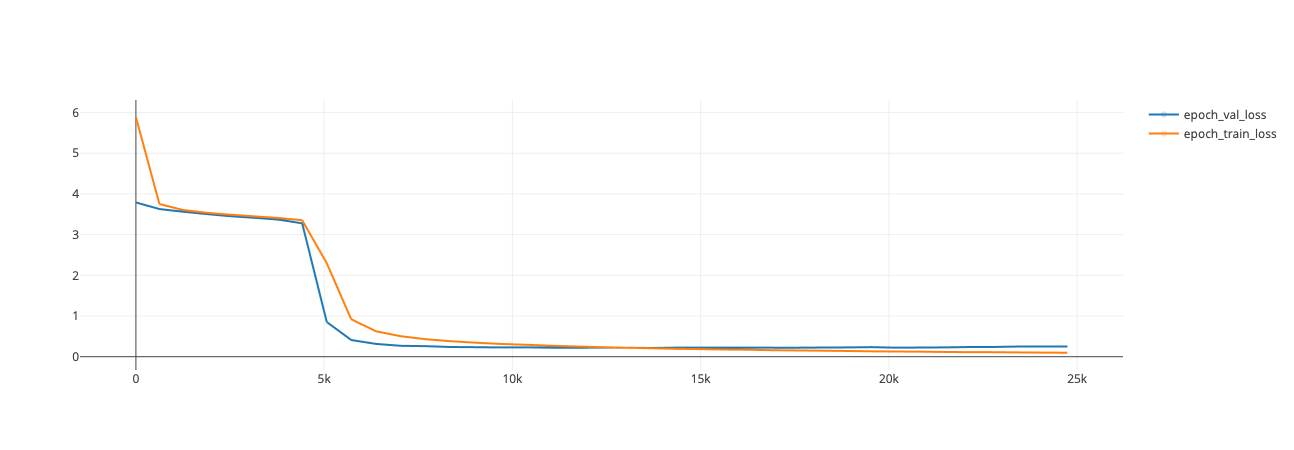
The model was evaluated on TIMIT's test split.
CER/PER (Phoneme Error Rate)
PER (Phoneme Error Rate) on TIMIT's test split: 0.0416
Carbon emissions can be estimated using the Machine Learning Impact calculator presented in Lacoste et al. (2019).
Transformer model + CTC loss
2 x Nvidia A100-80
python 3.12
transformers 4.50.0
torch 2.6.0
BibTeX:
I you use the LnNor dataset for research, cite these papers:
@article{magdalena2024lnnor,
  title={The LnNor Corpus: A spoken multilingual corpus of non-native and native Norwegian, English and Polish (Part 1)},
  author={Magdalena, Wrembel and Hwaszcz, Krzysztof and Agnieszka, Pludra and Ska{\l}ba, Anna and Weckwerth, Jaros{\l}aw and Walczak, Angelika and Sypia{\'n}ska, Jolanta and {\.Z}ychli{\'n}ski, Sylwiusz and Malarski, Kamil and K{\k{e}}dzierska, Hanna and others},
  year={2024},
  publisher={Adam Mickiewicz University}
}

@article{wrembel2024lnnor,
  title={The LnNor Corpus: A spoken multilingual corpus of non-native and native Norwegian, English and Polish--Part 2},
  author={Wrembel, Magdalena and Hwaszcz, Krzysztof and Pludra, Agnieszka and Ska{\l}ba, Anna and Weckwerth, Jaros{\l}aw and Malarski, Kamil and Cal, Zuzanna Ewa and K{\k{e}}dzierska, Hanna and Czarnecki-Verner, Tristan and Balas, Anna and others},
  year={2024},
  publisher={Adam Mickiewicz University}
}
Agnieszka Pludra
Izabela Krysińska
Piotr Kabaciński