
Downloads · 30 days
0
0% of all-time downloads
omkar1799/sd-annalaura-model
sd-annalaura-model is a text-to-image model from omkar1799. Use it when you need an image from a text prompt. It is set up for diffusers. The card lists the license as creativeml-openrail-m.
In an effort to explore fine-tuning generative AI models, I decided to try my hand at fine-tuning a text-to-image model on one of my favorite Instagram accounts, @annalauraart. Anna Laura's work is characterized by so…
Downloads · 30 days
0
0% of all-time downloads
All-time downloads
17
Public
Parameters
860M
167 GB on disk
Likes
0
Public
Click a slice to open those files.
.safetensors73.8 GB · 52%
From the Hugging Face model README
In an effort to explore fine-tuning generative AI models, I decided to try my hand at fine-tuning a text-to-image model on one of my favorite Instagram accounts, @annalaura_art. Anna Laura's work is characterized by soft watercolor drawings of adorable characters meant to evoke feelings of comfort and gratitude in their audience. I trained this model purely for my own personal exploration, and have absolutely no intention of using it to produce or publish artwork similar to theirs.
Here are some examples of Annalaura's work:
 | 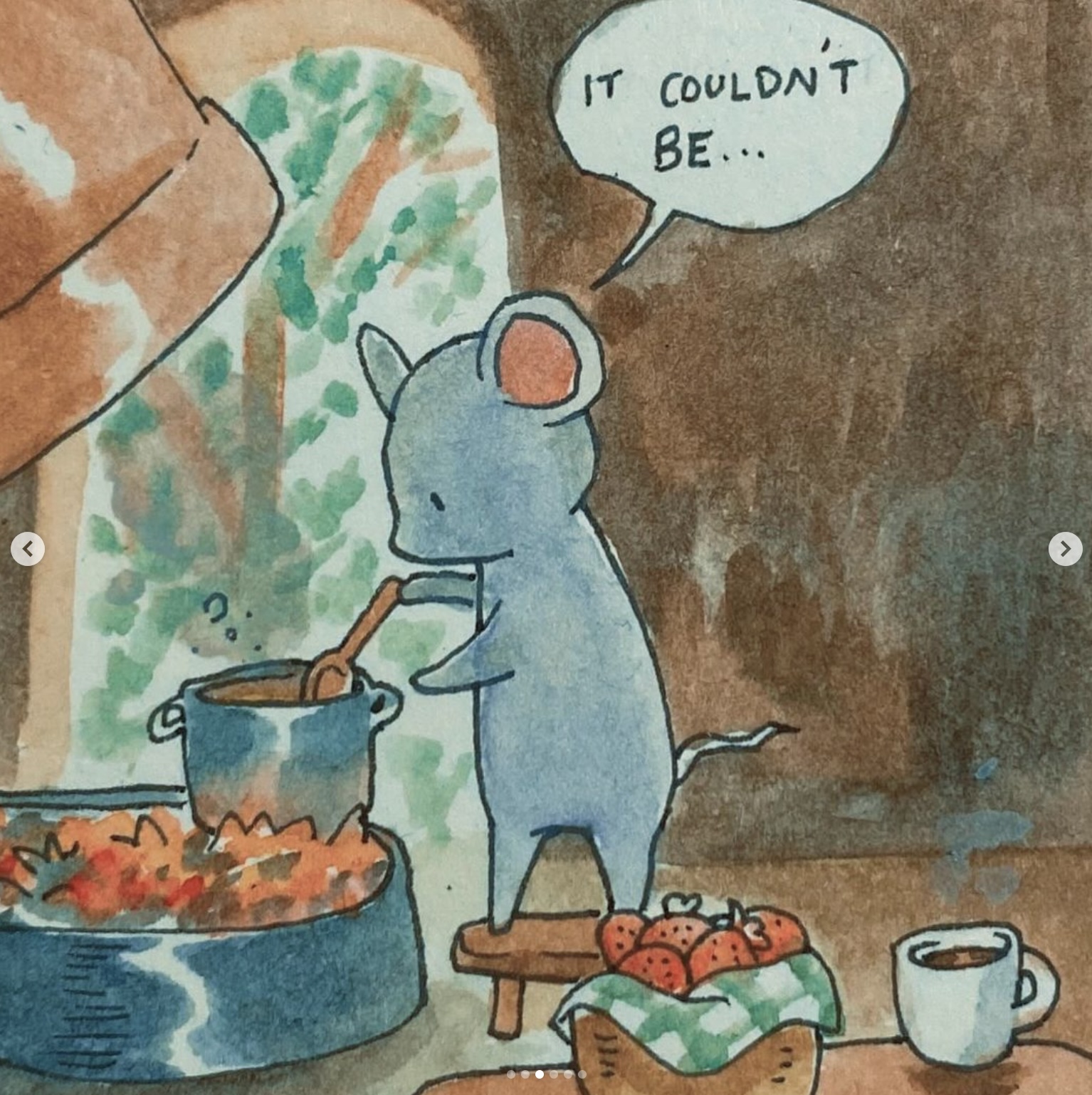 |  |  |
|---|
And here are some examples of outputs created by my model trying to generate similar scenes:
 |  |  |  |
|---|
This pipeline was finetuned from runwayml/stable-diffusion-v1-5 on the omkar1799/annalaura-diffusion-dataset dataset on Huggingface which I curated and annotated myself. I've included some example images generated
Before starting to fine tune the model, I selected runwayml/stable-diffusion-v1-5 as my foundation model and produced some outputs on a few prompts to see what it looks like out of the box. I'll recycle these prompts later for training validation and testing.
From left to right, the prompts are:
 |  |  |  |
|---|
Unsurprisingly, Stable Diffusion did not do a great job of replicating Anna Laura's unique watercolor style, and furthermore failed to generalize well enough to produce animal-like characters that behaved like humans (i.e. it drew both a turtle and a teacher separately for the second prompt, instead of a single entity).
To prepare my dataset for this training task, I needed both images and captions.
I used the Python instaloader package to quickly scrape specific posts off of the @annalaura_art Instagram account. You can find this script here. In total, I had about 850 images to work with as training examples.
Then, I wrote another script that fed these images to claude-3.5-sonnet and asked it to generate training data labels for each. In my prompt, I provided a few examples to guide it towards producing correct lables, and also set up a JSON formatter so I could easily pull these outputs into a dataframe later. Because of token limits per request, I only passed 10 images at a time. You can find that script here.
Lastly, I pulled associated these images and captions in a structured CSV using simple Pandas logic in a Jupyter notebook, which you can find here.
I then submitted my dataset to Huggingface at omkar1799/annalaura-diffusion-dataset which can be found here.
To train this model, I was guided by a tutorial published by Huggingface and used a jupyer notebook in Google Colab.
I tried using the script directly, but found that there were way too many options for configuration that I didn't need. I eventually ended up cutting out about half of it and keeping the other half for the actual training loop.
Some key tools used here were accelerate and xformers to speed up training time and reduce memory usage, respectively. Since I only have Colab Pro for hobbyists, it was really important I didn't exceed disk space. Also, I was only able to use 1 GPU at a time so I didn't get to enjoy any of the benefits of accelerate directly, but in the future if I got my hands on more machines I could.
To tokenize the captions I used the CLIPTokenizer and for scheduling noise during the forward pass of training stable diffusion I used the DDPMScheduler.
At first, I trained the model with these key hyperparameters:
Here are the outputs at 1,000 steps against the same four prompts as before:

Definitely an improvement! It's starting to look like the model is understanding what "annalaura watercolor" style means, and is recognizing animals as humanoid entities. That being said, these outputs are still far from the end result I'd like to see, and it appears it has more to learn.
So, here are the outputs at 5,000 steps with all the same hyperparameters against the same four prompts as before:
| | | |
|---|
Much better! There are definitely, some hallucinations (e.g. random letters in text bubbles), but the characters have taken on the shapes of Anna Laura's artwork and the model is doing a good job of generalizing to these similar but new prompts it hasn't seen before.
If I had more time and access to compute, I'd do the following:
from diffusers import DiffusionPipeline
import torch

pipeline = DiffusionPipeline.from_pretrained("omkar1799/script-sd-annalaura-model", torch_dtype=torch.float16)
prompt = "blue and yellow cats shopping at plant store in an annalaura watercolor drawing style"
image = pipeline(prompt).images[0]
image.save("my_image.png")