
Downloads · 30 days
0
monai-test/brats_mri_segmentation
brats_mri_segmentation is a machine learning model from monai-test. Use it for the machine learning task on the model card, and read the license before you ship it in a product. It is set up for monai. The card lists the license as apache-2.0.
A pre-trained model for volumetric (3D) segmentation of brain tumor subregions from multimodal MRIs based on BraTS 2018 data.
Downloads · 30 days
0
Access
Public
Updated Aug 16, 2023
Repo size
37.8 MB
Likes
3
Public
Click a slice to open those files.
.ts18.9 MB · 50%
From the Hugging Face model README
A pre-trained model for volumetric (3D) segmentation of brain tumor subregions from multimodal MRIs based on BraTS 2018 data.
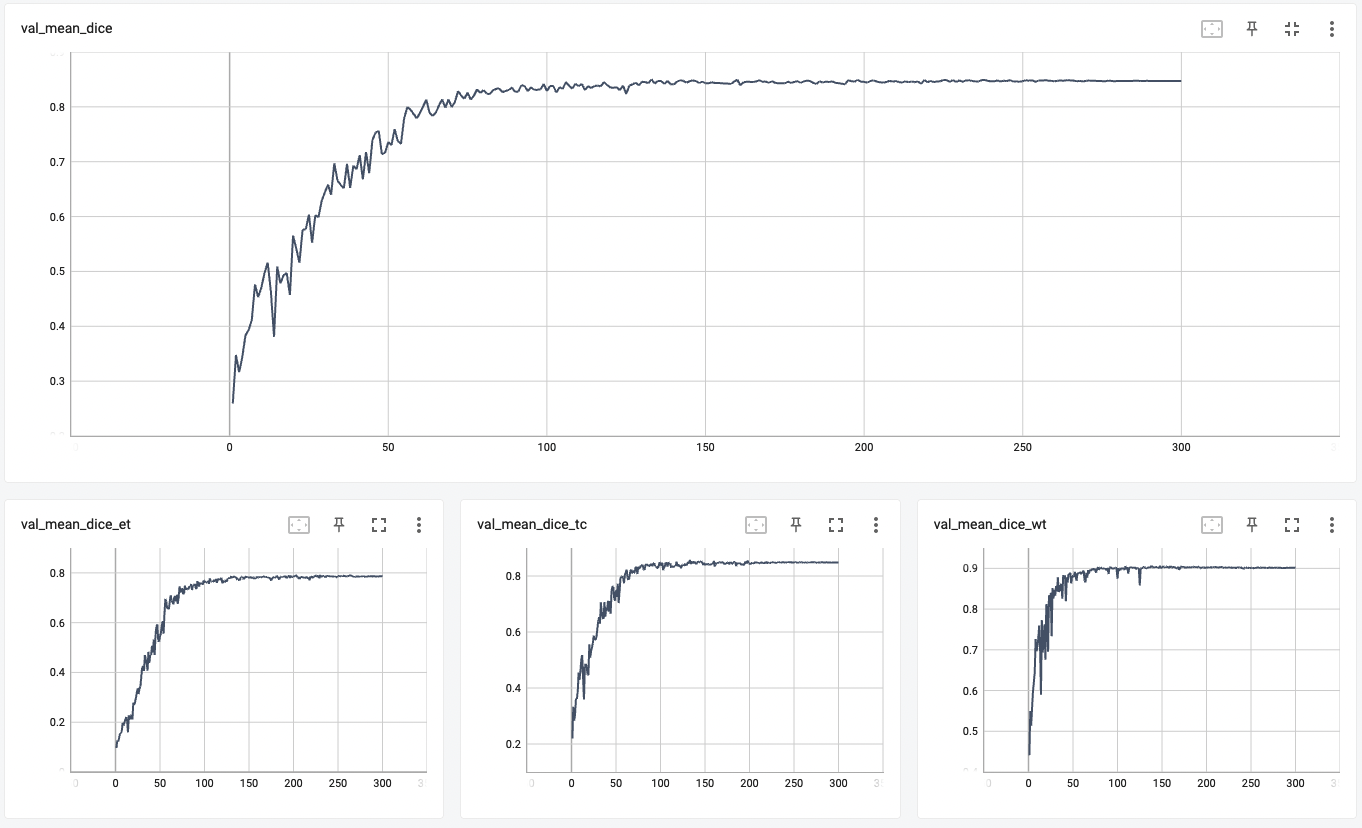
The model is trained to segment 3 nested subregions of primary brain tumors (gliomas): the "enhancing tumor" (ET), the "tumor core" (TC), the "whole tumor" (WT) based on 4 aligned input MRI scans (T1c, T1, T2, FLAIR).

The training data is from the Multimodal Brain Tumor Segmentation Challenge (BraTS) 2018.
The provided labelled data was partitioned, based on our own split, into training (200 studies), validation (42 studies) and testing (43 studies) datasets.
The data list/split can be created with the script scripts/prepare_datalist.py.
python scripts/prepare_datalist.py --path your-brats18-dataset-path
This model utilized a similar approach described in 3D MRI brain tumor segmentation using autoencoder regularization, which was a winning method in BraTS2018 [1]. The training was performed with the following:
4 channel aligned MRIs at 1 x 1 x 1 mm
3 channels
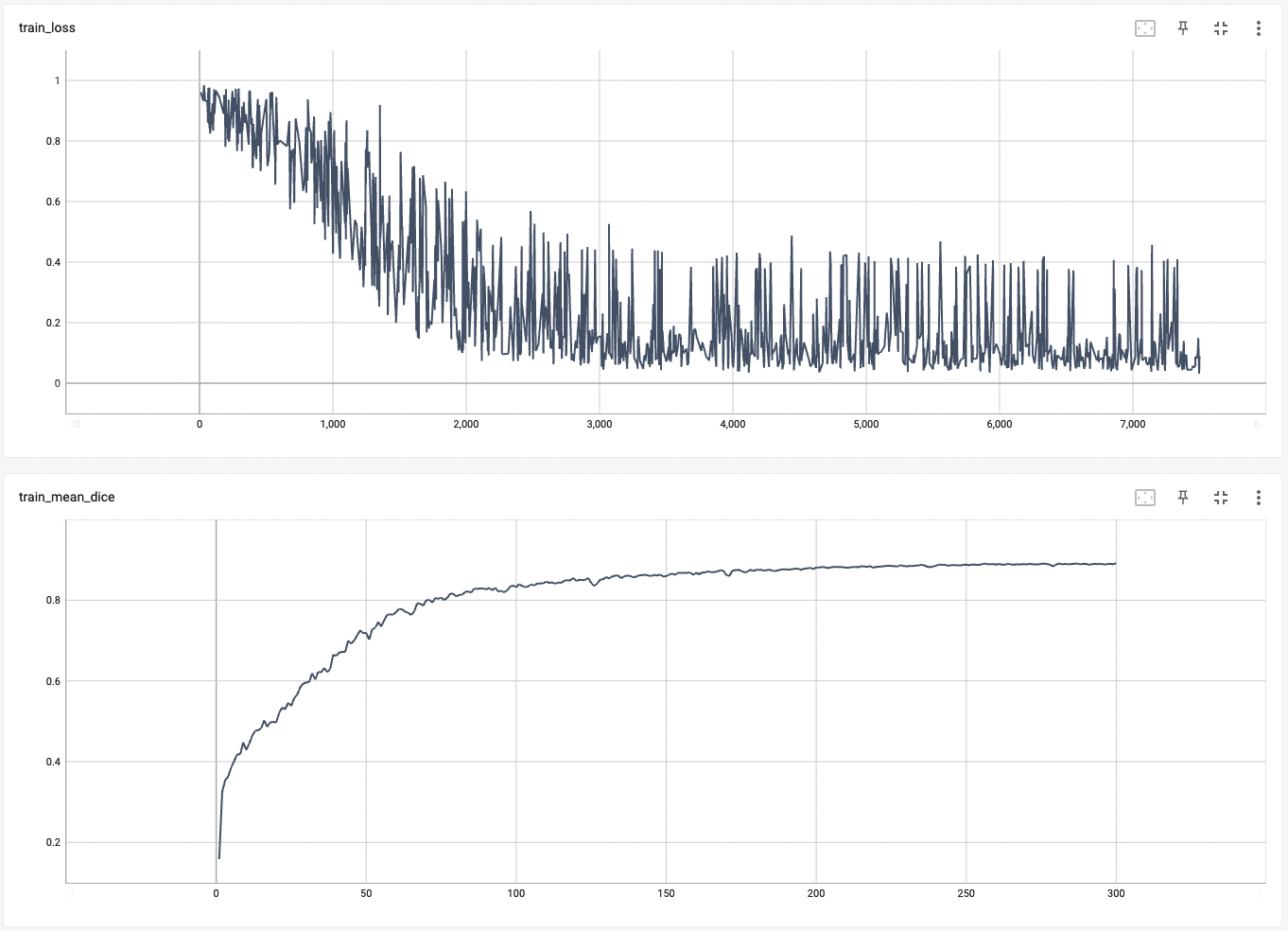
Dice score was used for evaluating the performance of the model. This model achieved Dice scores on the validation data of:
Please note that this bundle is non-deterministic because of the trilinear interpolation used in the network. Therefore, reproducing the training process may not get exactly the same performance. Please refer to https://pytorch.org/docs/stable/notes/randomness.html#reproducibility for more details about reproducibility.
The brats_mri_segmentation bundle supports acceleration with TensorRT through the ONNX-TensorRT method. The table below displays the speedup ratios observed on an A100 80G GPU.
| method | torch_fp32(ms) | torch_amp(ms) | trt_fp32(ms) | trt_fp16(ms) | speedup amp | speedup fp32 | speedup fp16 | amp vs fp16 |
|---|---|---|---|---|---|---|---|---|
| model computation | 5.49 | 4.36 | 2.35 | 2.09 | 1.26 | 2.34 | 2.63 | 2.09 |
| end2end | 592.01 | 434.59 | 395.73 | 394.93 | 1.36 | 1.50 | 1.50 | 1.10 |
Where:
model computation means the speedup ratio of model's inference with a random input without preprocessing and postprocessingend2end means run the bundle end-to-end with the TensorRT based model.torch_fp32 and torch_amp are for the PyTorch models with or without amp mode.trt_fp32 and trt_fp16 are for the TensorRT based models converted in corresponding precision.speedup amp, speedup fp32 and speedup fp16 are the speedup ratios of corresponding models versus the PyTorch float32 modelamp vs fp16 is the speedup ratio between the PyTorch amp model and the TensorRT float16 based model.Currently, the only available method to accelerate this model is through ONNX-TensorRT. However, the Torch-TensorRT method is under development and will be available in the near future.
This result is benchmarked under:
In addition to the Pythonic APIs, a few command line interfaces (CLI) are provided to interact with the bundle. The CLI supports flexible use cases, such as overriding configs at runtime and predefining arguments in a file.
For more details usage instructions, visit the MONAI Bundle Configuration Page.
python -m monai.bundle run --config_file configs/train.json
Please note that if the default dataset path is not modified with the actual path in the bundle config files, you can also override it by using --dataset_dir:
python -m monai.bundle run --config_file configs/train.json --dataset_dir <actual dataset path>
train config to execute multi-GPU training:torchrun --standalone --nnodes=1 --nproc_per_node=8 -m monai.bundle run --config_file "['configs/train.json','configs/multi_gpu_train.json']"
Please note that the distributed training-related options depend on the actual running environment; thus, users may need to remove --standalone, modify --nnodes, or do some other necessary changes according to the machine used. For more details, please refer to pytorch's official tutorial.
train config to execute evaluation with the trained model:python -m monai.bundle run --config_file "['configs/train.json','configs/evaluate.json']"
python -m monai.bundle run --config_file configs/inference.json
python -m monai.bundle trt_export --net_id network_def \
--filepath models/model_trt.ts --ckpt_file models/model.pt \
--meta_file configs/metadata.json --config_file configs/inference.json \
--precision <fp32/fp16> --input_shape "[1, 4, 240, 240, 160]" --use_onnx "True" \
--use_trace "True"
python -m monai.bundle run --config_file "['configs/inference.json', 'configs/inference_trt.json']"
[1] Myronenko, Andriy. "3D MRI brain tumor segmentation using autoencoder regularization." International MICCAI Brainlesion Workshop. Springer, Cham, 2018. https://arxiv.org/abs/1810.11654.
Copyright (c) MONAI Consortium
Licensed under the Apache License, Version 2.0 (the "License"); you may not use this file except in compliance with the License. You may obtain a copy of the License at
http://www.apache.org/licenses/LICENSE-2.0
Unless required by applicable law or agreed to in writing, software distributed under the License is distributed on an "AS IS" BASIS, WITHOUT WARRANTIES OR CONDITIONS OF ANY KIND, either express or implied. See the License for the specific language governing permissions and limitations under the License.