
Downloads · 30 days
282
21% of all-time downloads
maglun/Qwen3.8-27B-MLX-Mixed-4.95bpw
Qwen3.8-27B-MLX-Mixed-4.95bpw is a image-text-to-text model from maglun. Use it for the image-text-to-text task on the model card, and read the license before you ship it in a product. It is set up for mlx-vlm. The card lists the license as apache-2.0.
This is an Apple-silicon MLX-VLM conversion of Qwen/Qwen3.8-27B, revision 1d4bf0f2ff6012fd82039f2fa52739d0dd7c60c0.
Downloads · 30 days
282
21% of all-time downloads
All-time downloads
1.4K
Public
Parameters
27.4B
17.6 GB on disk
Likes
2
Public
Click a slice to open those files.
.safetensors17.6 GB · 100%
How the weights are stored.
U3226.9B · 98%
From the Hugging Face model README
This is an Apple-silicon MLX-VLM conversion of
Qwen/Qwen3.8-27B, revision
1d4bf0f2ff6012fd82039f2fa52739d0dd7c60c0.
The language tower uses an explicit mixed-bit affine MLX policy. The vision tower is the unquantized BF16 MLX-VLM conversion. The source checkpoint's MTP weights are intentionally not included in this release; normal autoregressive text, image, and video generation do not require an MTP companion.
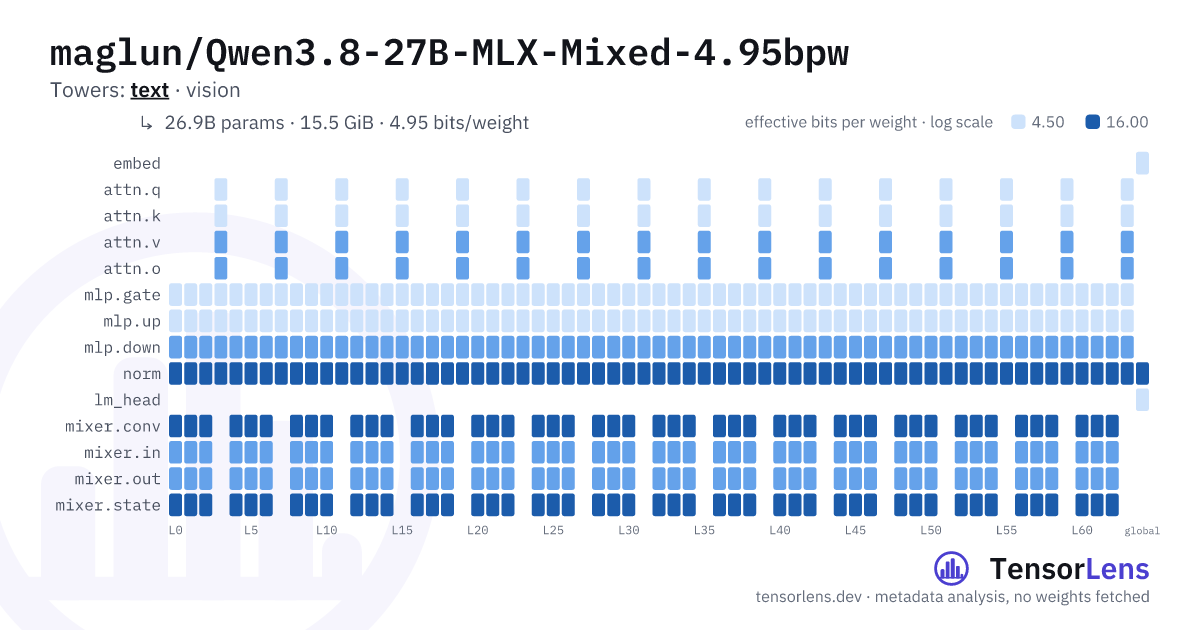 Fig 1. Bit allocation of model as shown on TensorLens (see link for details)
The text aggregate is higher than the 4.5/5.5-bit matrix rates because mixer state, mixer convolution, and normalization tensors remain BF16.
| Text tensor family | Effective BPW |
|---|---|
| Embeddings and untied LM head | 4.5 |
| Attention Q / K | 4.5 |
| Attention V / O | 5.5 |
| MLP gate / up | 4.5 |
| MLP down | 5.5 |
Linear-mixer input (in_proj_qkv, in_proj_z) | 5.5 |
| Linear-mixer output | 5.5 |
Linear-mixer state (in_proj_a, in_proj_b, A_log, dt_bias) | 16.0 |
| Linear-mixer convolution and all norms | 16.0 |
For group size 64, the reported 4.5 and 5.5 effective rates include the packed 4- or 5-bit codes plus BF16 affine scale and bias overhead.
These are small, deterministic launch-day checks, not statistically powered
leaderboard results. All three models used identical prompts/task IDs, greedy
decoding, and Qwen's explicit reasoning_effort=low thinking mode for
HumanEval+ and GSM8K, with an 8,192-token safety cap so reasoning is allowed to
finish naturally. “Reference” is the first 6.5229-BPW text recipe with BF16
mixer input; “mixer-in5” is the selected 4.9510-BPW release recipe.
| Check | BF16 text | Reference quant | Mixer-in5 release |
|---|---|---|---|
| Held-out chat-framed PPL ↓ (n=4) | 5.8107 | 5.8806 | 5.9028 |
| HumanEval+ pass@1 (n=8) | 75.0% | 75.0% | 75.0% |
| GSM8K accuracy (n=12) | 91.7% | 100.0% | 100.0% |
Raw per-item outcomes, exact task identities, corpus hashes, timings, and the paired summary are retained in the project release dossier rather than written inside the frozen model directory. The PPL panel is a numerical retention sanity check; HumanEval+ and GSM8K are more relevant behavioral signals for this coding/reasoning model, but the sample sizes remain too small for close claims.
Added 2026-10-15. Every row below was measured on one host — orion, Apple M5 Pro, 64 GB —
under mlx 0.32.3 / mlx-vlm 0.7.6 / mlx-lm 0.32.0, with identical prompts, task IDs, seeds,
greedy decoding, reasoning_effort=low, and an 8,192-token cap. PPL is teacher-forced on a fixed
held-out corpus of 4 documents / 6,057 tokens.
This is the same 4-document corpus as the launch-day table above, so the PPL figures in the two tables are directly comparable.
| build | GiB | GB | bpw | PPL ↓ | HumanEval+ (n=8) | GSM8K (n=12) | decode tok/s |
|---|---|---|---|---|---|---|---|
| BF16 text source (cross-host) | 51.75 | 55.56 | 16 | 5.8107 | 75.0% | 91.7% | — |
| this release — mixed affine 4.95 bpw | 16.36 | 17.57 | 4.95 | 5.9056 | 75.0% | 100.0% | 15.96 |
| MXFP4, text only | 13.31 | 14.29 | 4.251 | 6.0271 | 75.0% | 100.0% | 18.19 |
| MXFP4, with BF16 vision + MTP drafter | 14.17 | 15.21 | 4.251 | 6.0271 | 75.0% | 100.0% | 18.17 |
| sibling release — mixed affine 3.80 bpw | 12.76 | 13.70 | 3.80 | 6.4916 | 75.0% | 91.7% | 19.93 |
GiB is 1024-based and GB is 1000-based; the same artifact differs by about 7 % between them, so the unit matters when size-matching against another release.
The launch-day numbers reproduced on different hardware. This release re-measured 5.9056 here against 5.9028 on the retired Apple M4 Pro in August — same corpus, 0.047 % apart — and returned its published HumanEval+ and GSM8K scores exactly. The artifact was verified against the seal files committed at release time before evaluation, so these are the published bytes, not a rebuild.
What this means for this build. At 4.95 bpw this is the highest-quality quant of the set — it is the only one that beats MXFP4 on likelihood, by 0.12 PPL (2.06 % relative), and it holds the perfect GSM8K score. The cost is 3.27 GB more on disk and about 12 % slower decode than MXFP4. If you want the closest approach to BF16 behaviour in this family, this is it; if you are memory-bound or latency-bound, the 4.25 bpw MXFP4 builds are the better trade and the 3.80-BPW sibling is smaller and faster still.
What these probes can and cannot show. HumanEval+ reads 75.0 % for every row including BF16, so at n=8 it does not discriminate between these builds at all; GSM8K separates only the 3.80-BPW build and BF16, where a single item is 8.3 %. PPL is the only quality axis here with resolution. These are screening-tier counts: treat the table as a measurement, not a ranking, and do not read "no measurable difference" as "no difference".
decode tok/s is derived from the existing evaluation logs — generated tokens over both generative
axes divided by their wall time — not from a dedicated benchmark. Prompt and generation lengths
differ per row and prefill is folded in, so it is comparable within this table only. It is monotone
in bit width (19.93 / 18.17 / 15.96 at 3.80 / 4.25 / 4.95 bpw), which is what a bandwidth-bound
decode should do.
The BF16 row was measured on a different machine (the retired M4 Pro) and is therefore not host-matched to the rest of the table; it is included as the quality reference, not as a size or speed comparison.
The assembled bundle passed mlx_vlm.load(..., strict=True). A text prompt
returned The capital of Sweden is Stockholm. and a real image-path smoke returned
Two cats are sleeping on a couch.. Peak unified memory for strict load plus
both short generations was 17.37 GiB on
an Apple M4 Pro. Long-context and video behavior were not tested in this quick
release pass.
Validated with MLX-VLM commit
738e44063f145f7df24acc375e33c379053982d5
(mlx-vlm==0.6.14, mlx==0.32.0).
python -m pip install "mlx-vlm @ git+https://github.com/Blaizzy/mlx-vlm.git@738e44063f145f7df24acc375e33c379053982d5"
from mlx_vlm import generate, load
from mlx_vlm.prompt_utils import apply_chat_template
from mlx_vlm.utils import load_config

model_id = "maglun/Qwen3.8-27B-MLX-Mixed-4.95bpw"
model, processor = load(model_id, strict=True)
config = load_config(model_id)
images = ["image.jpg"]
prompt = apply_chat_template(
    processor, config, "Describe this image.", num_images=len(images)
)
result = generate(model, processor, prompt, image=images, max_tokens=256)
print(result.text)
Apache License 2.0, inherited from the upstream Qwen3.8-27B release. See
LICENSE and the upstream model card.