
Downloads · 30 days
245
0% of all-time downloads
m-a-p/music2vec-v1
music2vec-v1 is a feature extraction model from m-a-p. Use it when you need embeddings to search or compare text. It is set up for transformers. The card lists the license as cc-by-nc-4.0.
The development log of our Music Audio Pre-training (m-a-p) model family: - 17/03/2023: we release two advanced music understanding models, MERT-v1-95M and MERT-v1-330M , trained with new paradigm and dataset. They ou…
Downloads · 30 days
245
0% of all-time downloads
All-time downloads
421K
Public
Repo size
1.1 GB
Likes
44
Public
Click a slice to open those files.
.bin373 MB · 100%
From the Hugging Face model README
The development log of our Music Audio Pre-training (m-a-p) model family:
Here is a table for quick model pick-up:
| Name | Pre-train Paradigm | Training Data (hour) | Pre-train Context (second) | Model Size | Transformer Layer-Dimension | Feature Rate | Sample Rate | Release Date |
|---|---|---|---|---|---|---|---|---|
| MERT-v1-330M | MLM | 160K | 5 | 330M | 24-1024 | 75 Hz | 24K Hz | 17/03/2023 |
| MERT-v1-95M | MLM | 20K | 5 | 95M | 12-768 | 75 Hz | 24K Hz | 17/03/2023 |
| MERT-v0-public | MLM | 900 | 5 | 95M | 12-768 | 50 Hz | 16K Hz | 14/03/2023 |
| MERT-v0 | MLM | 1000 | 5 | 95 M | 12-768 | 50 Hz | 16K Hz | 29/12/2022 |
| music2vec-v1 | BYOL | 1000 | 30 | 95 M | 12-768 | 50 Hz | 16K Hz | 30/10/2022 |
The m-a-p models share the similar model architecture and the most distinguished difference is the paradigm in used pre-training. Other than that, there are several nuance technical configuration needs to know before using:
Music2Vec is accepted as 2-page abstract in Late Breaking Demos (LBD) at the ISMIR 2022. It is a completely unsupervised model trained on 1000 hour music audios. We release the crop5s version base model as music2vec-v1. Our base model is SOTA-comparable on multiple MIR tasks even under probing settings, while keeping fine-tunable on a single 2080Ti. Larger models trained with more data are on the way~
For a more recent pretrained model with better performance, please refer to m-a-p/MERT-v0.
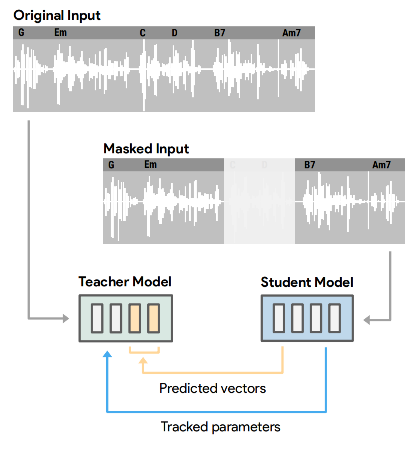
Music2Vec Framework. During pre-training, the student model aims to
reconstruct the masked music audio by taking the contextualized representations provided by the teacher model as prediction targets.
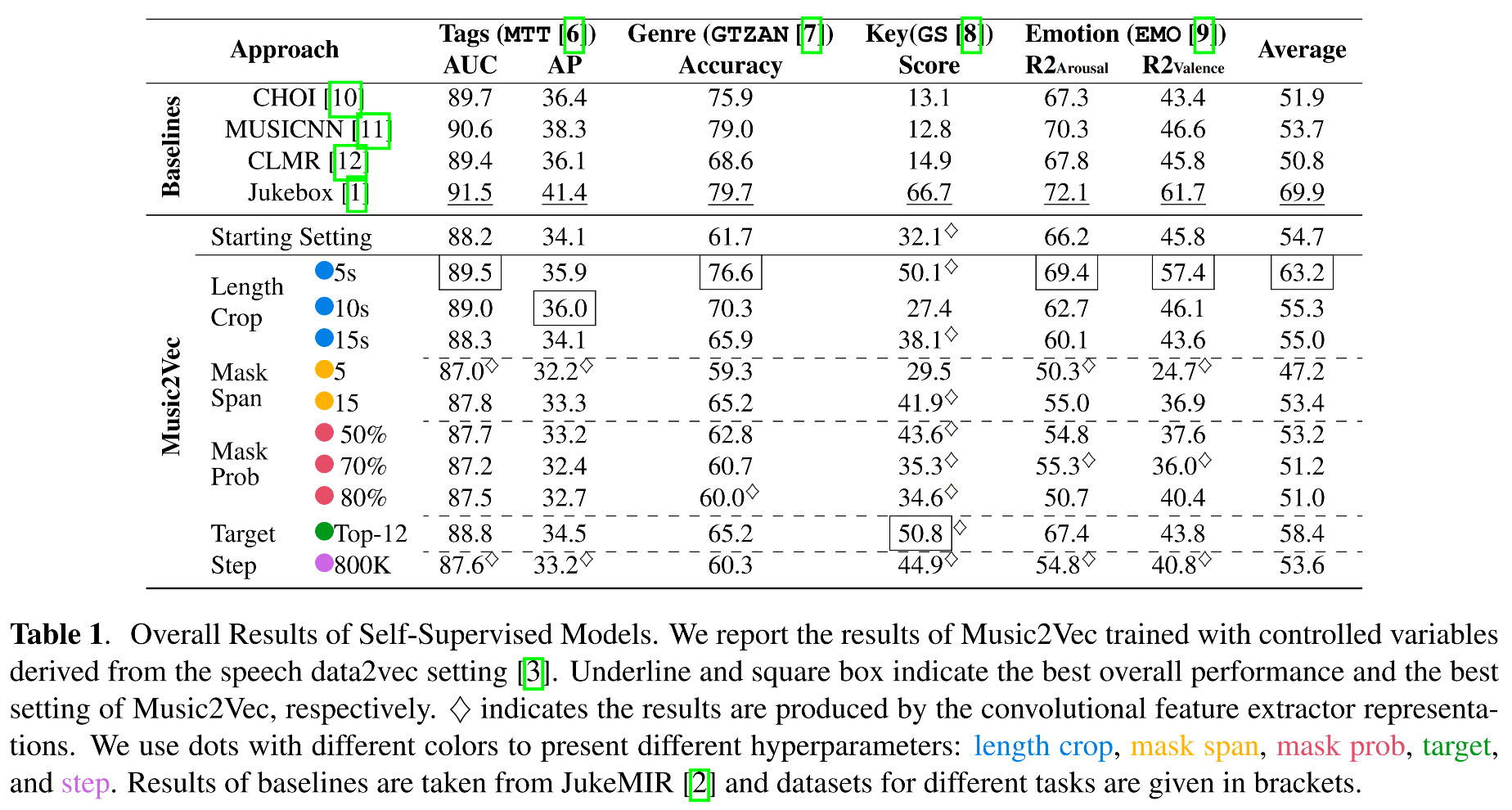
With 95M parameters and relatively small training data (1k hr), our base Music2Vec representation achieves comparable performance to the SOTA Jukebox-5B representation.
Note that our base model size is <2% of Jukebox-5B.
from transformers import Wav2Vec2Processor, Data2VecAudioModel
import torch
from torch import nn
from datasets import load_dataset

# load demo audio and set processor
dataset = load_dataset("hf-internal-testing/librispeech_asr_demo", "clean", split="validation")
dataset = dataset.sort("id")
sampling_rate = dataset.features["audio"].sampling_rate
processor = Wav2Vec2Processor.from_pretrained("facebook/data2vec-audio-base-960h")

# loading our model weights
model = Data2VecAudioModel.from_pretrained("m-a-p/music2vec-v1")


# audio file is decoded on the fly
inputs = processor(dataset[0]["audio"]["array"], sampling_rate=sampling_rate, return_tensors="pt")
with torch.no_grad():
    outputs = model(**inputs, output_hidden_states=True)

# take a look at the output shape, there are 13 layers of representation
# each layer performs differently in different downstream tasks, you should choose empirically
all_layer_hidden_states = torch.stack(outputs.hidden_states).squeeze()
print(all_layer_hidden_states.shape) # [13 layer, 292 timestep, 768 feature_dim]

# for utterance level classification tasks, you can simply reduce the representation in time
time_reduced_hidden_states = all_layer_hidden_states.mean(-2)
print(time_reduced_hidden_states.shape) # [13, 768]

# you can even use a learnable weighted average representation
aggregator = nn.Conv1d(in_channels=13, out_channels=1, kernel_size=1)
weighted_avg_hidden_states = aggregator(time_reduced_hidden_states).squeeze()
print(weighted_avg_hidden_states.shape) # [768]
Our model is based on the data2vec audio model.
The paper can be found at ISMIR.
@article{li2022map,
  title={MAP-Music2Vec: A Simple and Effective Baseline for Self-Supervised Music Audio Representation Learning},
  author={Li, Yizhi and Yuan, Ruibin and Zhang, Ge and Ma, Yinghao and Lin, Chenghua and Chen, Xingran and Ragni, Anton and Yin, Hanzhi and Hu, Zhijie and He, Haoyu and others},
  journal={arXiv preprint arXiv:2212.02508},
  year={2022}
}