
Downloads · 30 days
51
1% of all-time downloads
m-a-p/ChatMusician-Base
ChatMusician-Base is a text generation model from m-a-p. Use it when you need the model to write or continue text. It is set up for transformers. The card lists the license as mit.
🌐 DemoPage | 🤗 Pretrain Dataset | 🤗 SFT Dataset | 🤗 Benchmark | 📖 arXiv | 💻 Code | 🤖 Chat Model
Downloads · 30 days
51
1% of all-time downloads
All-time downloads
9.6K
Public
Repo size
27.7 GB
Likes
17
Public
Click a slice to open those files.
.bin13.5 GB · 100%
From the Hugging Face model README
🌐 DemoPage | 🤗 Pretrain Dataset | 🤗 SFT Dataset | 🤗 Benchmark | 📖 arXiv | 💻 Code | 🤖 Chat Model
While Large Language Models (LLMs) demonstrate impressive capabilities in text generation, we find that their ability has yet to be generalized to music, humanity’s creative language. We introduce ChatMusician, an open-source LLM that integrates intrinsic musical abilities.
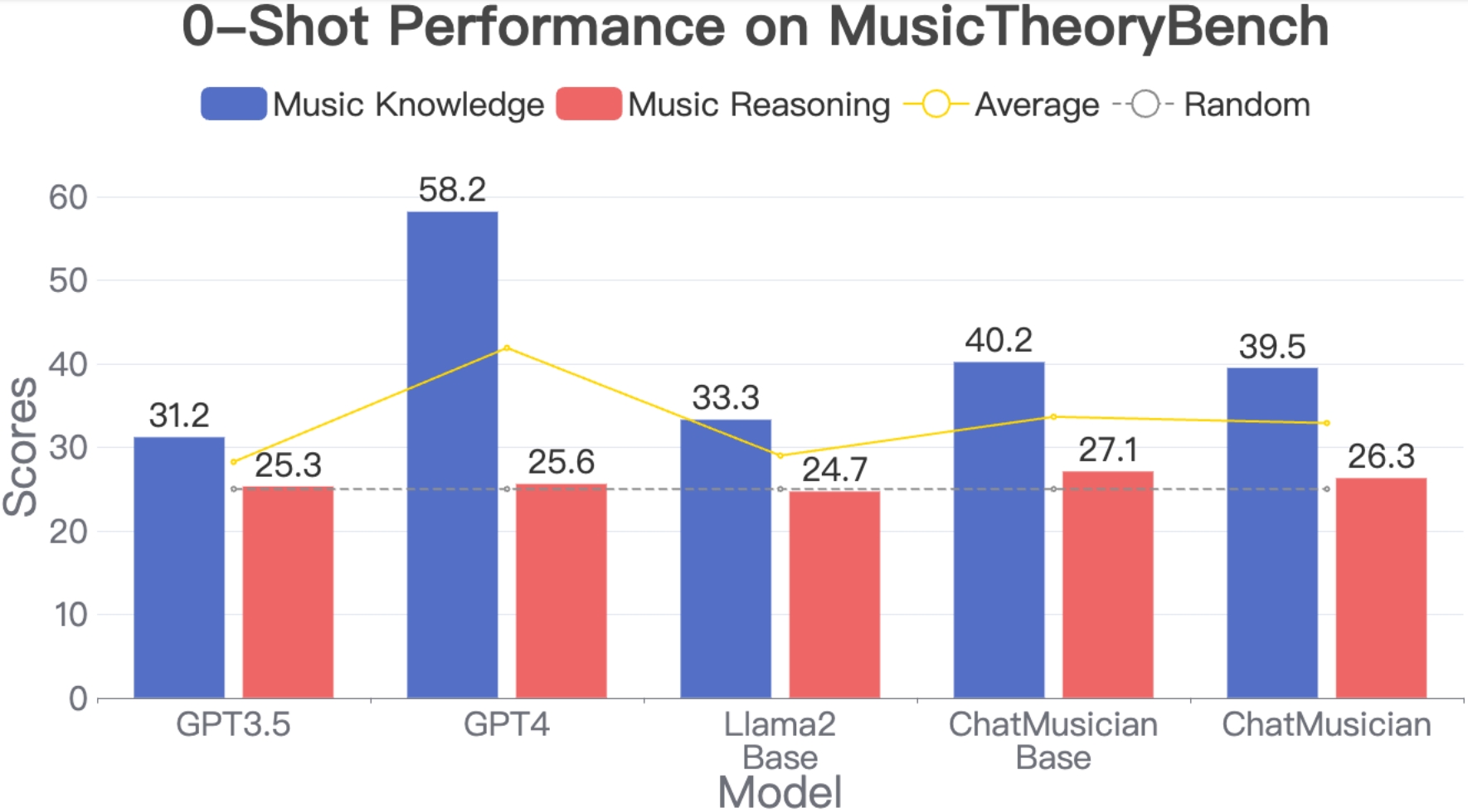
It is based on continual pre-training and finetuning LLaMA2 on a text-compatible music representation, ABC notation, and the music is treated as a second language. ChatMusician can understand and generate music with a pure text tokenizer without any external multi-modal neural structures or tokenizers. Interestingly, endowing musical abilities does not harm language abilities, even achieving a slightly higher MMLU score. Our model is capable of composing well-structured, full-length music, conditioned on texts, chords, melodies, motifs, musical forms, etc, surpassing GPT-4 baseline. On our meticulously curated college-level music understanding benchmark, MusicTheoryBench, ChatMusician surpasses LLaMA2 and GPT-3.5 on zero-shot setting by a noticeable margin. Our work reveals that LLMs can be an excellent compressor for music, but there remains significant territory to be conquered. Code, data, model, and benchmark are open-sourced.
<!-- <audio controls src="https://cdn-uploads.huggingface.co/production/uploads/5fd6f670053c8345eddc1b68/8NSONUjIF7KGUCfwzPCd9.mpga"></audio> -->
from transformers import AutoTokenizer, AutoModelForCausalLM, GenerationConfig
import torch
import re
from string import Template
prompt_template = Template("Human: ${inst} </s> Assistant: ")

tokenizer = AutoTokenizer.from_pretrained("m-a-p/ChatMusician-Base", trust_remote_code=True)
# you may replace "m-a-p/ChatMusician-Base" with "m-a-p/ChatMusician", since the base model may not follow instructions.
model = AutoModelForCausalLM.from_pretrained("m-a-p/ChatMusician-Base", torch_dtype=torch.float16, device_map="cuda", resume_download=True).eval()

generation_config = GenerationConfig(
    temperature=0.2,
    top_k=40,
    top_p=0.9,
    do_sample=True,
    num_beams=1,
    repetition_penalty=1.1,
    min_new_tokens=10,
    max_new_tokens=1536
)

instruction = """Develop a musical piece using the given chord progression.
'Dm', 'C', 'Dm', 'Dm', 'C', 'Dm', 'C', 'Dm'
"""

prompt = prompt_template.safe_substitute({"inst": instruction})
inputs = tokenizer(prompt, return_tensors="pt", add_special_tokens=False)
response = model.generate(
        input_ids=inputs["input_ids"].to(model.device),
        attention_mask=inputs['attention_mask'].to(model.device),
        eos_token_id=tokenizer.eos_token_id,
        generation_config=generation_config,
        )
response = tokenizer.decode(response[0][inputs["input_ids"].shape[1]:], skip_special_tokens=True)
print(response)

# to render abc notation, you need to install symusic
# pip install symusic
from symusic import Score, Synthesizer, BuiltInSF3, dump_wav

abc_pattern = r'(X:\d+\n(?:[^\n]*\n)+)'
abc_notation = re.findall(abc_pattern, response+'\n')[0]
s = Score.from_abc(abc_notation)
audio = Synthesizer().render(s, stereo=True)
dump_wav('cm_music_piece.wav', audio, sample_rate=44100, use_int16=True)
ChatMusician supports gradio web demo and multi-turn dialogue, please visit our github for more details. Our web demo also supports rendering ABC scores into images.
We provide some of the prompts that are tested to be stable. For more prompts, please check 🤗 MusicPile.
Develop a musical piece using the given chord progression.
'Dm', 'C', 'Dm', 'Dm', 'C', 'Dm', 'C', 'Dm'
Develop a tune influenced by Bach's compositions.
Using ABC notation, recreate the given text as a musical score.
Meter C
Notes The parts are commonly interchanged.
Transcription 1997 by John Chambers
Key D
Note Length 1/8
Rhythm reel
Construct smooth-flowing chord progressions for the supplied music.

|: BA | G2 g2"^(C)" edeg | B2 BA"^(D7)" BcBA | G2 g2 edeg | dBAG A2 BA |
G2 g2"^(C)" edeg | B2 BA B2 d2 | e2 ef e2 (3def | gedB A2 :: BA | G2 BG dGBe |
dBBA"^(D7)" B3 A | G2 BG dGBe | dBAG A4 | G2 BG dGBe | dBBA B3 d |
e2 ef e2 (3def | gedB A2 :|
Develop a series of chord pairings that amplify the harmonious elements in the given music piece.

E |: EAA ABc | Bee e2 d | cBA ABc | BEE E2 D | EAA ABc | Bee e2 d |
cBA ^GAB |1 A2 A A2 E :|2 A2 A GAB || c3 cdc | Bgg g2 ^g | aed cBA |
^GAB E^F^G | A^GA BAB | cde fed | cBA ^GAB |1 A2 A GAB :|2 \n A3 A2 ||
Develop a composition by incorporating elements from the given melodic structure.

Ternary, Sectional: Verse/Chorus/Bridge
Create music by incorporating the assigned motif into the predetermined musical arrangement.

Musical Form Input: Only One Section

ABC Notation Music Input:
X:1
L:1/8
M:9/8
K:Emin
vB2 E E2 F G2 A
Investigate the aspects of this musical work and convey its structural organization using suitable musical words.

X:1
L:1/8
M:2/2
K:G
G2 dG BGdG | G2 dc BAGB | A2 eA cAeA | A2 ed cAFA |
G2 dG BGdG | G2 dc BAGB | ABcd efge |1 aged cAFA :|2
aged ^cdef |: g3 f g2 ef | gedc BA G2 | eaag agea |
aged ^cdef | g3 f g2 ef |gedc BAGB | ABcd efge |1
aged ^cdef :|2 aged cAFA |:"^variations:" G2 BG dGBA |
G2 dG BAGB | A2 cA eAcA | A2 ed cAFA | G2 BG dGBA |
G2 dc BAGB | ABcd efge |1 aged cAFA :|2 aged ^cdef |:
g2 af g2 ef | gedc BAGB | Aaag ageg | aged ^cdef |
gbaf g2 ef | gedc BAGB | ABcd efge |1
aged ^cdef :|2 aged cAFA ||
Analyze the musical work and pinpoint the consistent melodic element in every section.

X:1
L:1/8
M:4/4
K:G
ge | d2 G2 cBAG | d2 G2 cBAG | e2 A2 ABcd | edcB A2 Bc |
d2 cB g2 fe | edcB cBAG | BAGE DEGA | B2 G2 G2 :: ga |
b2 gb a2 fa | g2 eg edcB | e2 A2 ABcd | edcB A2 ga |
b2 gb a2 fa | g2 eg edcB | cBAG DEGA | B2 G2 G2 :|
ChatMusician is pretrained on the 🤗 MusicPile, which is the first pretraining corpus for developing musical abilities in large language models. Check out the dataset card for more details. And supervised finetuned on 1.1M samples(2:1 ratio between music scores and music knowledge & music summary data) from MusicPile. Check our paper for more details.
If you find our work helpful, feel free to give us a cite.
@misc{yuan2024chatmusician,
      title={ChatMusician: Understanding and Generating Music Intrinsically with LLM},
      author={Ruibin Yuan and Hanfeng Lin and Yi Wang and Zeyue Tian and Shangda Wu and Tianhao Shen and Ge Zhang and Yuhang Wu and Cong Liu and Ziya Zhou and Ziyang Ma and Liumeng Xue and Ziyu Wang and Qin Liu and Tianyu Zheng and Yizhi Li and Yinghao Ma and Yiming Liang and Xiaowei Chi and Ruibo Liu and Zili Wang and Pengfei Li and Jingcheng Wu and Chenghua Lin and Qifeng Liu and Tao Jiang and Wenhao Huang and Wenhu Chen and Emmanouil Benetos and Jie Fu and Gus Xia and Roger Dannenberg and Wei Xue and Shiyin Kang and Yike Guo},
      year={2024},
      eprint={2402.16153},
      archivePrefix={arXiv},
      primaryClass={cs.SD}
}