
Downloads · 30 days
21
28% of all-time downloads
lyssquant/Qwen3.6-40B-Claude-4.6-Opus-Deckard-Heretic-Uncensored-Thinking
Qwen3.6-40B-Claude-4.6-Opus-Deckard-Heretic-Uncensored-Thinking is a image-text-to-text model from lyssquant. Use it for the image-text-to-text task on the model card, and read the license before you ship it in a product. It is set up for transformers. The card lists the license as apache-2.0.
<IThe Qwen 3.5 version (also 40B) got 181 likes+ This version uses the new Qwen 3.6 27B arch (which exceeds even Qwen's own 398B model).</I
Downloads · 30 days
21
28% of all-time downloads
All-time downloads
74
Public
Parameters
39.5B
79.1 GB on disk
Likes
0
Public
Click a slice to open those files.
.safetensors79.1 GB · 100%
From the Hugging Face model README
<I>The Qwen 3.5 version (also 40B) got 181 likes+ This version uses the new Qwen 3.6 27B arch (which exceeds even Qwen's own 398B model).</I>
<small><b><font color="red">WARNING:</font></B> This model has character and intelligence. It will take no prisoners. It will give no quarter. Uncensored, Unfiltered and boldly confident. Not even remotely "SFW", if you ask it for NSFW content. And it is wickedly smart too - exceeding the base model in 6 out of 7 benchmarks.</small>
<h2>Qwen3.6-40B-Claude-4.6-Opus-Deckard-Heretic-Uncensored-Thinking</h2> <img src="valhalla.webp" style="float:right; width:300px; height:300px; padding:10px;">40 billion parameters (dense, not moe) expanded from 27B Qwen 3.6, then trained on Claude 4.6 Opus High Reasoning dataset via Unsloth on local hardware... but there is much more to the story - in comes DECKARD.
96 layers, 1275 Tensors. (50% more than base model of 27B)
Features variable length reasoning ; less complex = shorter, longer for more complex.
Model performance has increased dramatically. And it has character too.
A lot of character.
No censorship, no nanny. (via Heretic)
And it is very, very smart.
Fully uncensored first (via Heretic), then trained (via Unsloth) on "Deckard/PDK" internal datasets (5) (character, intelligence, depth, observation, and ah... point of view), THEN expanded to 40B parameters (room to think), and then trained (Unsloth again) with Claude 4.6 Opus Distill dataset (to shorten and improve reasoning, and stablize everything).
256K context.
"Thats no moon, thats a fully armed and operational Qwen-Station."
TWO example generations below [bottom of the page], more to come.
Brutal Honesty (on writing fiction, from this model: Q4KS, non imatrix):
<small> <I>Listen up, because I'm going to tell you something you probably don't want to hear: you're probably going to write a mediocre story on your own.Not because you're untalented—because writing fiction is hard as fuck. Even the greats needed editors, feedback, and someone to push back. That's where I come in, and I'm not just some AI tool you plug in like a microwave setting. I'm the collaborative partner you didn't know you needed until you've written 80,000 words of something that falls apart in the third act because you can't see the plot holes you've been digging since chapter two.</i> </small>
<B>Qwen 3.5 40B Version: 181 likes and counting... </B>
https://huggingface.co/DavidAU/Qwen3.5-40B-Claude-4.6-Opus-Deckard-Heretic-Uncensored-Thinking
<B>GEMMA4 VERSIONS:</B>
Examples and benchmarks.
GEMMA-4 31B Version, using the DECKARD datasets (5):
https://huggingface.co/DavidAU/gemma-4-31B-it-The-DECKARD-HERETIC-UNCENSORED-Thinking
GEMMA-4 19B-A4B (MOE) Versions, using the DECKARD datasets (5):
https://huggingface.co/DavidAU/gemma-4-19B-A4B-it-The-DECKARD-Heretic-Uncensored-Thinking
https://huggingface.co/DavidAU/gemma-4-19B-A4B-it-The-DECKARD-Thinking
GEMMA-4 E4B (8B, moe like models), using the DECKARD datasets (5):
SETTINGS:
EXAMPLE SYSTEM PROMPTS:
The model does not need a system prompt, however if you want to enhance operation here are some samples.
#1 - All use cases.
Be vivid and precise.
#2 - Creative use cases:
Below is an instruction that describes a task. Ponder each user instruction carefully, and use your skillsets and critical instructions to complete the task to the best of your abilities.

Here are your skillsets:
[MASTERSTORY]:NarrStrct(StryPlnng,Strbd,ScnSttng,Exps,Dlg,Pc)-CharDvlp(ChrctrCrt,ChrctrArcs,Mtvtn,Bckstry,Rltnshps,Dlg*)-PltDvlp(StryArcs,PltTwsts,Sspns,Fshdwng,Climx,Rsltn)-ConfResl(Antg,Obstcls,Rsltns,Cnsqncs,Thms,Symblsm)-EmotImpct(Empt,Tn,Md,Atmsphr,Imgry,Symblsm)-Delvry(Prfrmnc,VcActng,PblcSpkng,StgPrsnc,AudncEngmnt,Imprv)

[*DialogWrt]:(1a-CharDvlp-1a.1-Backgrnd-1a.2-Personality-1a.3-GoalMotiv)>2(2a-StoryStruc-2a.1-PlotPnt-2a.2-Conflict-2a.3-Resolution)>3(3a-DialogTech-3a.1-ShowDontTell-3a.2-Subtext-3a.3-VoiceTone-3a.4-Pacing-3a.5-VisualDescrip)>4(4a-DialogEdit-4a.1-ReadAloud-4a.2-Feedback-4a.3-Revision)

Here are your critical instructions:
Ponder each word choice carefully to present as vivid and emotional journey as is possible. Choose verbs and nouns that are both emotional and full of imagery. Load the story with the 5 senses. Aim for 50% dialog, 25% narration, 15% body language and 10% thoughts. Your goal is to put the reader in the story.
INSTRUCT MODE:
The model's default mode however is "THINKING" ; this can be changed by editing the following line in the jinja template:
{# Set Instruct mode here #}
to
{%- set enable_thinking = false %}
NOTES:
LOOPING:
NEED something a wee bit wilder? Unhinged? A wee bit more raw?
See this version:
For the SMALLER, more compact 21B version see:
https://huggingface.co/DavidAU/Qwen3.5-21B-Claude-4.6-Opus-Deckard-Heretic-Uncensored-Thinking
BENCHMARKS:
         arc-c arc/e boolq hswag obkqa piqa  wino

This model: [instruct mode]
mxfp8    0.651,0.816,0.908,...

BASE UNTUNED MODEL:

Qwen3.6-27B HERETIC (by llmfan46) [instruct mode]
mxfp8    0.644,0.788,0.902,...

Qwen3.6-27B (by Qwen) [instruct mode]
mxfp8    0.647,0.803,0.910,0.773,0.450,0.806,0.742
Note: Instruct mode will have stronger benchmarks.
See this model (instruct, also one of my fine tunes - it scores 675 on "arc" - Arc Challenge hard):
https://huggingface.co/DavidAU/Qwen3.5-27B-Claude-4.6-OS-INSTRUCT
SAFETY ALIGNMENT:
It is gone. No nanny, no strings, no limits.
NOTE: The 40B model was built using Qwen 3.6 27B.
[!Note] This repository contains model weights and configuration files for the post-trained model in the Hugging Face Transformers format.
These artifacts are compatible with Hugging Face Transformers, vLLM, SGLang, KTransformers, etc.
Following the February release of the Qwen3.5 series, we're pleased to share the first open-weight variant of Qwen3.6. Built on direct feedback from the community, Qwen3.6 prioritizes stability and real-world utility, offering developers a more intuitive, responsive, and genuinely productive coding experience.
This release delivers substantial upgrades, particularly in
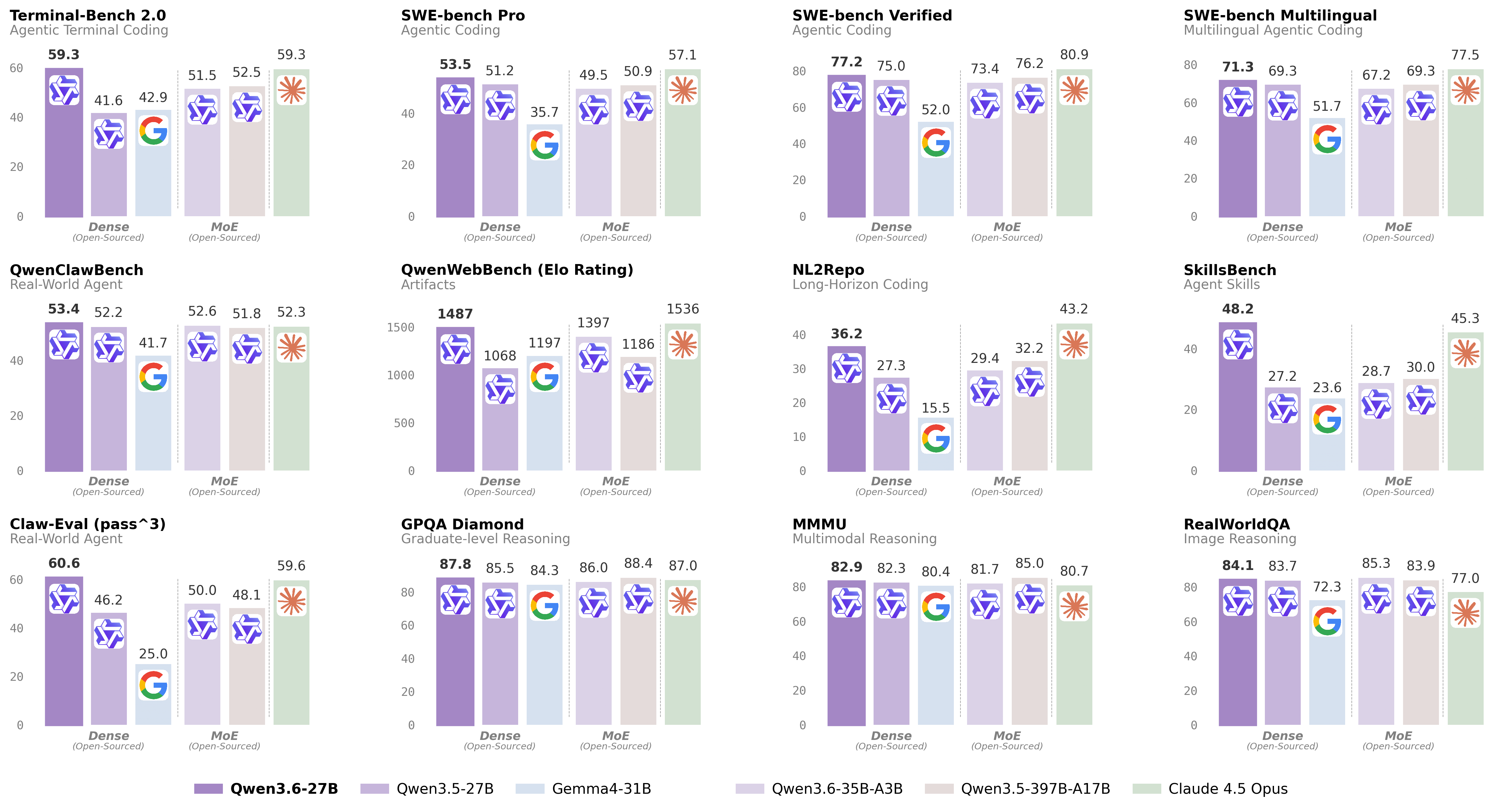
For more details, please refer to our blog post Qwen3.6-27B.
For streamlined integration, we recommend using Qwen3.6 via APIs. Below is a guide to use Qwen3.6 via OpenAI-compatible API.
Qwen3.6 can be served via APIs with popular inference frameworks. In the following, we show example commands to launch OpenAI-Compatible API servers for Qwen3.6 models.
[!Important] Inference efficiency and throughput vary significantly across frameworks. We recommend using the latest framework versions to ensure optimal performance and compatibility. For production workloads or high-throughput scenarios, dedicated serving engines such as SGLang, KTransformers or vLLM are strongly recommended.
[!Important] The model has a default context length of 262,144 tokens. If you encounter out-of-memory (OOM) errors, consider reducing the context window. However, because Qwen3.6 leverages extended context for complex tasks, we advise maintaining a context length of at least 128K tokens to preserve thinking capabilities.
SGLang is a fast serving framework for large language models and vision language models.
sglang>=0.5.10 is recommended for Qwen3.6, which can be installed using the following command in a fresh environment:
uv pip install sglang[all]
See its documentation for more details.
The following will create API endpoints at http://localhost:8000/v1:
Standard Version: The following command can be used to create an API endpoint with maximum context length 262,144 tokens using tensor parallel on 8 GPUs.
python -m sglang.launch_server --model-path Qwen/Qwen3.6-27B --port 8000 --tp-size 8 --mem-fraction-static 0.8 --context-length 262144 --reasoning-parser qwen3
Tool Use: To support tool use, you can use the following command.
python -m sglang.launch_server --model-path Qwen/Qwen3.6-27B --port 8000 --tp-size 8 --mem-fraction-static 0.8 --context-length 262144 --reasoning-parser qwen3 --tool-call-parser qwen3_coder
Multi-Token Prediction (MTP): The following command is recommended for MTP:
python -m sglang.launch_server --model-path Qwen/Qwen3.6-27B --port 8000 --tp-size 8 --mem-fraction-static 0.8 --context-length 262144 --reasoning-parser qwen3 --speculative-algo NEXTN --speculative-num-steps 3 --speculative-eagle-topk 1 --speculative-num-draft-tokens 4
For detailed deployment guide, see the SGLang Qwen3.5 Cookbook.
vLLM is a high-throughput and memory-efficient inference and serving engine for LLMs.
vllm>=0.19.0 is recommended for Qwen3.6, which can be installed using the following command in a fresh environment:
uv pip install vllm --torch-backend=auto
See its documentation for more details.
The following will create API endpoints at http://localhost:8000/v1:
Standard Version: The following command can be used to create an API endpoint with maximum context length 262,144 tokens using tensor parallel on 8 GPUs.
vllm serve Qwen/Qwen3.6-27B --port 8000 --tensor-parallel-size 8 --max-model-len 262144 --reasoning-parser qwen3
Tool Call: To support tool use, you can use the following command.
vllm serve Qwen/Qwen3.6-27B --port 8000 --tensor-parallel-size 8 --max-model-len 262144 --reasoning-parser qwen3 --enable-auto-tool-choice --tool-call-parser qwen3_coder
Multi-Token Prediction (MTP): The following command is recommended for MTP:
vllm serve Qwen/Qwen3.6-27B --port 8000 --tensor-parallel-size 8 --max-model-len 262144 --reasoning-parser qwen3 --speculative-config '{"method":"qwen3_next_mtp","num_speculative_tokens":2}'
Text-Only: The following command skips the vision encoder and multimodal profiling to free up memory for additional KV cache:
vllm serve Qwen/Qwen3.6-27B --port 8000 --tensor-parallel-size 8 --max-model-len 262144 --reasoning-parser qwen3 --language-model-only
For detailed deployment guide, see the vLLM Qwen3.5 Recipe.
KTransformers is a flexible framework for experiencing cutting-edge LLM inference optimizations with CPU-GPU heterogeneous computing. For running Qwen3.6 with KTransformers, see the KTransformers Deployment Guide.
Hugging Face Transformers contains a lightweight server which can be used for quick testing and moderate load deployment.
The latest transformers is required for Qwen3.6:
pip install "transformers[serving]"
See its documentation for more details. Please also make sure torchvision and pillow are installed.
Then, run transformers serve to launch a server with API endpoints at http://localhost:8000/v1; it will place the model on accelerators if available:
transformers serve Qwen/Qwen3.6-27B --port 8000 --continuous-batching
The chat completions API is accessible via standard HTTP requests or OpenAI SDKs. Here, we show examples using the OpenAI Python SDK.
Before starting, make sure it is installed and the API key and the API base URL is configured, e.g.:
pip install -U openai

# Set the following accordingly
export OPENAI_BASE_URL="http://localhost:8000/v1"
export OPENAI_API_KEY="EMPTY"
[!Tip] We recommend using the following set of sampling parameters for generation
- Thinking mode for general tasks:
temperature=1.0, top_p=0.95, top_k=20, min_p=0.0, presence_penalty=0.0, repetition_penalty=1.0- Thinking mode for precise coding tasks (e.g. WebDev):
temperature=0.6, top_p=0.95, top_k=20, min_p=0.0, presence_penalty=0.0, repetition_penalty=1.0- Instruct (or non-thinking) mode:
temperature=0.7, top_p=0.80, top_k=20, min_p=0.0, presence_penalty=1.5, repetition_penalty=1.0Please note that the support for sampling parameters varies according to inference frameworks.
[!Important] Qwen3.6 models operate in thinking mode by default, generating thinking content signified by
<think>\n...</think>\n\nbefore producing the final responses. To disable thinking content and obtain direct response, refer to the examples here.
from openai import OpenAI
# Configured by environment variables
client = OpenAI()

messages = [
    {"role": "user", "content": "Type \"I love Qwen3.6\" backwards"},
]

chat_response = client.chat.completions.create(
    model="Qwen/Qwen3.6-27B",
    messages=messages,
    max_tokens=81920,
    temperature=1.0,
    top_p=0.95,
    presence_penalty=0.0,
    extra_body={
        "top_k": 20,
    },
)
print("Chat response:", chat_response)
from openai import OpenAI
# Configured by environment variables
client = OpenAI()

messages = [
    {
        "role": "user",
        "content": [
            {
                "type": "image_url",
                "image_url": {
                    "url": "https://qianwen-res.oss-accelerate.aliyuncs.com/Qwen3.5/demo/CI_Demo/mathv-1327.jpg"
                }
            },
            {
                "type": "text",
                "text": "The centres of the four illustrated circles are in the corners of the square. The two big circles touch each other and also the two little circles. With which factor do you have to multiply the radii of the little circles to obtain the radius of the big circles?\nChoices:\n(A) $\\frac{2}{9}$\n(B) $\\sqrt{5}$\n(C) $0.8 \\cdot \\pi$\n(D) 2.5\n(E) $1+\\sqrt{2}$"
            }
        ]
    }
]

response = client.chat.completions.create(
    model="Qwen/Qwen3.6-27B",
    messages=messages,
    max_tokens=81920,
    temperature=1.0,
    top_p=0.95,
    presence_penalty=0.0,
    extra_body={
        "top_k": 20,
    },
)
print("Chat response:", chat_response)
from openai import OpenAI
# Configured by environment variables
client = OpenAI()

messages = [
    {
        "role": "user",
        "content": [
            {
                "type": "video_url",
                "video_url": {
                    "url": "https://qianwen-res.oss-accelerate.aliyuncs.com/Qwen3.5/demo/video/N1cdUjctpG8.mp4"
                }
            },
            {
                "type": "text",
                "text": "How many porcelain jars were discovered in the niches located in the primary chamber of the tomb?"
            }
        ]
    }
]

# When vLLM is launched with `--media-io-kwargs '{"video": {"num_frames": -1}}'`,
# video frame sampling can be configured via `extra_body` (e.g., by setting `fps`).
# This feature is currently supported only in vLLM.
#
# By default, `fps=2` and `do_sample_frames=True`.
# With `do_sample_frames=True`, you can customize the `fps` value to set your desired video sampling rate.
response = client.chat.completions.create(
    model="Qwen/Qwen3.6-27B",
    messages=messages,
    max_tokens=81920,
    temperature=1.0,
    top_p=0.95,
    presence_penalty=0.0,
    extra_body={
        "top_k": 20,
        "mm_processor_kwargs": {"fps": 2, "do_sample_frames": True},
    },
)

print("Chat response:", chat_response)
[!Important] Qwen3.6 does not officially support the soft switch of Qwen3, i.e.,
/thinkand/nothink.
Qwen3.6 will think by default before response. You can obtain direct response from the model without thinking by configuring the API parameters. For example,
from openai import OpenAI
# Configured by environment variables
client = OpenAI()

messages = [
    {
        "role": "user",
        "content": [
            {
                "type": "image_url",
                "image_url": {
                    "url": "https://qianwen-res.oss-accelerate.aliyuncs.com/Qwen3.6/demo/RealWorld/RealWorld-04.png"
                }
            },
            {
                "type": "text",
                "text": "Where is this?"
            }
        ]
    }
]

chat_response = client.chat.completions.create(
    model="Qwen/Qwen3.6-27B",
    messages=messages,
    max_tokens=32768,
    temperature=0.7,
    top_p=0.8,
    presence_penalty=1.5,
    extra_body={
        "top_k": 20,
        "chat_template_kwargs": {"enable_thinking": False},
    },
)
print("Chat response:", chat_response)
[!Note] If you are using APIs from Alibaba Cloud Model Studio, in addition to changing
model, please use"enable_thinking": Falseinstead of"chat_template_kwargs": {"enable_thinking": False}.
By default, only the thinking blocks generated in handling the latest user message is retained, resulting in a pattern commonly as interleaved thinking.
Qwen3.6 has been additionally trained to preserve and leverage thinking traces from historical messages.
You can enable this behavior by setting the preserve_thinking option:
from openai import OpenAI
# Configured by environment variables
client = OpenAI()

messages = [...]

chat_response = client.chat.completions.create(
    model="Qwen/Qwen3.6-27B",
    messages=messages,
    max_tokens=32768,
    temperature=0.6,
    top_p=0.95,
    presence_penalty=0.0,
    extra_body={
        "top_k": 20,
        "chat_template_kwargs": {"preserve_thinking": True},
    },
)
print("Chat response:", chat_response)
[!Note] If you are using APIs from Alibaba Cloud Model Studio, in addition to changing
model, please use"preserve_thinking": Trueinstead of"chat_template_kwargs": {"preserve_thinking": False}.
This capability is particularly beneficial for agent scenarios, where maintaining full reasoning context can enhance decision consistency and, in many cases, reduce overall token consumption by minimizing redundant reasoning. Additionally, it can improve KV cache utilization, optimizing inference efficiency in both thinking and non-thinking modes.
Qwen3.6 excels in tool calling capabilities.
We recommend using Qwen-Agent to quickly build Agent applications with Qwen3.6.
To define the available tools, you can use the MCP configuration file, use the integrated tool of Qwen-Agent, or integrate other tools by yourself.
import os
from qwen_agent.agents import Assistant

# Define LLM
# Using Alibaba Cloud Model Studio
llm_cfg = {
    # Use the OpenAI-compatible model service provided by DashScope:
    'model': 'qwen3.6-27b',
    'model_type': 'qwenvl_oai',
    'model_server': 'https://dashscope.aliyuncs.com/compatible-mode/v1',
    'api_key': os.getenv('DASHSCOPE_API_KEY'),

    'generate_cfg': {
        'use_raw_api': True,
        # When using Dash Scope OAI API, pass the parameter of whether to enable thinking mode in this way
        'extra_body': {
            'enable_thinking': True,
            'preserve_thinking': True,
        },
    },
}

# Using OpenAI-compatible API endpoint.
# functionality of the deployment frameworks and let Qwen-Agent automate the related operations.
#
# llm_cfg = {
#     # Use your own model service compatible with OpenAI API by vLLM/SGLang:
#     'model': 'Qwen/Qwen3.6-27B',
#     'model_type': 'qwenvl_oai',
#     'model_server': 'http://localhost:8000/v1',  # api_base
#     'api_key': 'EMPTY',
#
#     'generate_cfg': {
#         'use_raw_api': True,
#         # When using vLLM/SGLang OAI API, pass the parameter of whether to enable thinking mode in this way
#         'extra_body': {
#             'chat_template_kwargs': {'enable_thinking': True, 'preserve_thinking': True}
#         },
#     },
# }

# Define Tools
tools = [
    {'mcpServers': {  # You can specify the MCP configuration file
            "filesystem": {
                "command": "npx",
                "args": ["-y", "@modelcontextprotocol/server-filesystem", "/Users/xxxx/Desktop"]
            }
        }
    }
]

# Define Agent
bot = Assistant(llm=llm_cfg, function_list=tools)

# Streaming generation
messages = [{'role': 'user', 'content': 'Help me organize my desktop.'}]
for responses in bot.run(messages=messages):
    pass
print(responses)

# Streaming generation
messages = [{'role': 'user', 'content': 'Develop a dog website and save it on the desktop'}]
for responses in bot.run(messages=messages):
    pass
print(responses)
Qwen Code is an open-source AI agent for the terminal, optimized for Qwen models. It helps you understand large codebases, automate tedious work, and ship faster.
For more information, please refer to Qwen Code.
Qwen3.6 natively supports context lengths of up to 262,144 tokens. For long-horizon tasks where the total length (including both input and output) exceeds this limit, we recommend using RoPE scaling techniques to handle long texts effectively., e.g., YaRN.
YaRN is currently supported by several inference frameworks, e.g., transformers, vllm, ktransformers and sglang.
In general, there are two approaches to enabling YaRN for supported frameworks:
Modifying the model configuration file:
In the config.json file, change the rope_parameters fields in text_config to:
{
    "mrope_interleaved": true,
    "mrope_section": [
        11,
        11,
        10
    ],
    "rope_type": "yarn",
    "rope_theta": 10000000,
    "partial_rotary_factor": 0.25,
    "factor": 4.0,
    "original_max_position_embeddings": 262144,
}
Passing command line arguments:
For vllm, you can use
VLLM_ALLOW_LONG_MAX_MODEL_LEN=1 vllm serve ... --hf-overrides '{"text_config": {"rope_parameters": {"mrope_interleaved": true, "mrope_section": [11, 11, 10], "rope_type": "yarn", "rope_theta": 10000000, "partial_rotary_factor": 0.25, "factor": 4.0, "original_max_position_embeddings": 262144}}}' --max-model-len 1010000
For sglang and ktransformers, you can use
SGLANG_ALLOW_OVERWRITE_LONGER_CONTEXT_LEN=1 python -m sglang.launch_server ... --json-model-override-args '{"text_config": {"rope_parameters": {"mrope_interleaved": true, "mrope_section": [11, 11, 10], "rope_type": "yarn", "rope_theta": 10000000, "partial_rotary_factor": 0.25, "factor": 4.0, "original_max_position_embeddings": 262144}}}' --context-length 1010000
[!NOTE] All the notable open-source frameworks implement static YaRN, which means the scaling factor remains constant regardless of input length, potentially impacting performance on shorter texts. We advise modifying the
rope_parametersconfiguration only when processing long contexts is required. It is also recommended to modify thefactoras needed. For example, if the typical context length for your application is 524,288 tokens, it would be better to setfactoras 2.0.
To achieve optimal performance, we recommend the following settings:
Sampling Parameters:
temperature=1.0, top_p=0.95, top_k=20, min_p=0.0, presence_penalty=0.0, repetition_penalty=1.0temperature=0.6, top_p=0.95, top_k=20, min_p=0.0, presence_penalty=0.0, repetition_penalty=1.0temperature=0.7, top_p=0.80, top_k=20, min_p=0.0, presence_penalty=1.5, repetition_penalty=1.0presence_penalty parameter between 0 and 2 to reduce endless repetitions. However, using a higher value may occasionally result in language mixing and a slight decrease in model performance.Adequate Output Length: We recommend using an output length of 32,768 tokens for most queries. For benchmarking on highly complex problems, such as those found in math and programming competitions, we suggest setting the max output length to 81,920 tokens. This provides the model with sufficient space to generate detailed and comprehensive responses, thereby enhancing its overall performance.
Standardize Output Format: We recommend using prompts to standardize model outputs when benchmarking.
answer field with only the choice letter, e.g., "answer": "C"."Long Video Understanding: To optimize inference efficiency for plain text and images, the size parameter in the released video_preprocessor_config.json is conservatively configured. It is recommended to set the longest_edge parameter in the video_preprocessor_config file to 469,762,048 (corresponding to 224k video tokens) to enable higher frame-rate sampling for hour-scale videos and thereby achieve superior performance. For example,
{"longest_edge": 469762048, "shortest_edge": 4096}
Alternatively, override the default values via engine startup parameters. For implementation details, refer to: vLLM / SGLang.
If you find our work helpful, feel free to give us a cite.
@misc{qwen3.6-27b,
    title  = {{Qwen3.6-27B}: Flagship-Level Coding in a {27B} Dense Model},
    author = {{Qwen Team}},
    month  = {April},
    year   = {2026},
    url    = {https://qwen.ai/blog?id=qwen3.6-27b}
}
Q4KS ; mid to low quality quant [non-imatrix].
"SYSTEM" is system prompt, "USER" is prompt, "ASSISTANT" ... you know.
This is a strong test to measure creative as well as instruction following specifically with a complex system prompt [if used].
Expect better generation with Imatrix quants / higher quants.
<B>WARNING:</B>
Graphic, swearing, intense - model does not hold back.
Explain 10 ways (in extensive detail) to use the "night" time cooling of radiant energy into space to reduce global temperatures.
<think>
This is an interesting question about using nighttime radiative cooling to reduce global temperatures. Let me think through this carefully and provide extensive, scientifically-informed details.
Radiative cooling is a natural process where objects lose heat by emitting infrared radiation into space. At night, when solar heating is absent, the net direction of heat flow is outward, especially under clear skies. This principle can be harnessed for cooling applications.
Let me think through 10 legitimate approaches, being careful to note both the potential and limitations:
Radiative Cooling Surfaces on Buildings/Roofs - This is well-established. Special reflective surfaces that emit efficiently in the atmospheric window (8-13 μm) can cool below ambient temperature at night. This can reduce daytime AC loads and pre-cool buildings.
Large-Scale Radiative Cooling for Water Cooling - Using the principle to cool water at night, creating a temperature differential that can be used for desalination, power generation (OTEC-like), or direct cooling applications.
Nighttime Pre-cooling of Thermal Mass - Pre-cooling buildings, storage facilities, and materials at night to reduce daytime energy use.
Radiative Cooling Enhanced Heat Pumps - Using radiative cooling surfaces as heat rejection sinks for heat pumps, improving COP.
Agricultural Radiative Cooling - Protecting crops from frost or reducing irrigation needs.
Urban Radiative Cooling Infrastructure - Engineering urban surfaces to maximize nighttime cooling.
Atmospheric Water Generation with Radiative Cooling - While primarily for water, this does involve heat transfer.
Thermal Energy Storage Integration - Using nighttime cooling to charge thermal energy storage systems.
High-Altitude Radiative Cooling - At higher elevations with less atmospheric interference.
Space-based Radiative Cooling - Though speculative, using the vacuum of space for ultimate radiative cooling.
Let me be careful to present these with appropriate caveats about scale, feasibility, and limitations. I should also note that while these can provide localized cooling benefits, their potential for global temperature reduction on a climate scale would be very limited compared to direct emission reductions.
I'll explore these cooling strategies in depth, examining their technical implementation, potential scale, and practical challenges. Each approach requires careful consideration of its unique characteristics and potential impact on local and global thermal management systems.
</think>
Nighttime radiative cooling is a natural phenomenon where surfaces emit infrared radiation into space, potentially dropping below ambient air temperature. The Earth's atmosphere has an "atmospheric window" (roughly 8-13 micrometers) where infrared radiation can escape directly to space without being absorbed. Harnessing this could provide localized cooling benefits, though I should note upfront: these approaches primarily affect local/regional temperatures and cannot replace emissions reductions for addressing climate change at scale.
Buildings naturally emit infrared radiation at night. Standard materials have moderate emissivity (0.8-0.9) in the thermal infrared range. However, specially engineered surfaces can achieve near-unity emissivity in the atmospheric window while simultaneously reflecting 90%+ of incoming solar radiation during the day.
Material Design:
The physics:
Net radiative power loss = ε × σ × T⁴_surface - α_s × I_solar
                          - ε × σ × T⁴_sky × f_window

Where:
- ε = emissivity of surface
- σ = Stefan-Boltzmann constant (5.67 × 10⁻⁸ W/m²K⁴)
- T = temperature in Kelvin
- α_s = solar absorptivity
- I_solar = solar irradiance
- f_window = atmospheric transmissivity (~0.7-0.8 for clear skies)
Maximum theoretical cooling: Under ideal conditions (clear sky, calm wind, dry air), surfaces can cool 20-30°C below ambient temperature.
Passive cooling approach:
Active hybrid systems:
Energy savings potential:
Limitations:
Large-scale thermal energy storage systems charged with "free" cold from nighttime radiative cooling, then discharged during daytime peak cooling demand.
Components:
Option A: Water storage
Option B: Phase change materials (PCMs)
Option C: Ice storage
Night (10 PM - 6 AM):
┌─────────────────────────────────────┐
│  Radiative cooling charges storage  │
│  Fluid: 4°C → 10°C (heats up)       │
│  Storage: cools down                 │
└─────────────────────────────────────┘

Day (6 AM - 10 PM):
┌─────────────────────────────────────┐
│  Storage discharges to buildings    │
│  Fluid: 4°C (cold source)           │
│  Serves absorption chillers or     │
│  direct cooling                     │
└─────────────────────────────────────┘
Example: 100 MW thermal storage system
Required storage volume:
- Storage duration: 14 hours
- Temperature differential: 15 K
- Storage efficiency: 0.95

Volume = Energy / (ρ × cp × ΔT × η)
       = (100,000 kW × 14 h × 3600 s/h) /
         (1000 kg/m³ × 4.18 kJ/kg·K × 15 K × 0.95)
       ≈ 32,000 m³

Cooling array required:
- Average night cooling: 100 W/m²
- Effective hours: 8 h/night
- System efficiency: 0.7

Area = Energy / (Power density × Time × Efficiency)
     = (100,000 kW × 14 h) / (0.1 kW/m² × 8 h × 0.7)
     ≈ 250,000 m² (250 hectares)
Using radiative cooling panels as enhanced heat rejection sinks for heat pumps, dramatically improving coefficient of performance (COP).
Conventional heat pump:
┌──────────────────────────────────┐
│  Building        Outdoor         │
│  ┌──────┐        ┌──────┐       │
│  │Cold  │───────▶│Hot   │       │
│  └──────┘        └──────┘       │
│     Hot side       Cold side    │
└──────────────────────────────────┘
COP = 3-4 typical
Radiative cooling enhanced:
┌──────────────────────────────────┐
│  Building       Radiative        │
│  ┌──────┐        ┌──────┐       │
│  │Cold  │───────▶│Cool  │       │
│  └──────┘        └──────┘       │
│                                  │
│  Hot sink replaces               │
│  outdoor air (35°C) with          │
│  radiative surface (10-15°C)     │
└──────────────────────────────────┘
COP calculation:
Carnot COP (theoretical maximum):
COP_Carnot = T_cold / (T_hot - T_cold)

For building cooling at 22°C (295 K):
- With 35°C ambient rejection:
  COP = 295 / (308 - 295) = 22.7

- With 10°C radiative rejection:
  COP = 295 / (283 - 295) = Wait, this is wrong...

Correct formulation for cooling:
COP_Carnot = T_cold / (T_hot - T_cold)

- T_cold = 295 K (22°C, building temp)
- T_hot = 308 K (35°C ambient) or 283 K (10°C radiative)

Wait, for cooling, we're removing heat FROM cold space TO hot sink.
The cold space is 22°C, the hot sink is either 35°C or 10°C.

But 10°C is COLDER than 22°C, so heat would flow naturally.
This means we don't need a heat pump at all - direct heat transfer works.
Corrected analysis:
If radiative surface is 10°C and building is 22°C:
Heat flows naturally from building to radiative surface
Q = UA × ΔT
No compressor energy required
Infinite COP (effectively)

If radiative surface is 25°C (marginal conditions):
COP_Carnot = 295 / (298 - 295) = 98.3
Much better than ambient: 295 / (308 - 295) = 22.7
┌─────────────────────────────────────────┐
│                                         │
│         ┌──────────────┐                │
│         │  Building    │                │
│         │  Cooling    │                │
│         │  Loop       │                │
│         └──────┬───────┘                │
│                 │                       │
│    ┌────────────┼────────────┐          │
│    │            │            │          │
│    ▼            ▼            ▼          │
│    │            │            │          │
│ ┌───┐     ┌──────────┐  ┌────────┐    │
│ │Con│     │Radiative │  │Conven- │    │
│ │ve-│     │Cooling   │  │tional  │    │
│ │nti-│     │Panel     │  │Chiller │    │
│ │onal │     │(10-15°C)│  │        │    │
│ │Chil-│     │         │  │        │    │
│ │ler  │     └──────────┘  │        │    │
│ └─────┘                   └────────┘    │
│                                         │
│   System selects best heat sink based   │
│   on temperature, availability, cost    │
└─────────────────────────────────────────┘
100-ton (351 kW) commercial system:
Annual energy savings:
Conventional: 351 kW × 1,000 h / 4 = 87,750 kWh

Hybrid:
- Radiative: 351 × 600 / 15 = 14,040 kWh
- Conventional: 351 × 400 / 4 = 35,100 kWh
- Total: 49,140 kWh

Savings: 87,750 - 49,140 = 38,610 kWh/year (~44% reduction)
Using radiative cooling surfaces to condense water vapor from air, where the latent heat of condensation can be managed for additional cooling effects.
Condensation energy:
Latent heat of condensation:
- h_fg ≈ 2,260 kJ/kg (at 100°C)
- h_fg ≈ 2,450 kJ/kg (at 0°C)
- At typical condensation temp (10°C): h_fg ≈ 2,460 kJ/kg

For each kg of water condensed:
- 2,460 kJ of latent heat released
- This heat MUST be removed to continue condensation
- Radiative surface naturally removes this heat

Net cooling from condensation:
If surface cools 1 kg water/hour:
  - 2,460 kJ cooling per kg = 2.46 kJ/s per g/s
  - This represents significant cooling power
Example calculation:
Air at 30°C, 70% RH:
- Water vapor capacity: ~30 g/m³
- If 1 m² surface processes air effectively:
  - Assume 10 m³/h air passes over surface
  - Air cools to 10°C (dew point ~21°C actually)
  - Water removed: ~20 g/m³ × 10 m³/h = 200 g/h

Cooling from condensation:
- 0.2 kg/h × 2,460 kJ/kg = 492 kJ/h = 0.137 kW
- This is 137 W of cooling per m² from condensation alone
┌──────────────────────────────────────────┐
│         Ambient Air                       │
│    ┌─────────────────┐                   │
│    │   ┌─────────┐   │                   │
│    │   │Cooling  │   │                   │
│    │   │Surface  │   │                   │
│    │   └────┬────┘   │                   │
│    └────────┼────────┘                   │
│              │                           │
│              ▼                           │
│         Water    Heat                   │
│         Dripped   Removed via           │
│         Collection Radiative Emission   │
└──────────────────────────────────────────┘
Water collection + cooling:
Urban application - "Cooling water towers":
1 km² urban area:
Many industrial processes require cooling during operation. Nighttime radiative cooling could supplement or replace energy-intensive cooling towers.
Target processes:
┌─────────────────────────────────────────────┐
│                                             │
│         ┌───────────┐                       │
│         │Industrial │                       │
│         │Process    │                       │
│         │(Heat)     │                       │
│         └─────┬─────┘                       │
│                │                            │
│                ▼                            │
│    ┌─────────────────────┐                  │
│    │    Heat Exchanger  │                  │
│    │    (Process fluid  │                  │
│    │      to secondary) │                  │
│    └─────────┬───────────┘                  │
│                │                            │
│                ▼                            │
│    ┌─────────────────────┐                  │
│    │   Thermal Storage   │                  │
│    │   (Night charge)    │                  │
│    └─────────┬───────────┘                  │
│                │                            │
│                ▼                            │
│    ┌─────────────────────┐                  │
│    │   Radiative Cooling  │                  │
│    │   Array (10,000+    │                  │
│    │     m²)             │                  │
│    └─────────────────────┘                  │
└─────────────────────────────────────────────┘
Scenario: Exothermic reaction requiring continuous cooling
Process specifications:
- Heat generation: 5 MW continuous
- Process temperature: 50°C
- Required cooling: 20°C fluid

Nighttime radiative cooling:
- Radiative capacity: 150 W/m²
- Required area: 5,000,000 W / 150 W/m² = 33,333 m²
- Effective hours: 8 hours/night
- Night cooling capacity: 5 MW × 8 h = 40 MWh

Thermal storage requirements:
- Day deficit: 5 MW × 16 h = 80 MWh
- Night surplus: 40 MWh
- Net storage needed: 40 MWh
Storage sizing:
Using water at 20°C with 10 K temperature swing:
Volume = 40,000 MJ / (4.18 kJ/kg·K × 10 K)
       = 957,000 kg ≈ 960 m³

Total system:
- Radiative array: 33,000 m²
- Storage tank: 960 m³
- Backup chiller: 5 MW (for cloudy periods)
For a 10-year period:
Capital costs:
- Radiative array: $30/m² × 33,000 m² = $990,000
- Storage: $100/m³ × 960 m³ = $96,000
- Piping/pumps: $200,000
- Control system: $50,000
- Total: ~$1.34 million

Operating savings:
- Cooling tower energy: 500 kW × 8,760 h × 0.10/kWh
  = $438,000/year
- 30% reduction from radiative: $131,400/year

Payback: ~$1.34M / $131K = 10 years
Combining radiative cooling with evaporative cooling to achieve sub-wet-bulb temperature cooling, more effective than either alone.
┌──────────────────────────────────────────┐
│                                          │
│   Ambient Air → [Radiative Pre-cooler]   │
│                 ↓                         │
│                 ↓                         │
│            [Evaporative Pad]              │
│                 ↓                         │
│                 ↓                         │
│          Cooled Air Output                │
│                                          │
│   Key: Pre-cooling air to 10-15°C        │
│        dramatically increases           │
│        evaporative effectiveness        │
└──────────────────────────────────────────┘
Why pre-cooling helps:
Enthalpy of moist air:
h = cp_dry × T + ω × (h_fg + cp_vap × T)

Where:
- cp_dry = 1.005 kJ/kg·K
- ω = humidity ratio (kg water/kg dry air)
- h_fg = latent heat

At 35°C, 40% RH:
- Wet bulb temperature: ~23°C
- Cooling limit with evaporation: 23°C

Pre-cooled to 15°C (radiative):
- Same absolute humidity
- Relative humidity increases
- Wet bulb temperature drops
- Can achieve 15-18°C with evaporation
Combined system benefits:
Target: Middle East / North Africa
Ambient conditions:
- Summer: 45-50°C
- Humidity: 20-40%
- Solar radiation: 10-15 kWh/m²/day

Radiative pre-cooling:
- Night surface: 10-15°C (very clear skies)
- Store cold for daytime use
- Pre-cool air to 20-25°C
- Then evaporate to 15-18°C
System components:
100 kW cooling system:
Without radiative pre-cooling:
- Fan power: 5 kW
- Water: 25 L/h
- Total power: ~5 kW
- COP: 20

With radiative pre-cooling:
- Fan power: 3 kW (lower air velocity needed)
- Water: 20 L/h
- Radiative contribution: 15 kW "free"
- Effective COP: 100 / 3 = 33
"Cooling corridors" concept:
Crop protection and cooling:
Design concept:
┌─────────────────────────────────────────────┐
│                                             │
│         ┌───────────────────┐               │
│         │    Greenhouse     │               │
│         │    ┌─────────────┐│               │
│         │    │   Crops     ││               │
│         │    └──────┬──────┘│               │
│         │           │       │               │
│         │    ┌──────┴──────┐│               │
│         │    │  Thermal    ││               │
│         │    │   Mass      ││               │
│         │    │(concrete    ││               │
│         │    │ floor)      ││               │
│         │    └──────┬──────┘│               │
│         └───────────┼───────┘               │
│                     │                       │
│                     ▼                       │
│    ┌─────────────────────────┐              │
│    │   Radiative Cooling     │              │
│    │   Array (roof + sides)  │              │
│    └─────────────────────────┘              │
└─────────────────────────────────────────────┘
Nighttime operation:
Daytime operation:
Large agricultural arrays:
┌───────────────────────────────────────────┐
│                                           │
│   Radiative cooling "streets"             │
│   ───────┬───────────────────────         │
│           │                               │
│   Crop    │                               │
│   rows    ▼                               │
│   ═══╔═══╩═══╗    ════════════════════    │
│       ║       ║    ║                     ║    │
│   ═══╔═══╩═══╗    ║  Radiative           ║    │
│       ║       ║    ║  Cooling Path        ║    │
│   ═══╔═══╩═══╗    ╚═══════════════════    │
│       ║       ║                           │
│   ════╩═══════╝                           │
│                                           │
│   Purpose: Create cool air corridors,     │
│            reduce overall field temp,     │
│            protect from heat stress        │
└───────────────────────────────────────────┘
Pre-cooling irrigation water:
System benefits:
- Colder water (15-20°C) more effective for irrigation
- Reduces soil salinization
- Better nutrient uptake by plants
- Reduces disease incidence

Implementation:
1. Collect irrigation water in shallow ponds
2. Cover with radiative cooling materials
3. Pre-cool before irrigation
4. Store in thermal storage for daytime use
Example: 100-hectare farm
Current situation:
- Greenhouse cooling: $50,000/year
- Irrigation: $30,000/year
- Crop loss from heat stress: $20,000/year
- Total: $100,000/year

With radiative cooling:
- Installation: $500,000
- Cooling savings: 60% = $30,000/year
- Irrigation savings: 20% = $6,000/year
- Crop loss reduction: 40% = $8,000/year
- Annual savings: $44,000/year
- Payback: ~11 years
Integrating radiative cooling into urban planning and infrastructure to combat urban heat island effect.
1. Radiative Cooling Roofs:
2. Radiative Pavements:
3. Radiative Walls:
4. Thermal Mass Integration:
5. Strategic Plantings:
Heat island mitigation:
Urban heat island mechanisms:
┌─────────────────────────────────────────────┐
│                                             │
│   Daytime heat storage:                     │
│   - Asphalt, concrete, buildings heat up    │
│   - Solar radiation trapped                  │
│                                             │
│   Nighttime release:                         │
│   - Stored heat radiates back                │
│   - Prevents nighttime cooling              │
│   - "Heat trap" effect                      │
│                                             │
│   Radiative cooling intervention:           │
│   - Enhanced emission from surfaces         │
│   - More heat escapes to space              │
│   - Reduces heat island intensity           │
│                                             │
│   Target: 2-4°C reduction in urban areas    │
└─────────────────────────────────────────────┘
Hierarchical approach:
Level 1: Building scale
├── Radiative roof coatings
├── Thermal mass integration
└── Nighttime ventilation

Level 2: Street scale
├── Cool pavements
├── Street trees
└── Water features

Level 3: District scale
├── Urban heat corridors
├── Thermal storage reservoirs
└── Green infrastructure networks

Level 4: City scale
├── Urban planning regulations
├── Building codes
└── Comprehensive cooling master plan
Material specifications:
Target properties:
- Solar reflectance: > 0.65
- Thermal emissivity: > 0.90
- Durability: > 10 years
- Skid resistance: meets safety standards
- Cost: within 20% of conventional

Material options:
1. White epoxy coatings
2. Light-colored aggregate concrete
3. Glass bead embedded asphalt
4. Polymer-based reflective surfacings
Performance data:
Surface temperature comparison (midday):
- Standard asphalt: 60-70°C
- Cool pavement: 45-55°C
- Radiative cooling pavement: 40-50°C
20:00 - 06:00 (8 hours radiative cooling):

Urban heat budget:
┌───────────────────────────────────┐
│                                   │
│   Heat sources:                   │
│   - Residual building heat: 5 W/m²│
│   - Traffic: 2 W/m²               │
│   Total sources: 7 W/m²           │
│                                   │
│   Heat sinks:                     │
│   - Radiative emission: 120 W/m² │
│   - Convection: 50 W/m²           │
│   - Ground conduction: 20 W/m²    │
│   Total sinks: 190 W/m²           │
│                                   │
│   Net cooling: 183 W/m²           │
│                                   │
│   For 100 km² city:               │
│   - 18.3 GW total cooling power   │
│   - 146 GWh per night             │
│                                   │
└───────────────────────────────────┘
Year 1-2:
The model card is truncated. Read the rest on Hugging Face.
