
Downloads · 30 days
0
lijialudew/wav2vec_LittleBeats_LENA
wav2vec_LittleBeats_LENA is a audio classification model from lijialudew. Use it for the audio classification task on the model card, and read the license before you ship it in a product. It is set up for fairseq. The card lists the license as openrail.
We explore benefits of unsupervised pretraining of wav2vec 2.0 (W2V2) using large-scale unlabeled home recordings collected using LittleBeats (LB) and LENA (Language Environment Analysis) devices. LittleBeats is a new…
Downloads · 30 days
0
Access
Public
Updated Jun 17, 2024
Repo size
3.6 GB
Likes
5
Public
Click a slice to open those files.
.pt2.3 GB · 64%
From the Hugging Face model README
We explore benefits of unsupervised pretraining of wav2vec 2.0 (W2V2) using large-scale unlabeled home recordings collected using LittleBeats (LB) and LENA (Language Environment Analysis) devices. LittleBeats is a new infant wearable multi-modal device that we developed, which simultaneously records audio, movement of the infant, as well as heart-rate variablity. We use W2V2 to advance LB audio pipeline such that it automatically provides reliable labels of speaker diarization and vocalization classifications for family members, including infants, parents, and siblings, at home. We show that W2V2 pretrained on thousands hours of large-scale unlabeled home audio outperforms oracle W2V2 pretrained on 960 hours Librispeech released by Facebook/Meta in terms of automatic family audio analysis tasks.
For more details about LittleBeats, check out https://littlebeats.hdfs.illinois.edu/
For more information regarding this model, please checkout our paper
Two versions of pretrained W2V2 models using fairseq are available:
One version of fine-tuned W2V2 models on labeled LB and LENA data using SpeechBrain is available:
Two pretrained ECAPA-TDNN speaker embeddings are available:
We develop our complete fine-tuning recipe using SpeechBrain toolkit available at
To extract features from pretrained W2V2 model, first install fairseq and speechbrain framework
<pre><code> pip install fairseq pip install speechbrain </code></pre>Download this code snippet (fairseq_wav2vec.py) in this repo. Download the pretrained or fine-tuned model weights. Run the following sample code by importing the FairseqWav2Vec2 class.
<pre><code> from fairseq_wav2vec import FairseqWav2Vec2 import torch inputs = torch.rand([10, 6000]) # input wav B x T save_path = "your/path/to/LL_4300/checkpoint_best.pt" # extract features from all transformer layers model = FairseqWav2Vec2(save_path) # Output all features from 12 transformer layers with shapes of 12 x B x T' x D # To extract features from a certain transformer layer # model = FairseqWav2Vec2(save_path, output_all_hiddens = False, tgt_layer = [1]) # Output features from the first transformer layer # to load W2V2 model fine-tuned on LENA and LB audio data fine_tuned_path = "your/path/to/LL_4300_fine_tuned/save/CKPT+2022-11-26+14-06-17+00/wav2vec2.ckpt" model._load_sb_pretrained_w2v2_parameters(fine_tuned_path) # To extract wav2vec features outputs = model(inputs) print(outputs.shape) </code></pre> <!-- previous comments If you wish to use fairseq framework, the following code snippet provides two functions of loading our pretrained W2V2 model and extracting features. <pre><code> import torch import torch.nn.functional as F from torch import nn import fairseq import torchaudio def load_model(model_path, freeze=True): ''' This function loads pretrained model using fairseq framework. Arguments --------- model_path : str Path and filename of the pretrained model freeze : bool (default: True) If True, the model is frozen with no parameter updates through training. ''' model,_,_ = fairseq.checkpoint_utils.load_model_ensemble_and_task([model_path]) model = model[0] if freeze: model.eval() # Freeze parameters for param in model.parameters(): param.requires_grad = False else: model.train() for param in model.parameters(): param.requires_grad = True #remove unnecessary components model.quantizer = None model.project_q = None model.target_glu = None model.final_proj = None return model def extract_features(model, wav, input_norm=None, output_norm=True, tgt_layer=None, output_all_hiddens=False): ''' This function extracts features from w2v2 model. The function extracts the last transformer layer feature by default. It allows for extracting features from certain layer, or features from all layers Arguments --------- model : fairseq wav2vec wav : tensor audio wav for feature extraction input_norm : bool (default: None) If True, a layer_norm (affine) will be applied to the input waveform. output_norm : bool (default: True) If True, a layer_norm (affine) will be applied to the output obtained from the wav2vec model. tgt_layer : int (default: None) Target transformer layer features, 0-indexed. output_all_hiddens : bool (default: False) Whether to extract features from all layers. Need to set tgt_layer as None ''' if input_norm: wav = F.layer_norm(wav, wav.shape) # Extract wav2vec output out = model.extract_features(wav, padding_mask=None, mask=False)['x'] if isinstance(tgt_layer, int): out = model.extract_features(wav, padding_mask=None, mask=False, layer=tgt_layer)['x'] elif output_all_hiddens: features = [] model.layerdrop = 0 for i in range(len(out['layer_results'])): curr_feature = out['layer_results'][i][0].transpose(0,1) features.append(curr_feature) out = torch.stack(features) if output_norm: out = F.layer_norm(out, out.shape) return out model=load_model("your/path/to/LL_4300/checkpoint_best.pt") audio, fs = torchaudio.load("sample.wav") audio = audio.transpose(0,1).squeeze(1) features = extract_features(model, audio) </code></pre> -->We test 4 unlabeled datasets on unsupervised pretrained W2V2-base models:
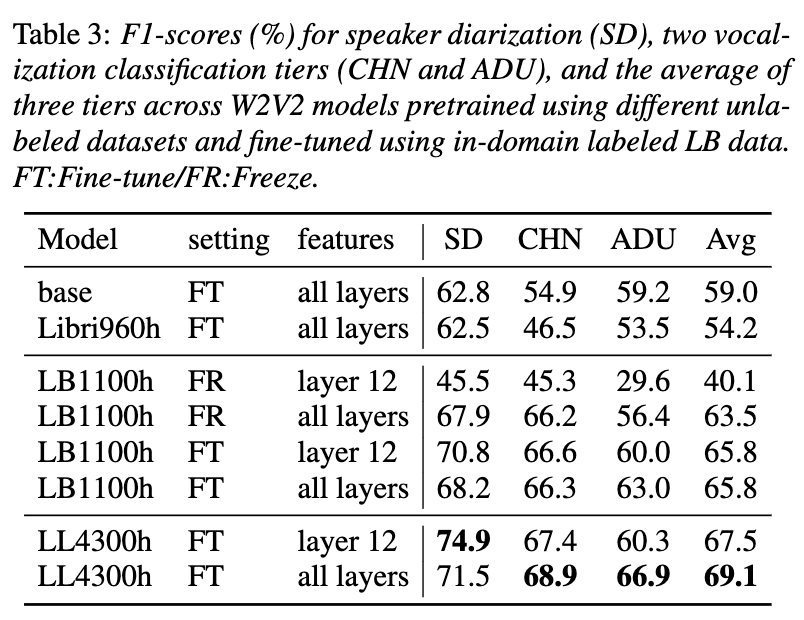
Additionally, we improve our model performances by adding relevant labeled home recordings and using data augmentation techniques of SpecAug and noise/reverberation corruption. For more details of experiments and results, please refer to our paper.
If you found this model helpful to you, please cite us as
<pre><code> @inproceedings{li23e_interspeech, author={Jialu Li and Mark Hasegawa-Johnson and Nancy L. McElwain}, title={{Towards Robust Family-Infant Audio Analysis Based on Unsupervised Pretraining of Wav2vec 2.0 on Large-Scale Unlabeled Family Audio}}, year=2023, booktitle={Proc. INTERSPEECH 2023}, pages={1035--1039}, doi={10.21437/Interspeech.2023-460} } </code></pre>Jialu Li, Ph.D. (she, her, hers)
E-mail: [email protected]
Homepage: https://sites.google.com/view/jialuli/