
Downloads · 30 days
19
3% of all-time downloads
keras-io/vq-vae
vq-vae is a machine learning model from keras-io. Use it for the machine learning task on the model card, and read the license before you ship it in a product. It is set up for tf-keras.
Learning latent space representations of data remains to be an important task in machine learning. This model, the Vector-Quantized Variational Autoencoder (VQ-VAE) builds upon traditional VAEs in two ways. - The enco…
Downloads · 30 days
19
3% of all-time downloads
All-time downloads
683
Public
Repo size
5 MB
Likes
3
Public
Click a slice to open those files.
.v23.4 MB · 74%
From the Hugging Face model README
Learning latent space representations of data remains to be an important task in machine learning. This model, the Vector-Quantized Variational Autoencoder (VQ-VAE) builds upon traditional VAEs in two ways.
To learn discrete latent representations, ideas from vector quantisation (VQ) are used. Using the VQ method allows the model to avoid issues of "posterior collapse". By pairing these representations with an autoregressive prior, VQ-VAE models can generate high quality images, videos, speech as well as doing high quality speaker conversion and unsupervised learning of phonemes, providing further evidence of the utility of the learnt representations.
Full Credits for this example go to Sayak Paul
This model has been trained using code from this example, and a result of this paper.
Below we have a graphic from the paper above, showing the VQ-VAE model architecture and quantization process.
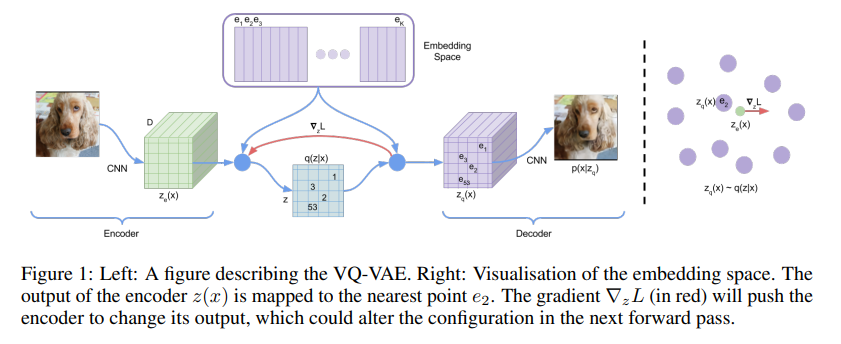
This model is intended to be used for educational purposes. To train your own VQ-VAE model, follow along with this example
This model is trained using the popular MNIST dataset. This dataset can be found/used with the following command
keras.datasets.mnist.load_data()
The model was trained usign the following
The author of the example encourages toying with both the number and size of the embeddings to see how it affects the results.
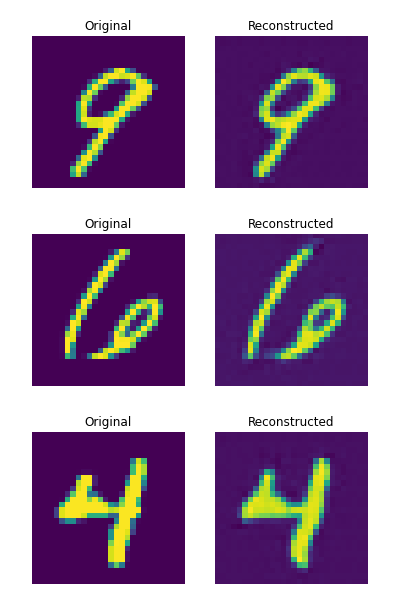
Below, we can see a few examples of MNIST digits being reconstructed after passing through our model.
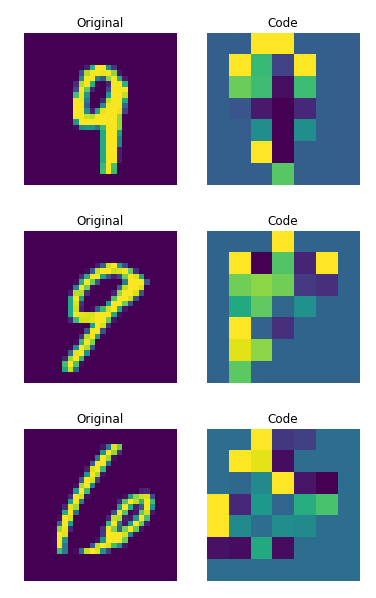
Below, we can see a few examples of MNIST digits being mapped to a discrete latent space.
The keras example details of this model shows it can be paired with a PixelCNN for novel image generation. Check out the example linked above to try it yourself.