
Downloads · 30 days
4
11% of all-time downloads
introvoyz041/NV-Segment-CT
NV-Segment-CT is a image segmentation model from introvoyz041. Use it for the image segmentation task on the model card, and read the license before you ship it in a product. It is set up for monai. The card lists the license as other.
Downloads · 30 days
4
11% of all-time downloads
All-time downloads
38
Public
Repo size
2.6 GB
Likes
0
Public
Click a slice to open those files.
.pt1.7 GB · 67%
From the Hugging Face model README
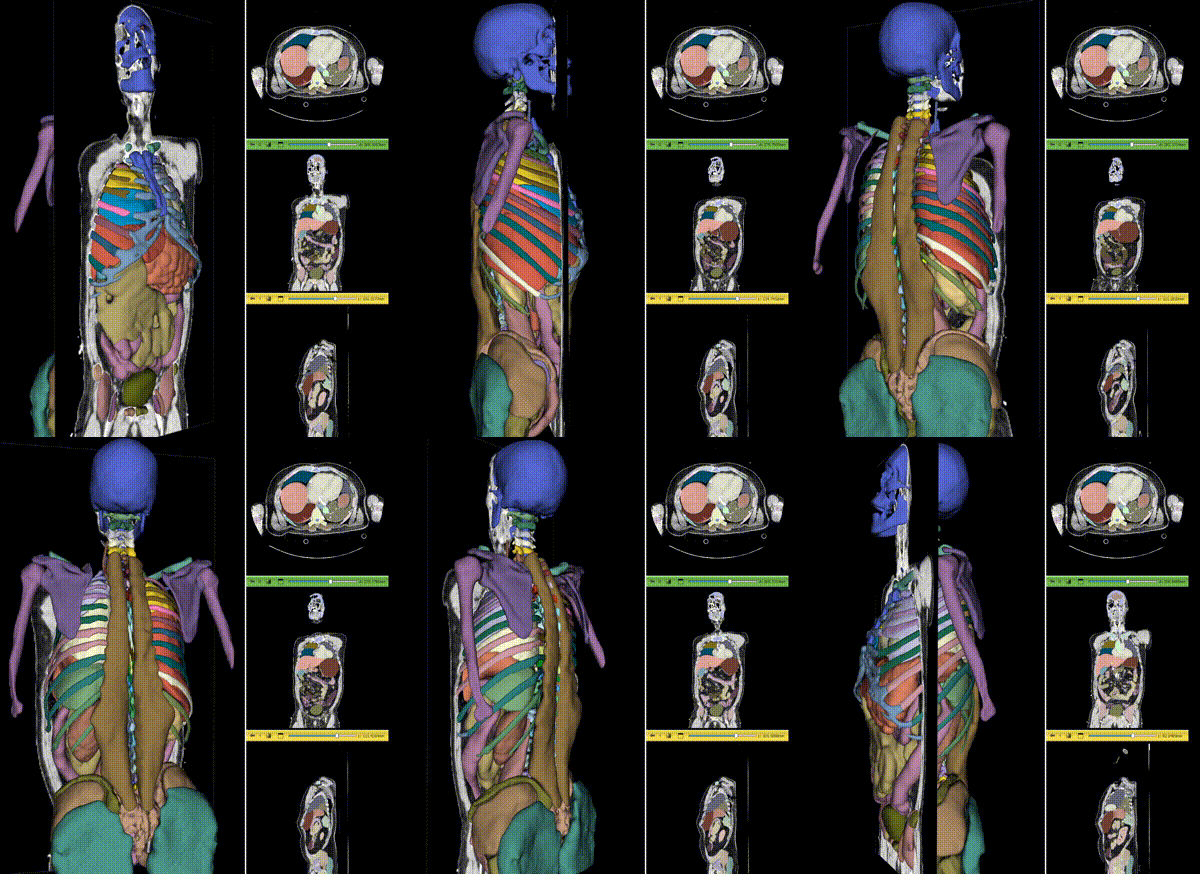
NV-Segment-CT is a specialized interactive foundation model for 3D medical imaging. It excels in providing accurate and adaptable segmentation analysis across anatomies and modalities. Utilizing a multi-head architecture, NV-Segment-CT adapts to varying conditions and anatomical areas, helping guide users' annotation workflow.
This model is for research purposes and not for clinical usage.
Training & Fine-tuning: Visit GitHub for training code, fine-tuning guides, continual learning examples, and comprehensive development documentation.
Core to NV-Segment-CT are three workflows:
https://github.com/NVIDIA-Medtech/NV-Segment-CTMR
For running the pipeline, NV-Segment-CT requires at least one prompt for segmentation. It supports label prompt, which is the index of the class for automatic segmentation. It also supports point-click prompts for binary interactive segmentation. Users can provide both prompts at the same time.
Here is a code snippet to showcase how to execute inference with this model.
import os
import tempfile

import torch
from hugging_face_pipeline import HuggingFacePipelineHelper


FILE_PATH = os.path.dirname(__file__)
with tempfile.TemporaryDirectory() as tmp_dir:
    output_dir = os.path.join(tmp_dir, "output_dir")
    pipeline_helper = HuggingFacePipelineHelper("vista3d")
    pipeline = pipeline_helper.init_pipeline(
        os.path.join(FILE_PATH, "vista3d_pretrained_model"),
        device=torch.device("cuda:0"),
    )
    inputs = [
        {
            "image": "/data/Task09_Spleen/imagesTs/spleen_1.nii.gz",
            "label_prompt": [3],
        },
        {
            "image": "/data/Task09_Spleen/imagesTs/spleen_11.nii.gz",
            "label_prompt": [3],
        },
    ]
    pipeline(inputs, output_dir=output_dir)
The inputs defines the image to segment and the prompt for segmentation.
inputs = {'image': '/data/Task09_Spleen/imagesTs/spleen_15.nii.gz', 'label_prompt':[1]}
inputs =  {'image': '/data/Task09_Spleen/imagesTs/spleen_15.nii.gz', 'points':[[138,245,18], [271,343,27]], 'point_labels':[1,0]}
image which contain the absolute path to the nii image file, and includes prompt keys of label_prompt, points and point_labels.label_prompt is a list of length B, which can perform B foreground objects segmentation, e.g. [2,3,4,5]. If B>1, Point prompts must NOT be provided.points is of shape [N, 3] like [[x1,y1,z1],[x2,y2,z2],...[xN,yN,zN]], representing N point coordinates IN THE ORIGINAL IMAGE SPACE of a single foreground object. point_labels is a list of length [N] like [1,1,0,-1,...], which
matches the points. 0 means background, 1 means foreground, -1 means ignoring this point. points and point_labels must pe provided together and match length.everything_labels to segment 117 classes:list(set([i+1 for i in range(132)]) - set([2,16,18,20,21,23,24,25,26,27,128,129,130,131,132]))
points together with label_prompts for "Kidney", "Lung", "Bone" (class index [2, 20, 21]) are not allowed since those prompts will be divided into sub-categories (e.g. left kidney and right kidney). Use points for the sub-categories as defined in the inference.json.label_prompt to a value between 133 and 254. Ensure that points and point_labels are also provided; otherwise, the inference result will be a tensor of zeros.Architecture Type: Transformer <br> Network Architecture: SAM-like<br>
Input Type(s): Computed Tomography (CT) Image<br> Input Format(s): (Neuroimaging Informatics Technology Initiative) NIfTI <br> Input Parameters: Three-Dimensional (3D) <br> Other Properties Related to Input: Array of Class/Point Information
Output Type(s): Image <br> Output Format: NIfTI <br> Output Parameters: 3D <br>
Runtime Engine(s): MONAI Core v.1.3 <br>
Supported Hardware Microarchitecture Compatibility: <br>
[Preferred/Supported] Operating System(s): <br>
Engine: Triton <br> Test Hardware: A100<br> H100<br> L40<br>
NVIDIA believes Trustworthy AI is a shared responsibility and we have established policies and practices to enable development for a wide array of AI applications. When downloaded or used in accordance with our terms of service, developers should work with their internal model team to ensure this model meets requirements for the relevant industry and use case and addresses unforeseen product misuse. Please report security vulnerabilities or NVIDIA AI Concerns here.
The current list of classes available:
"0": "background", "1": "liver", "2": "kidney", "3": "spleen", "4": "pancreas", "5": "right kidney", "6": "aorta", "7": "inferior vena cava", "8": "right adrenal gland", "9": "left adrenal gland", "10": "gallbladder", "11": "esophagus", "12": "stomach", "13": "duodenum", "14": "left kidney", "15": "bladder", "16": "prostate or uterus", "17": "portal vein and splenic vein", "18": "rectum", "19": "small bowel", "20": "lung", "21": "bone", "22": "brain", "23": "lung tumor", "24": "pancreatic tumor", "25": "hepatic vessel", "26": "hepatic tumor", "27": "colon cancer primaries", "28": "left lung upper lobe", "29": "left lung lower lobe", "30": "right lung upper lobe", "31": "right lung middle lobe", "32": "right lung lower lobe", "33": "vertebrae L5", "34": "vertebrae L4", "35": "vertebrae L3", "36": "vertebrae L2", "37": "vertebrae L1", "38": "vertebrae T12", "39": "vertebrae T11", "40": "vertebrae T10", "41": "vertebrae T9", "42": "vertebrae T8", "43": "vertebrae T7", "44": "vertebrae T6", "45": "vertebrae T5", "46": "vertebrae T4", "47": "vertebrae T3", "48": "vertebrae T2", "49": "vertebrae T1", "50": "vertebrae C7", "51": "vertebrae C6", "52": "vertebrae C5", "53": "vertebrae C4", "54": "vertebrae C3", "55": "vertebrae C2", "56": "vertebrae C1", "57": "trachea", "58": "left iliac artery", "59": "right iliac artery", "60": "left iliac vena", "61": "right iliac vena", "62": "colon", "63": "left rib 1", "64": "left rib 2", "65": "left rib 3", "66": "left rib 4", "67": "left rib 5", "68": "left rib 6", "69": "left rib 7", "70": "left rib 8", "71": "left rib 9", "72": "left rib 10", "73": "left rib 11", "74": "left rib 12", "75": "right rib 1", "76": "right rib 2", "77": "right rib 3", "78": "right rib 4", "79": "right rib 5", "80": "right rib 6", "81": "right rib 7", "82": "right rib 8", "83": "right rib 9", "84": "right rib 10", "85": "right rib 11", "86": "right rib 12", "87": "left humerus", "88": "right humerus", "89": "left scapula", "90": "right scapula", "91": "left clavicula", "92": "right clavicula", "93": "left femur", "94": "right femur", "95": "left hip", "96": "right hip", "97": "sacrum", "98": "left gluteus maximus", "99": "right gluteus maximus", "100": "left gluteus medius", "101": "right gluteus medius", "102": "left gluteus minimus", "103": "right gluteus minimus", "104": "left autochthon", "105": "right autochthon", "106": "left iliopsoas", "107": "right iliopsoas", "108": "left atrial appendage", "109": "brachiocephalic trunk", "110": "left brachiocephalic vein", "111": "right brachiocephalic vein", "112": "left common carotid artery", "113": "right common carotid artery", "114": "costal cartilages", "115": "heart", "116": "left kidney cyst", "117": "right kidney cyst", "118": "prostate", "119": "pulmonary vein", "120": "skull", "121": "spinal cord", "122": "sternum", "123": "left subclavian artery", "124": "right subclavian artery", "125": "superior vena cava", "126": "thyroid gland", "127": "vertebrae S1", "128": "bone lesion", "129": "kidney mass", "130": "liver tumor", "131": "vertebrae L6", "132": "airway"
This project includes code licensed under the Apache License 2.0. You may obtain a copy of the License at
http://www.apache.org/licenses/LICENSE-2.0
NVIDIA Open Model License Agreement
https://www.nvidia.com/en-us/agreements/enterprise-software/nvidia-open-model-license/
Antonelli, M., Reinke, A., Bakas, S. et al. The Medical Segmentation Decathlon. Nat Commun 13, 4128 (2022). https://doi.org/10.1038/s41467-022-30695-9
He, Yufan, et al. VISTA3D: A unified segmentation foundation model for 3D medical imaging. CVPR 2025. https://arxiv.org/abs/2406.05285