
Downloads · 30 days
0
hs-094/Seq2Seq
Seq2Seq is a summarization model from hs-094. Use it when you need a shorter version of a longer text. It is set up for keras. The card lists the license as cc-by-4.0.
This repository contains a Sequence-to-Sequence (Seq2Seq) model with attention, trained on the CNN/DailyMail dataset for text summarization tasks. The model is built using Keras and leverages pre-trained GloVe embeddi…
Downloads · 30 days
0
Access
Public
Updated Sep 24, 2024
Repo size
132 MB
Likes
1
Public
Click a slice to open those files.
.h5132 MB · 100%
From the Hugging Face model README
This repository contains a Sequence-to-Sequence (Seq2Seq) model with attention, trained on the CNN/DailyMail dataset for text summarization tasks. The model is built using Keras and leverages pre-trained GloVe embeddings for enhanced word representations. It consists of an encoder-decoder architecture using LSTM layers with attention to capture long-term dependencies.
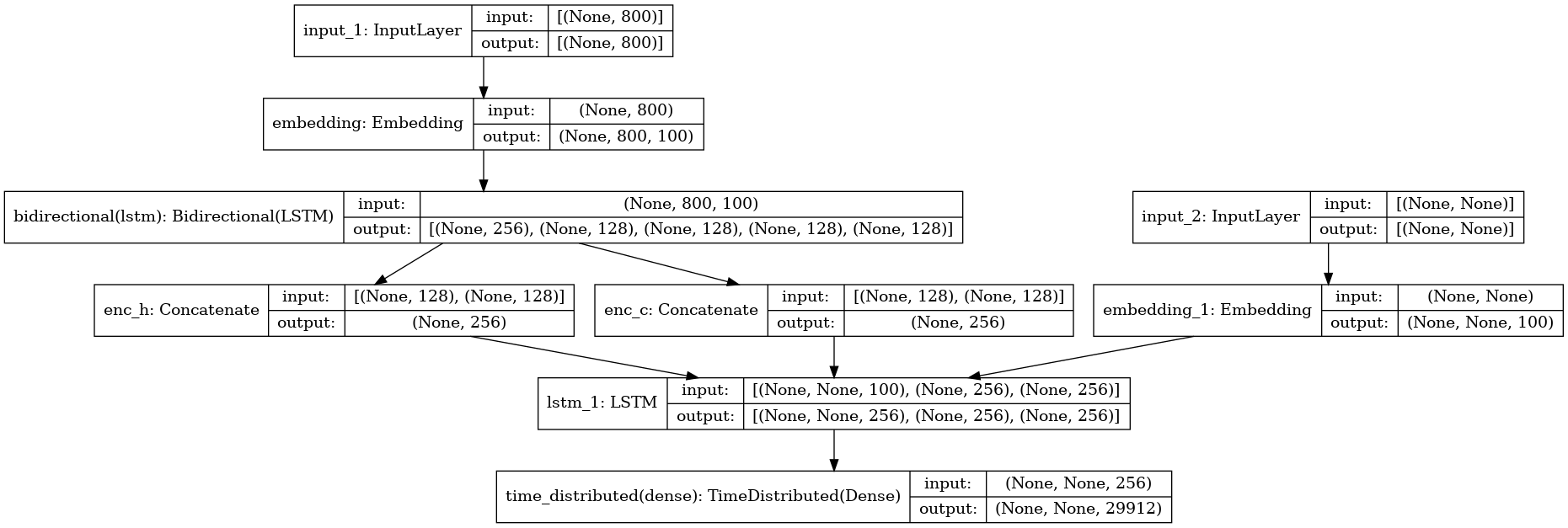
The model follows the classic encoder-decoder structure, with attention to handle long sequences:
We use GloVe embeddings (100-dimensional) pre-trained on a large corpus of text data. The embedding matrix is constructed for both the input (text) and output (summary) using the GloVe embeddings.
embedding_index = {}
embed_dim = 100
with open('../input/glove6b100dtxt/glove.6B.100d.txt') as f:
    for line in f:
        values = line.split()
        word = values[0]
        coefs = np.asarray(values[1:], dtype='float32')
        embedding_index[word] = coefs

# Embedding for input (articles)
t_embed = np.zeros((t_max_features, embed_dim))
for word, i in t_tokenizer.word_index.items():
    vec = embedding_index.get(word)
    if i < t_max_features and vec is not None:
        t_embed[i] = vec

# Embedding for output (summaries)
s_embed = np.zeros((s_max_features, embed_dim))
for word, i in s_tokenizer.word_index.items():
    vec = embedding_index.get(word)
    if i < s_max_features and vec is not None:
        s_embed[i] = vec
A bidirectional LSTM is used for encoding the input text. The forward and backward hidden and cell states are concatenated to pass as the initial states to the decoder.
latent_dim = 128
enc_input = Input(shape=(maxlen_text,))
enc_embed = Embedding(t_max_features, embed_dim, input_length=maxlen_text, weights=[t_embed], trainable=False)(enc_input)
enc_lstm = Bidirectional(LSTM(latent_dim, return_state=True))
enc_output, enc_fh, enc_fc, enc_bh, enc_bc = enc_lstm(enc_embed)

# Concatenate the forward and backward states
enc_h = Concatenate(axis=-1)([enc_fh, enc_bh])
enc_c = Concatenate(axis=-1)([enc_fc, enc_bc])
The decoder is an LSTM that takes the encoder's final states as the initial states to generate the output summary sequence.
dec_input = Input(shape=(None,))
dec_embed = Embedding(s_max_features, embed_dim, weights=[s_embed], trainable=False)(dec_input)
dec_lstm = LSTM(latent_dim * 2, return_sequences=True, return_state=True, dropout=0.3, recurrent_dropout=0.2)
dec_outputs, _, _ = dec_lstm(dec_embed, initial_state=[enc_h, enc_c])

# Dense layer with softmax activation for final output
dec_dense = TimeDistributed(Dense(s_max_features, activation='softmax'))
dec_output = dec_dense(dec_outputs)
The full Seq2Seq model with an attention mechanism is compiled using sparse categorical crossentropy loss and the RMSProp optimizer.
A diagram of the model is generated using Keras' plot_model function:
The model is trained with early stopping to prevent overfitting. The model is fit using batches of 128 and a maximum of 10 epochs, with validation data for performance monitoring.
early_stop = keras.callbacks.EarlyStopping(monitor='val_loss', mode='min', verbose=1, patience=2)
model.fit([train_x, train_y[:, :-1]],
          train_y.reshape(train_y.shape[0], train_y.shape[1], 1)[:, 1:],
          epochs=10,
          callbacks=[early_stop],
          batch_size=128,
          verbose=2,
          validation_data=([val_x, val_y[:, :-1]], val_y.reshape(val_y.shape[0], val_y.shape[1], 1)[:, 1:]))
The CNN/DailyMail dataset is used for training and validation. It contains news articles and their corresponding summaries, which makes it suitable for the text summarization task.
The model generates abstractive summaries of news articles. You can tweak the latent dimensions, embedding sizes, and add attention for improved performance.