
Downloads · 30 days
0
0% of all-time downloads
h2oai/h2ogpt-research-oig-oasst1-512-30b-lora
h2ogpt-research-oig-oasst1-512-30b-lora is a machine learning model from h2oai. Use it for the machine learning task on the model card, and read the license before you ship it in a product. It is set up for transformers. The card lists the license as other.
H2O.ai's h2oai/h2ogpt-research-oig-oasst1-512-30b is a 30 billion parameter instruction-following large language model for research use only.
Downloads · 30 days
0
0% of all-time downloads
All-time downloads
3
Public
Repo size
823 MB
Likes
8
Public
Click a slice to open those files.
.bin818 MB · 99%
From the Hugging Face model README
H2O.ai's h2oai/h2ogpt-research-oig-oasst1-512-30b is a 30 billion parameter instruction-following large language model for research use only.
We provide LORA weights based upon the base model listed below.
The model was trained using h2oGPT code as:
torchrun --nproc_per_node=8 finetune.py --base_model=decapoda-research/llama-30b-hf --micro_batch_size=1 --batch_size=8 --cutoff_len=512 --num_epochs=2.0 --val_set_size=0 --eval_steps=100000 --save_steps=17000 --save_total_limit=20 --prompt_type=plain --save_code=True --train_8bit=False --run_id=llama30b_17 --llama_flash_attn=True --lora_r=64 --lora_target_modules=['q_proj', 'k_proj', 'v_proj', 'o_proj'] --learning_rate=2e-4 --lora_alpha=32 --drop_truncations=True --data_path=h2oai/h2ogpt-oig-oasst1-instruct-cleaned-v2 --data_mix_in_path=h2oai/openassistant_oasst1_h2ogpt --data_mix_in_factor=1.0 --data_mix_in_prompt_type=plain --data_mix_in_col_dict={'input': 'input'}
On h2oGPT Hash: 131f6d098b43236b5f91e76fc074ad089d6df368
Only the last checkpoint at epoch 2.0 and step 137,846 is provided in this model repository because the LORA state is large enough and there are enough checkpoints to make total run 19GB. Feel free to request additional checkpoints and we can consider adding more.
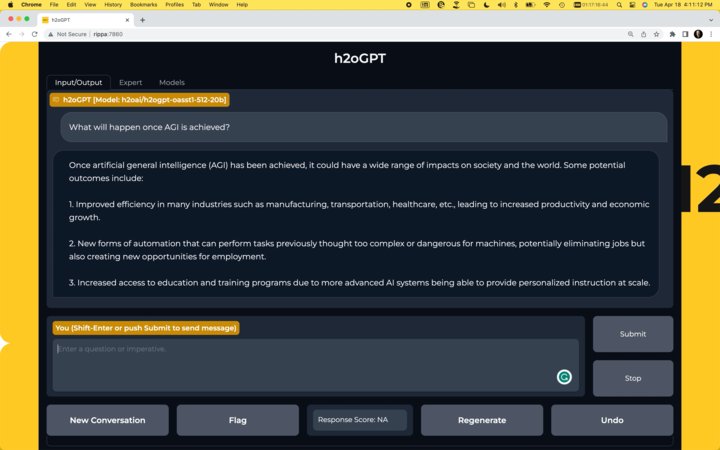
This 30B model consumes about 66GB of GPU memory, so can operate on a single 80GB GPU or 2 48GB GPUs in 16-bit inference mode, or 1 48GB GPU in 8-bit inference mode. But memory usage depends also on input length, etc.
Directly use the LORA as:
python generate.py --base_model=decapoda-research/llama-30b-hf --lora_weights=<lora_weights_path> --infer_devices=False
This will start the chatbot with the LLaMa + LORA pre-loaded. It can also be loaded directly from the gradio app after just doing:
python generate.py
by going to the models tab, adding the model name and LORA name to list, then loading that as the model/lora state.
Choose prompt_type of human_bot because that is the way it was instruct fine-tuned.
Here <lora_weights_path> is a directory of some name that contains the files in this HF model repository:
One can build an HF compatible model object from the base model and LORA.
Get: https://github.com/h2oai/h2ogpt/blob/main/export_hf_checkpoint.py and change:
BASE_MODEL = 'decapoda-research/llama-30b-hf'
LORA_WEIGHTS = '<lora_weights_path>'
OUTPUT_NAME = "local_h2ogpt-research-oasst1-512-30b"
where <lora_weights_path> is same path that includes the files mentioned in last section.
To build the HF model, now just run
python export_hf_checkpoint.py
Once the HF model is built, to use the model with the transformers library on a machine with GPUs, first make sure you have the transformers and accelerate libraries installed.
pip install transformers==4.28.1
pip install accelerate==0.18.0
import torch
from transformers import pipeline

generate_text = pipeline(model="local_h2ogpt-research-oasst1-512-30b", torch_dtype=torch.bfloat16, trust_remote_code=True, device_map="auto")

res = generate_text("Why is drinking water so healthy?", max_new_tokens=100)
print(res[0]["generated_text"])
Alternatively, if you prefer to not use trust_remote_code=True you can download instruct_pipeline.py and stopping.py,
store it alongside your notebook, and construct the pipeline yourself from the loaded model and tokenizer:
import torch
from h2oai_pipeline import H2OTextGenerationPipeline
from transformers import AutoModelForCausalLM, AutoTokenizer

tokenizer = AutoTokenizer.from_pretrained("local_h2ogpt-research-oasst1-512-30b", padding_side="left")
model = AutoModelForCausalLM.from_pretrained("local_h2ogpt-research-oasst1-512-30b", torch_dtype=torch.bfloat16, device_map="auto")
generate_text = H2OTextGenerationPipeline(model=model, tokenizer=tokenizer)

res = generate_text("Why is drinking water so healthy?", max_new_tokens=100)
print(res[0]["generated_text"])
PeftModelForCausalLM(
  (base_model): LoraModel(
    (model): LlamaForCausalLM(
      (model): LlamaModel(
        (embed_tokens): Embedding(32000, 6656, padding_idx=31999)
        (layers): ModuleList(
          (0-59): 60 x LlamaDecoderLayer(
            (self_attn): LlamaAttention(
              (q_proj): Linear(
                in_features=6656, out_features=6656, bias=False
                (lora_dropout): ModuleDict(
                  (default): Dropout(p=0.05, inplace=False)
                )
                (lora_A): ModuleDict(
                  (default): Linear(in_features=6656, out_features=64, bias=False)
                )
                (lora_B): ModuleDict(
                  (default): Linear(in_features=64, out_features=6656, bias=False)
                )
              )
              (k_proj): Linear(
                in_features=6656, out_features=6656, bias=False
                (lora_dropout): ModuleDict(
                  (default): Dropout(p=0.05, inplace=False)
                )
                (lora_A): ModuleDict(
                  (default): Linear(in_features=6656, out_features=64, bias=False)
                )
                (lora_B): ModuleDict(
                  (default): Linear(in_features=64, out_features=6656, bias=False)
                )
              )
              (v_proj): Linear(
                in_features=6656, out_features=6656, bias=False
                (lora_dropout): ModuleDict(
                  (default): Dropout(p=0.05, inplace=False)
                )
                (lora_A): ModuleDict(
                  (default): Linear(in_features=6656, out_features=64, bias=False)
                )
                (lora_B): ModuleDict(
                  (default): Linear(in_features=64, out_features=6656, bias=False)
                )
              )
              (o_proj): Linear(
                in_features=6656, out_features=6656, bias=False
                (lora_dropout): ModuleDict(
                  (default): Dropout(p=0.05, inplace=False)
                )
                (lora_A): ModuleDict(
                  (default): Linear(in_features=6656, out_features=64, bias=False)
                )
                (lora_B): ModuleDict(
                  (default): Linear(in_features=64, out_features=6656, bias=False)
                )
              )
              (rotary_emb): LlamaRotaryEmbedding()
            )
            (mlp): LlamaMLP(
              (gate_proj): Linear(in_features=6656, out_features=17920, bias=False)
              (down_proj): Linear(in_features=17920, out_features=6656, bias=False)
              (up_proj): Linear(in_features=6656, out_features=17920, bias=False)
              (act_fn): SiLUActivation()
            )
            (input_layernorm): LlamaRMSNorm()
            (post_attention_layernorm): LlamaRMSNorm()
          )
        )
        (norm): LlamaRMSNorm()
      )
      (lm_head): Linear(in_features=6656, out_features=32000, bias=False)
    )
  )
)
trainable params: 204472320 || all params: 32733415936 || trainable%: 0.6246592790675496
{
  "base_model_name_or_path": "decapoda-research/llama-30b-hf",
  "bias": "none",
  "fan_in_fan_out": false,
  "inference_mode": true,
  "init_lora_weights": true,
  "lora_alpha": 32,
  "lora_dropout": 0.05,
  "modules_to_save": null,
  "peft_type": "LORA",
  "r": 64,
  "target_modules": [
    "q_proj",
    "k_proj",
    "v_proj",
    "o_proj"
  ],
  "task_type": "CAUSAL_LM"
Classical benchmarks align with base LLaMa 30B model, but are not useful for conversational purposes. One could use GPT3.5 or GPT4 to evaluate responses, while here we use a RLHF based reward model developed by OpenAssistant to judge human preferences. This is run using h2oGPT:
python generate.py --base_model=decapoda-research/llama-30b-hf --gradio=False --infer_devices=False --eval_sharegpt_prompts_only=100 --eval_sharegpt_as_output=False --lora_weights=llama-30b-hf.h2oaih2ogpt-oig-oasst1-instruct-cleaned-v2.2.0_epochs.131f6d098b43236b5f91e76fc074ad089d6df368.llama30b_17
i.e. with 1 beam. To reproduce, just replace the lora_weights path with your own path as described in previous sections. Or for native HF models, just pass only base_model as HF model.
| Model | RLHF Mean Score | RLHF Median Score |
|---|---|---|
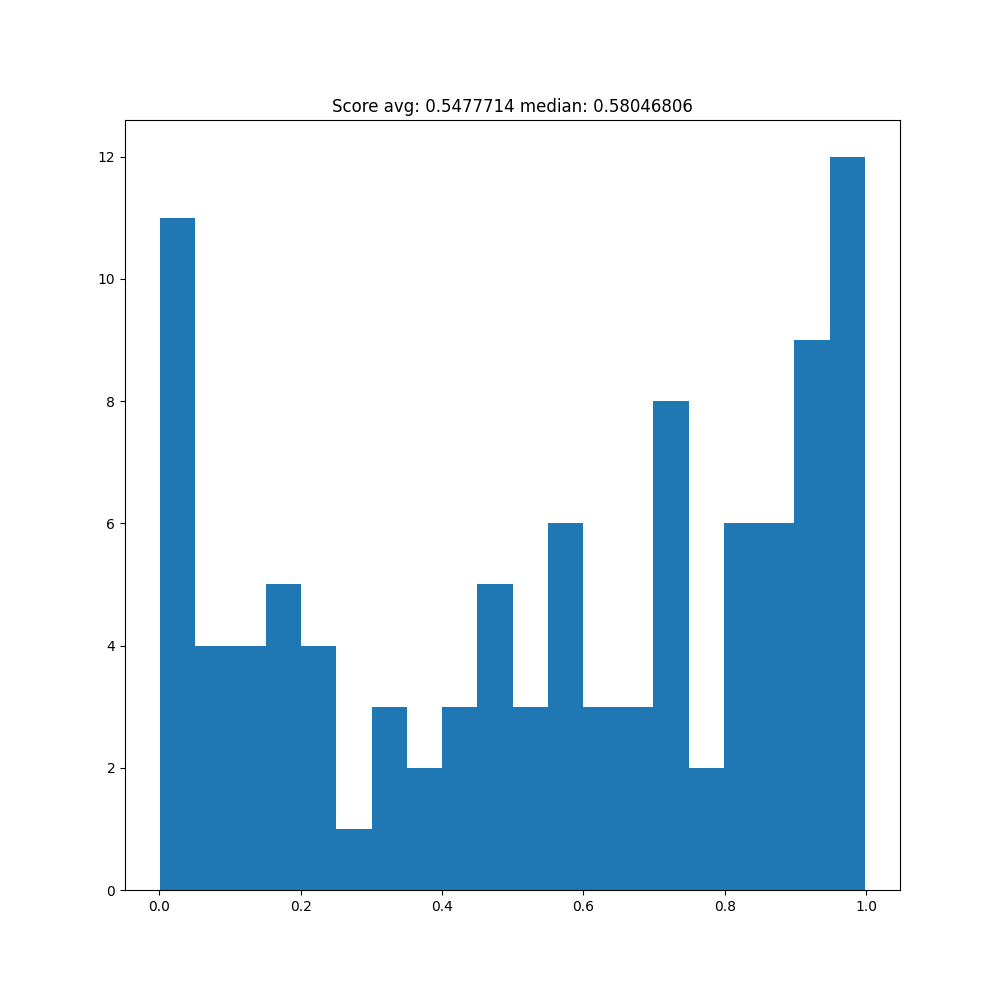
| h2oai/h2ogpt-research-oig-oasst1-512-30b | 0.55 | 0.58 |
| OpenAssistant/oasst-sft-7-llama-30b-xor | 0.51 | 0.48 |
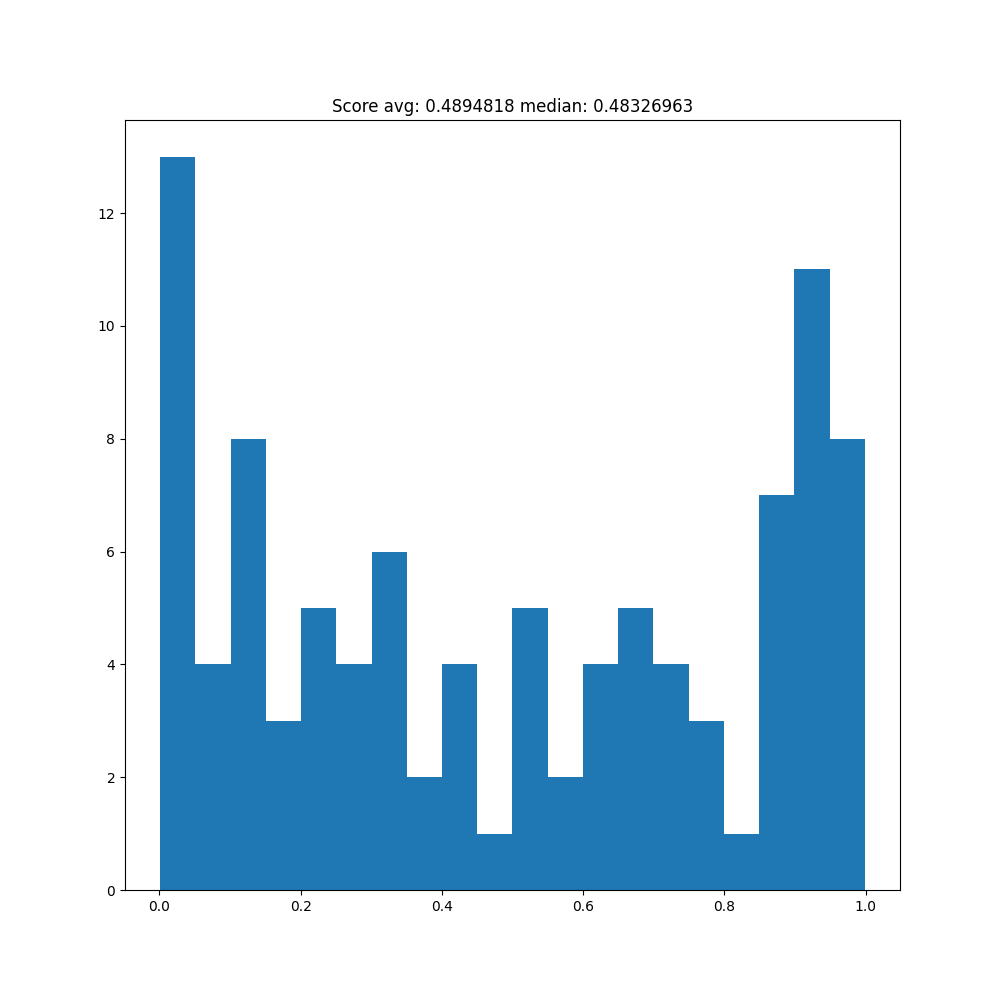
| h2oai/h2ogpt-oasst1-512-20b | 0.49 | 0.48 |
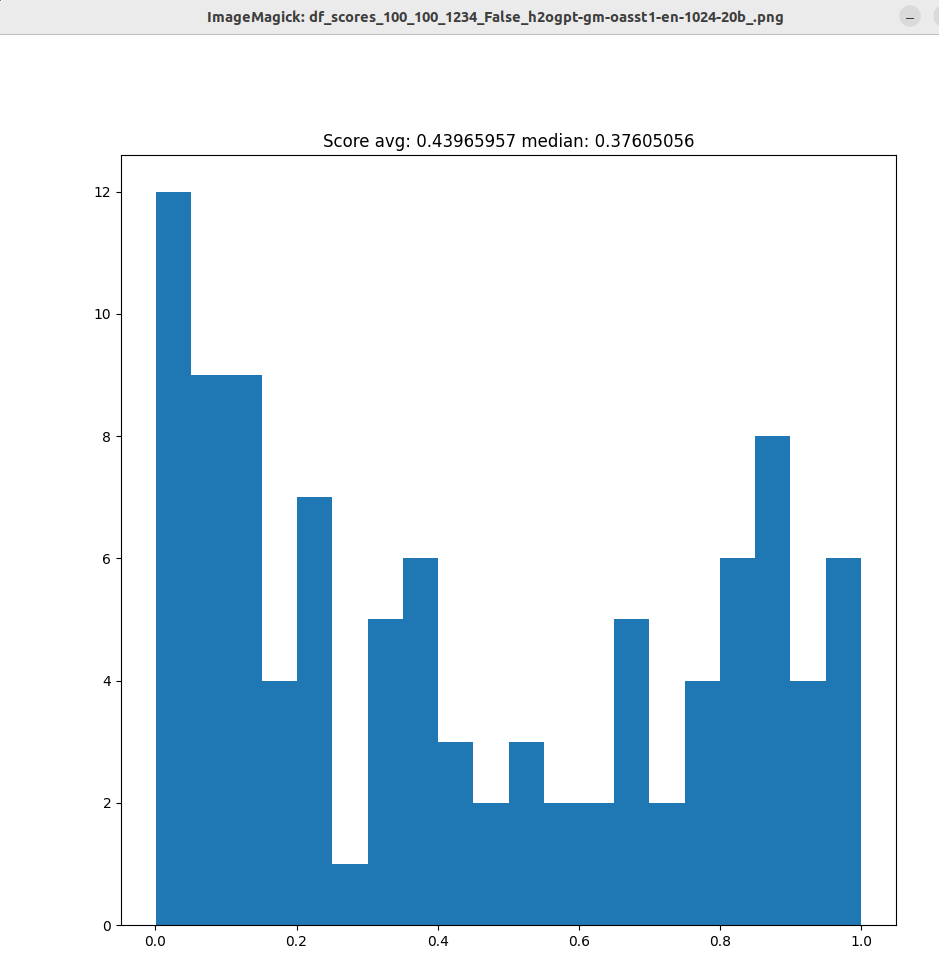
| h2oai/h2ogpt-gm-oasst1-en-1024-20b | 0.43 | 0.38 |
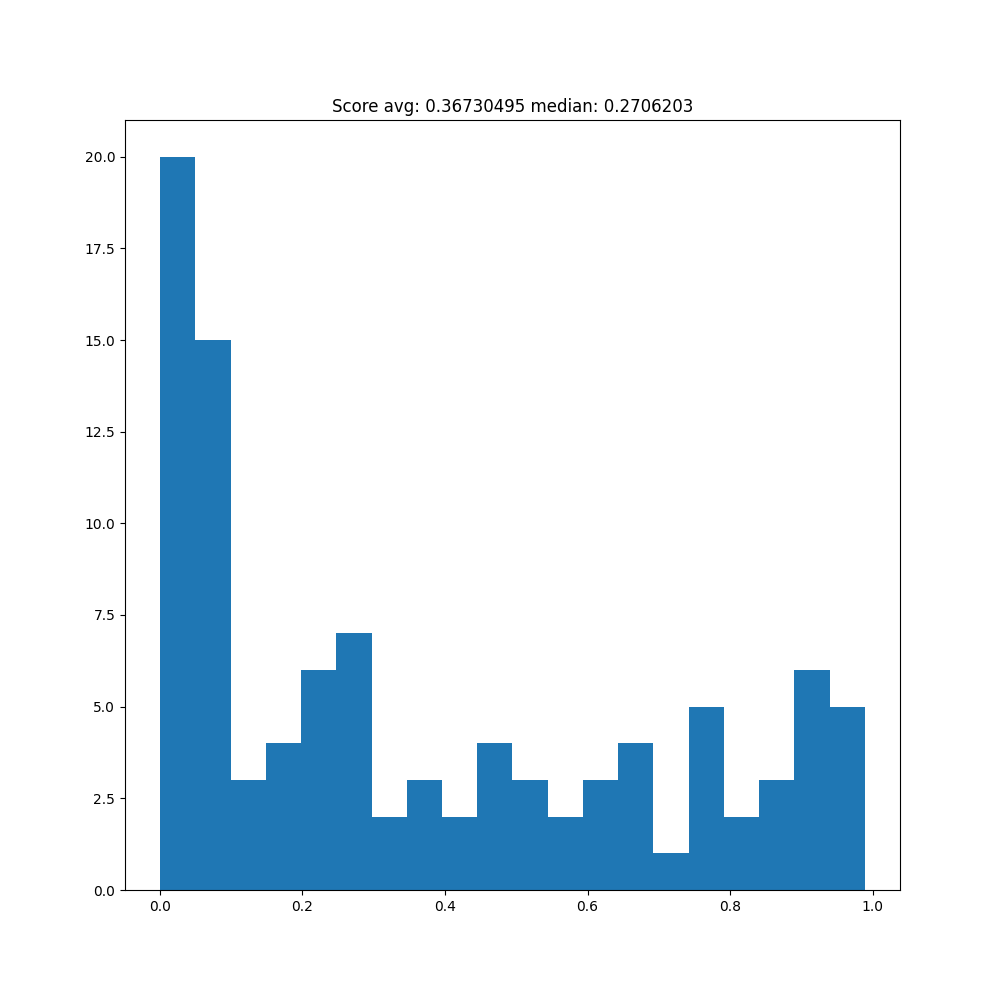
| databricks/dolly-v2-12b | 0.37 | 0.27 |
Logs h2oai/h2ogpt-research-oig-oasst1-512-30b and prompt-response pairs
The full distribution of scores for h2ogpt-research-oig-oasst1-512-30b:
Same plot for h2oai/h2ogpt-oasst1-512-20b:
Logs h2oai/h2ogpt-oasst1-512-20b
Ran with 2 beams (1 beam leads to same mean but median of 0.44):
python generate.py --base_model=h2oai/h2ogpt-oasst1-512-20b --gradio=False --infer_devices=False --eval_sharegpt_prompts_only=100 --eval_sharegpt_as_output=False --num_beams=2 &> score_h2ogpt-oasst1-512-20b_a.log
Same plot for h2oai/h2ogpt-gm-oasst1-en-1024-20b:
Logs h2oai/h2ogpt-gm-oasst1-en-1024-20b
Ran with 2 beams:
python generate.py --base_model=h2oai/h2ogpt-gm-oasst1-en-1024-20b --gradio=False --infer_devices=False --eval_sharegpt_prompts_only=100 --eval_sharegpt_as_output=False --num_beams=2 &> score_h2ogpt-gm-oasst1-en-1024-20b_a.log
Same plot for databricks/dolly-v2-12b:
Please read this disclaimer carefully before using the large language model provided in this repository. Your use of the model signifies your agreement to the following terms and conditions.
By using the large language model provided in this repository, you agree to accept and comply with the terms and conditions outlined in this disclaimer. If you do not agree with any part of this disclaimer, you should refrain from using the model and any content generated by it.