
Downloads · 30 days
19
25% of all-time downloads
guillermoruiz/bilma_CL
bilma_CL is a machine learning model from guillermoruiz. Use it for the machine learning task on the model card, and read the license before you ship it in a product. It is set up for transformers. The card lists the license as mit.
Bilma is a BERT implementation in tensorflow and trained on the Masked Language Model task under the https://sadit.github.io/regional-spanish-models-talk-2022/ datasets. It is a model trained on regionalized Spanish s…
Downloads · 30 days
19
25% of all-time downloads
All-time downloads
75
Public
Repo size
314 MB
Likes
0
Public
Click a slice to open those files.
.h5157 MB · 99%
From the Hugging Face model README
Bilma is a BERT implementation in tensorflow and trained on the Masked Language Model task under the https://sadit.github.io/regional-spanish-models-talk-2022/ datasets. It is a model trained on regionalized Spanish short texts from the Twitter (now X) platform.
We have pretrained models for the countries of Argentina, Chile, Colombia, Spain, Mexico, United States, Uruguay, and Venezuela.
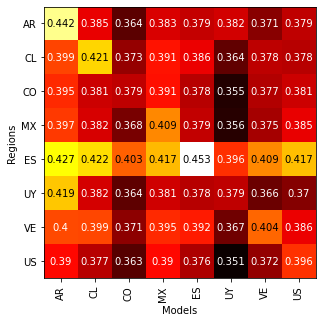
The accuracy of the models trained on the MLM task for different regions are:
You will need TensorFlow 2.4 or newer.
Install the following version for the transformers library
!pip install transformers==4.30.2
Instanciate the tokenizer and the trained model
from transformers import AutoTokenizer
from transformers import TFAutoModel

tok = AutoTokenizer.from_pretrained("guillermoruiz/bilma_mx")
model = TFAutoModel.from_pretrained("guillermoruiz/bilma_mx", trust_remote_code=True)
Now,we will need some text and then pass it through the tokenizer:
text = ["Vamos a comer [MASK].",
        "Hace mucho que no voy al [MASK]."]
t = tok(text, padding="max_length", return_tensors="tf", max_length=280)
With this, we are ready to use the model
p = model(t)
Now, we get the most likely words with:
import tensorflow as tf
tok.batch_decode(tf.argmax(p["logits"], 2)[:,1:], skip_special_tokens=True)
which produces the output:
['vamos a comer tacos.', 'hace mucho que no voy al gym.']
If you find this model useful for your research, please cite the following paper:
@misc{tellez2022regionalized,
      title={Regionalized models for Spanish language variations based on Twitter},
      author={Eric S. Tellez and Daniela Moctezuma and Sabino Miranda and Mario Graff and Guillermo Ruiz},
      year={2022},
      eprint={2110.06128},
      archivePrefix={arXiv},
      primaryClass={cs.CL}
}