
Downloads · 30 days
16
2% of all-time downloads
deetungsten/wizard-vicuna-13B-GPTQ-8bit-128g
wizard-vicuna-13B-GPTQ-8bit-128g is a text generation model from deetungsten. Use it when you need the model to write or continue text. It is set up for transformers.
This repository contains 8-bit quantized models in GPTQ format of TheBlokes's wizard-vicuna 13B in FP16 HF format.
Downloads · 30 days
16
2% of all-time downloads
All-time downloads
647
Public
Repo size
13.6 GB
Likes
2
Public
Click a slice to open those files.
.safetensors13.6 GB · 100%
From the Hugging Face model README
This repository contains 8-bit quantized models in GPTQ format of TheBlokes's wizard-vicuna 13B in FP16 HF format.
These models are the result of quantization to 8-bit using GPTQ-for-LLaMa.
While most metrics suggest that 8-bit is only marginally better than 4-bit, I have found that the 8-bit model follows instructions significantly better. The responses from the 8-bit model feel very close to the quality of GPT-3, whereas the 4-bit model lacks some "intelligence".
With this quantized model, I can replace GPT-3 for most of my work. However, a drawback is that it requires approximately 15GB of VRAM, so you need a GPU with at least 16GB of VRAM.
The content below is straight copy and paste from TheBloke's README with the 4 bit content changed to 8 bit and referencing this model.
Open the text-generation-webui UI as normal.
deetungsten/wizard-vicuna-13B-GPTQ-8bit-128g.wizard-vicuna-13B-GPTQ-8bit-128g.GPTQ parameters on the right: Bits = 8, Groupsize = 128, model_type = LlamaCompatible file - wizard-vicuna-13B-GPTQ-8bit-128g.no-act-order.safetensors
In the main branch - the default one - you will find wizard-vicuna-13B-GPTQ-8bit-128g.no-act-order.safetensors
This will work with all versions of GPTQ-for-LLaMa. It has maximum compatibility
It was created without the --act-order parameter. It may have slightly lower inference quality compared to the other file, but is guaranteed to work on all versions of GPTQ-for-LLaMa and text-generation-webui.
wizard-vicuna-13B-GPTQ-8bit-128g.no-act-order.safetensors
CUDA_VISIBLE_DEVICES=0 python3 llama.py wizard-vicuna-13B-HF c4 --wbits 8 --true-sequential --groupsize 128 --save_safetensors wizard-vicuna-13B-GPTQ-8bit.compat.no-act-order.safetensors
Github page: https://github.com/melodysdreamj/WizardVicunaLM
I am a big fan of the ideas behind WizardLM and VicunaLM. I particularly like the idea of WizardLM handling the dataset itself more deeply and broadly, as well as VicunaLM overcoming the limitations of single-turn conversations by introducing multi-round conversations. As a result, I combined these two ideas to create WizardVicunaLM. This project is highly experimental and designed for proof of concept, not for actual usage.
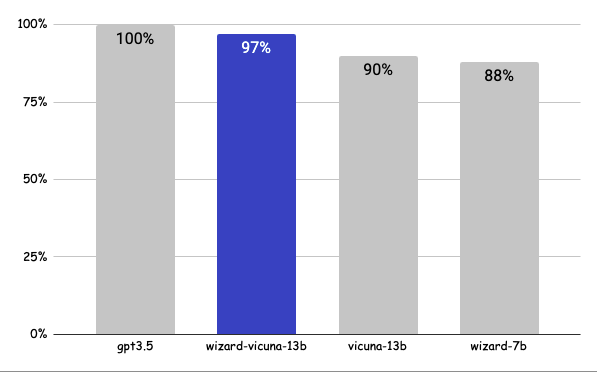
The questions presented here are not from rigorous tests, but rather, I asked a few questions and requested GPT-4 to score them. The models compared were ChatGPT 3.5, WizardVicunaLM, VicunaLM, and WizardLM, in that order.
| gpt3.5 | wizard-vicuna-13b | vicuna-13b | wizard-7b | link | |
|---|---|---|---|---|---|
| Q1 | 95 | 90 | 85 | 88 | link |
| Q2 | 95 | 97 | 90 | 89 | link |
| Q3 | 85 | 90 | 80 | 65 | link |
| Q4 | 90 | 85 | 80 | 75 | link |
| Q5 | 90 | 85 | 80 | 75 | link |
| Q6 | 92 | 85 | 87 | 88 | link |
| Q7 | 95 | 90 | 85 | 92 | link |
| Q8 | 90 | 85 | 75 | 70 | link |
| Q9 | 92 | 85 | 70 | 60 | link |
| Q10 | 90 | 80 | 75 | 85 | link |
| Q11 | 90 | 85 | 75 | 65 | link |
| Q12 | 85 | 90 | 80 | 88 | link |
| Q13 | 90 | 95 | 88 | 85 | link |
| Q14 | 94 | 89 | 90 | 91 | link |
| Q15 | 90 | 85 | 88 | 87 | link |
| 91 | 88 | 82 | 80 |
We adopted the approach of WizardLM, which is to extend a single problem more in-depth. However, instead of using individual instructions, we expanded it using Vicuna's conversation format and applied Vicuna's fine-tuning techniques.
Turning a single command into a rich conversation is what we've done here.
After creating the training data, I later trained it according to the Vicuna v1.1 training method.
First, we explore and expand various areas in the same topic using the 7K conversations created by WizardLM. However, we made it in a continuous conversation format instead of the instruction format. That is, it starts with WizardLM's instruction, and then expands into various areas in one conversation using ChatGPT 3.5.
After that, we applied the following model using Vicuna's fine-tuning format.
Trained with 8 A100 GPUs for 35 hours.
You can see the dataset we used for training and the 13b model in the huggingface.
If we extend the conversation to gpt4 32K, we can expect a dramatic improvement, as we can generate 8x more, more accurate and richer conversations.
The model is licensed under the LLaMA model, and the dataset is licensed under the terms of OpenAI because it uses ChatGPT. Everything else is free.
JUNE LEE - He is active in Songdo Artificial Intelligence Study and GDG Songdo.