
Downloads · 30 days
61
16% of all-time downloads
corentinm7/MyoQuant-SDH-Model
MyoQuant-SDH-Model is a machine learning model from corentinm7. Use it for the machine learning task on the model card, and read the license before you ship it in a product. It is set up for keras. The card lists the license as agpl-3.0.
Update 10-06-2025: The model have been re-trained and made compatible with Keras v3
Downloads · 30 days
61
16% of all-time downloads
All-time downloads
391
Public
Repo size
1.1 GB
Likes
2
Public
Click a slice to open those files.
.keras283 MB · 49%
From the Hugging Face model README
Update 10-06-2025: The model have been re-trained and made compatible with Keras v3
This is the model card for the SDH Model used by the MyoQuant tool.
It's intended to allow people to use, improve and verify the reproducibility of our MyoQuant tool. The SDH model is used to classify SDH stained muscle fiber with abnormal mitochondria profile.
It's trained on the corentinm7/MyoQuant-SDH-Data, avaliable on HuggingFace Dataset Hub.
This model was trained using the ResNet50V2 model architecture in Keras.
All images have been resized to 256x256.
Data augmentation was included as layers before ResNet50V2.
Full model code:
data_augmentation = keras.Sequential([
    keras.layers.RandomBrightness(factor=0.2, input_shape=(None, None, 3)),
    keras.layers.RandomContrast(factor=0.2),
    keras.layers.RandomFlip("horizontal_and_vertical"),
    keras.layers.RandomRotation(0.3, fill_mode="constant"),
    keras.layers.RandomZoom(.2, .2, fill_mode="constant"),
    keras.layers.RandomTranslation(0.2, .2, fill_mode="constant"),
    keras.layers.Resizing(256, 256, interpolation="bilinear", crop_to_aspect_ratio=True, input_shape=(None, None, 3)),
    keras.layers.Rescaling(scale=1. / 127.5, offset=-1),  # For [-1, 1] scaling
])

# My ResNet50V2
model = keras.models.Sequential()
model.add(data_augmentation)
model.add(
    ResNet50V2(
        include_top=False,
        input_shape=(256, 256, 3),
        pooling="avg",
    )
)
model.add(keras.layers.Dense(len(config.SUB_FOLDERS), activation='softmax'))

model.summary()
_________________________________________________________________
 Layer (type)                Output Shape              Param #
=================================================================
 sequential (Sequential)     (None, 256, 256, 3)       0

 resnet50v2 (Functional)     (None, 2048)              23564800

 flatten (Flatten)           (None, 2048)              0

 dense (Dense)               (None, 2)                 4098

=================================================================
Total params: 23,568,898 (89.91 MB)
Trainable params: 23,523,458 (89.73 MB)
Non-trainable params: 45,440 (177.50 KB)
_________________________________________________________________
We used a ResNet50V2 pre-trained on ImageNet as a starting point and trained the model using an EarlyStopping with a value of 20 (i.e. if validation loss doesn't improve after 20 epoch, stop the training and roll back to the epoch with lowest val loss.)
Class imbalance was handled by using the class_-weight attribute during training. It was calculated for each class as (1/n. elem of the class) * (n. of all training elem / 2) giving in our case: {0: 0.6593016912165849, 1: 2.069349315068493}
The following hyperparameters were used during training:
ReduceLROnPlateau(monitor='val_loss', factor=0.2, patience=5, min_lr=1e-7 with START_LR = 1e-5 and MIN_LR = 1e-7For more details please see the training notebook associated.
Full training results are avaliable on Weights and Biases
here: https://wandb.ai/lambda-science/myoquant-sdh
Plot of the accuracy vs epoch and loss vs epoch for training and validation set.
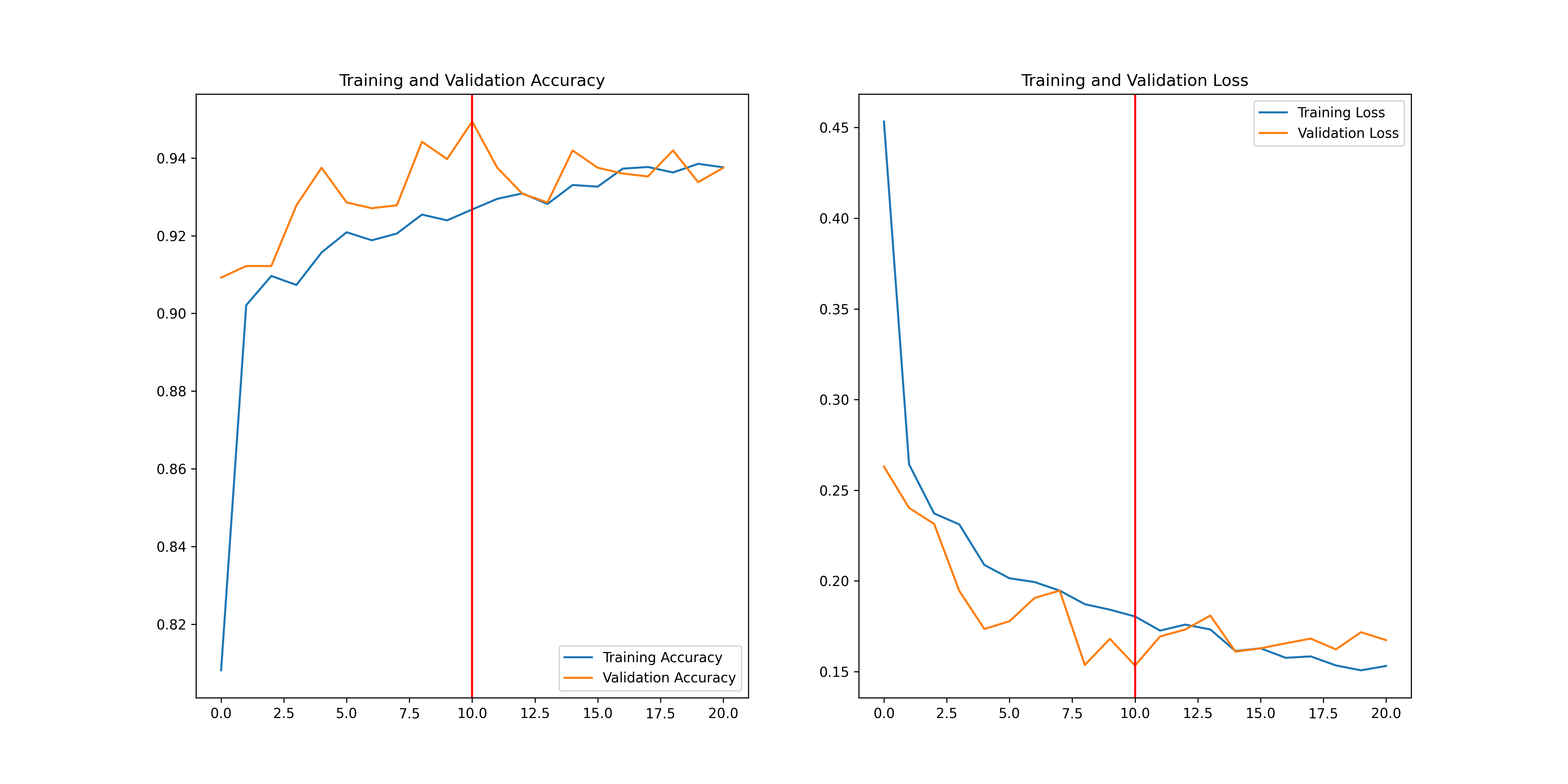
Results for accuracy and balanced accuracy metrics on the test split of the corentinm7/MyoQuant-SDH-Data dataset.
105/105 - 22s - 207ms/step - accuracy: 0.9276 - loss: 0.1678
Test data results:
0.9276354908943176
105/105 ━━━━━━━━━━━━━━━━━━━━ 20s 168ms/step
Test data results:
0.9128566397981572
With Keras 3 / Tensorflow 2.19 and over:
import keras
model = keras.saving.load_model("hf://corentinm7/MyoQuant-SDH-Model")
Resizing and rescaling layer are already implemented inside the model. You simply need to provide your input images as numpy float32 array (0-255) of any shape (None, None, 3) (3 channels - RGB).
The creator, uploader and main maintainer of this model, associated dataset and MyoQuant is:
Special thanks to the experts that created the data for the dataset and all the time they spend counting cells :
Last but not least thanks to Bertrand Vernay being at the origin of this project:
MyoQuant-SDH-Model is born within the collaboration between the CSTB Team @ ICube led by Julie D. Thompson, the Morphological Unit of the Institute of Myology of Paris led by Teresinha Evangelista, the imagery platform MyoImage of Center of Research in Myology led by Bruno Cadot, the photonic microscopy platform of the IGMBC led by Bertrand Vernay and the Pathophysiology of neuromuscular diseases team @ IGBMC led by Jocelyn Laporte