
Downloads · 30 days
86
9% of all-time downloads
claudios/VulBERTa-mlm
VulBERTa-mlm is a text classification model from claudios. Use it when you need a label for a piece of text. It is set up for transformers. The card lists the license as mit.
Downloads · 30 days
86
9% of all-time downloads
All-time downloads
959
Public
Parameters
125M
499 MB on disk
Likes
0
Public
Click a slice to open those files.
.safetensors499 MB · 100%
From the Hugging Face model README
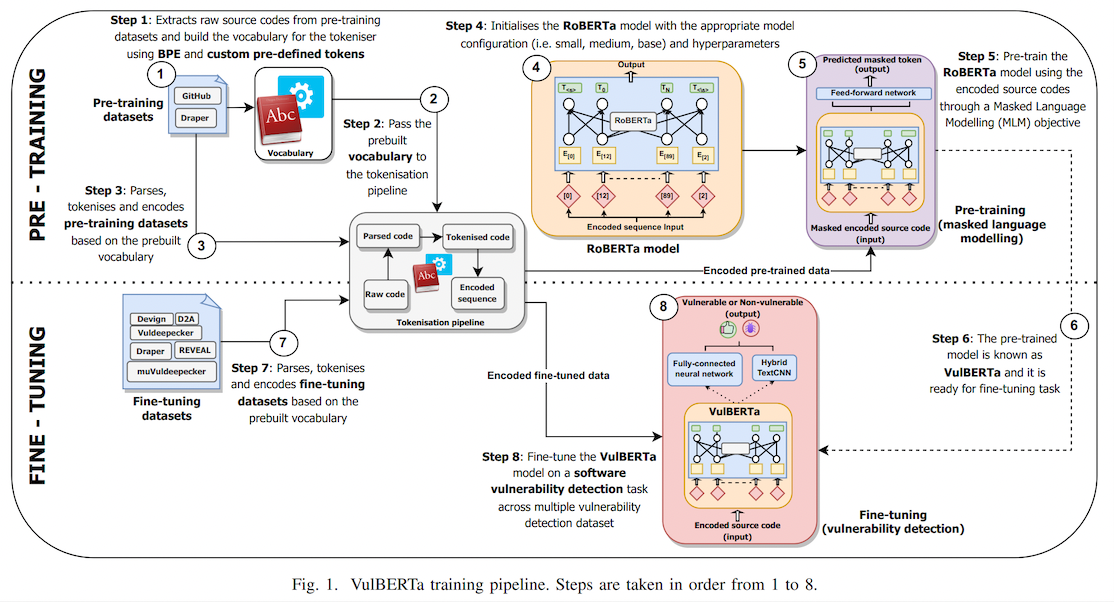
This model is the unofficial HuggingFace version of "VulBERTa" with an MLP classification head, trained on CodeXGlue Devign (C code), by Hazim Hanif & Sergio Maffeis (Imperial College London). I simplified the tokenization process by adding the cleaning (comment removal) step to the tokenizer and added the simplified tokenizer to this model repo as an AutoClass.
This paper presents presents VulBERTa, a deep learning approach to detect security vulnerabilities in source code. Our approach pre-trains a RoBERTa model with a custom tokenisation pipeline on real-world code from open-source C/C++ projects. The model learns a deep knowledge representation of the code syntax and semantics, which we leverage to train vulnerability detection classifiers. We evaluate our approach on binary and multi-class vulnerability detection tasks across several datasets (Vuldeepecker, Draper, REVEAL and muVuldeepecker) and benchmarks (CodeXGLUE and D2A). The evaluation results show that VulBERTa achieves state-of-the-art performance and outperforms existing approaches across different datasets, despite its conceptual simplicity, and limited cost in terms of size of training data and number of model parameters.
You must install libclang for tokenization.
pip install libclang
Note that due to the custom tokenizer, you must pass trust_remote_code=True when instantiating the model.
Example:
from transformers import pipeline
pipe = pipeline("text-classification", model="claudios/VulBERTa-MLP-Devign", trust_remote_code=True, return_all_scores=True)
pipe("static void filter_mirror_setup(NetFilterState *nf, Error **errp)\n{\n    MirrorState *s = FILTER_MIRROR(nf);\n    Chardev *chr;\n    chr = qemu_chr_find(s->outdev);\n    if (chr == NULL) {\n        error_set(errp, ERROR_CLASS_DEVICE_NOT_FOUND,\n                  \"Device '%s' not found\", s->outdev);\n    qemu_chr_fe_init(&s->chr_out, chr, errp);")
>> [[{'label': 'LABEL_0', 'score': 0.014685827307403088},
  {'label': 'LABEL_1', 'score': 0.985314130783081}]]
We provide all data required by VulBERTa.
This includes:
Please refer to the data directory for further instructions and details.
We provide all models pre-trained and fine-tuned by VulBERTa.
This includes:
Please refer to the models directory for further instructions and details.
In our project, we uses Jupyterlab notebook to run experiments.
Therefore, we separate each task into different notebook:
Accepted as conference paper (oral presentation) at the International Joint Conference on Neural Networks (IJCNN) 2022.
Link to paper: https://ieeexplore.ieee.org/document/9892280
@INPROCEEDINGS{hanif2022vulberta,
  author={Hanif, Hazim and Maffeis, Sergio},
  booktitle={2022 International Joint Conference on Neural Networks (IJCNN)},
  title={VulBERTa: Simplified Source Code Pre-Training for Vulnerability Detection},
  year={2022},
  volume={},
  number={},
  pages={1-8},
  doi={10.1109/IJCNN55064.2022.9892280}

}