
Downloads · 30 days
17
0% of all-time downloads
ccdv/lsg-base-4096
lsg-base-4096 is a fill-mask model from ccdv. Use it when you need the model to fill a missing word. It is set up for transformers.
Transformers = 4.36.1\ This model relies on a custom modeling file, you need to add trustremotecode=True\ See \13467
Downloads · 30 days
17
0% of all-time downloads
All-time downloads
4.4K
Public
Repo size
2.6 GB
Likes
2
Public
Click a slice to open those files.
.bin511 MB · 99%
From the Hugging Face model README
Transformers >= 4.36.1
This model relies on a custom modeling file, you need to add trust_remote_code=True
See #13467
LSG ArXiv paper.
Github/conversion script is available at this link.
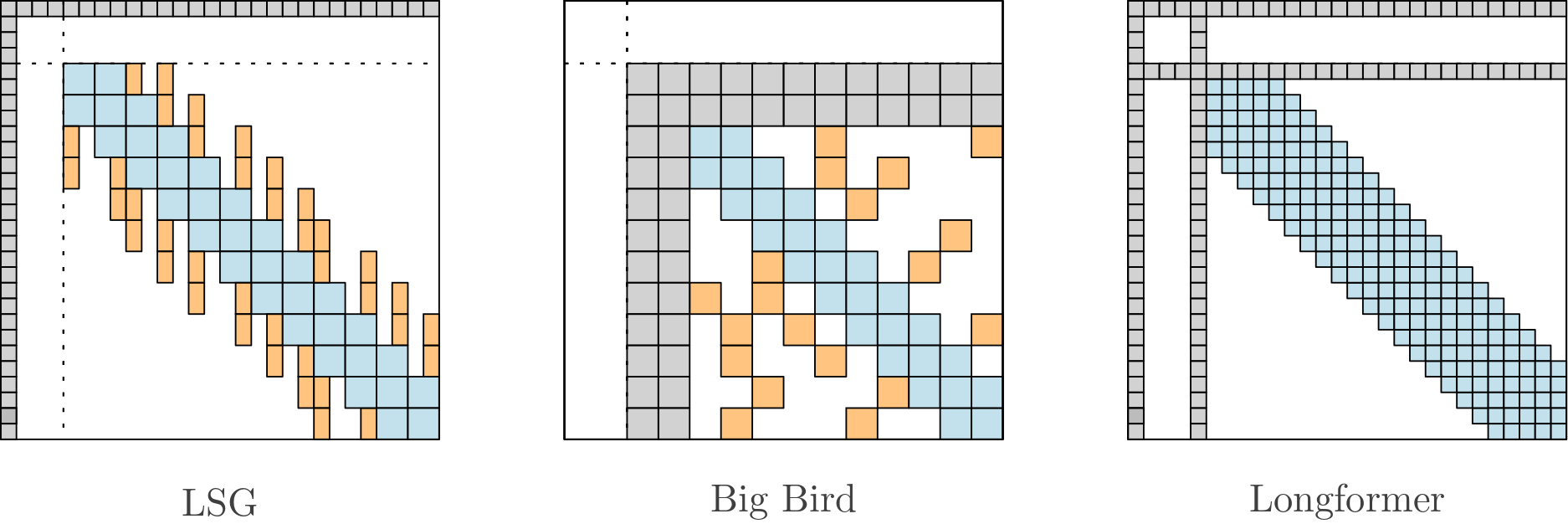
This model can handle long sequences but faster and more efficiently than Longformer or BigBird (from Transformers) and relies on Local + Sparse + Global attention (LSG).
The model requires sequences whose length is a multiple of the block size. The model is "adaptive" and automatically pads the sequences if needed (adaptive=True in config). It is however recommended, thanks to the tokenizer, to truncate the inputs (truncation=True) and optionally to pad with a multiple of the block size (pad_to_multiple_of=...). \
The model is trained starting from a RoBERTa-base checkpoint on 16Gb of data (Wikipedia, Bookcorpus etc...) using the same number of parameters/layers and the same tokenizer.
Support encoder-decoder and causal masking but I didnt test it extensively.
Implemented in PyTorch.
The model relies on a custom modeling file, you need to add trust_remote_code=True to use it.
from transformers import AutoModel, AutoTokenizer

model = AutoModel.from_pretrained("ccdv/lsg-base-4096", trust_remote_code=True)
tokenizer = AutoTokenizer.from_pretrained("ccdv/lsg-base-4096")
You can change various parameters like :
Default parameters work well in practice. If you are short on memory, reduce block sizes, increase sparsity factor and remove dropout in the attention score matrix.
from transformers import AutoModel

model = AutoModel.from_pretrained("ccdv/lsg-base-4096",
    trust_remote_code=True,
    num_global_tokens=16,
    block_size=64,
    sparse_block_size=64,
    attention_probs_dropout_prob=0.0
    sparsity_factor=4,
    sparsity_type="none",
    mask_first_token=True
)
There are 6 different sparse selection patterns. The best type is task dependent.
If sparse_block_size=0 or sparsity_type="none", only local attention is considered.
Note that for sequences with length < 2*block_size, the type has no effect.
sparsity_type="bos_pooling" (new)
sparsity_type="norm", select highest norm tokens
sparsity_type="pooling", use average pooling to merge tokens
sparsity_type="lsh", use the LSH algorithm to cluster similar tokens
sparsity_type="stride", use a striding mecanism per head
sparsity_type="block_stride", use a striding mecanism per head
Fill mask example:
from transformers import FillMaskPipeline, AutoModelForMaskedLM, AutoTokenizer

model = AutoModelForMaskedLM.from_pretrained("ccdv/lsg-base-4096", trust_remote_code=True)
tokenizer = AutoTokenizer.from_pretrained("ccdv/lsg-base-4096")

SENTENCES = ["Paris is the <mask> of France.", "The goal of life is <mask>."]
pipeline = FillMaskPipeline(model, tokenizer)
output = pipeline(SENTENCES, top_k=1)

output = [o[0]["sequence"] for o in output]
> ['Paris is the capital of France.', 'The goal of life is happiness.']
Classification example:
from transformers import AutoModelForSequenceClassification, AutoTokenizer

model = AutoModelForSequenceClassification.from_pretrained("ccdv/lsg-base-4096",
    trust_remote_code=True,
    pool_with_global=True, # pool with a global token instead of first token
)
tokenizer = AutoTokenizer.from_pretrained("ccdv/lsg-base-4096")

SENTENCE = "This is a test for sequence classification. " * 300
token_ids = tokenizer(
    SENTENCE,
    return_tensors="pt",
    #pad_to_multiple_of=... # Optional
    truncation=True
    )
output = model(**token_ids)

> SequenceClassifierOutput(loss=None, logits=tensor([[-0.3051, -0.1762]], grad_fn=<AddmmBackward>), hidden_states=None, attentions=None)
To train global tokens and the classification head only:
from transformers import AutoModelForSequenceClassification, AutoTokenizer

model = AutoModelForSequenceClassification.from_pretrained("ccdv/lsg-base-4096",
    trust_remote_code=True,
    pool_with_global=True, # pool with a global token instead of first token
    num_global_tokens=16
)
tokenizer = AutoTokenizer.from_pretrained("ccdv/lsg-base-4096")

for name, param in model.named_parameters():
    if "global_embeddings" not in name:
        param.requires_grad = False
    else:
        param.required_grad = True