
Downloads · 30 days
77
35% of all-time downloads
abratnap/bge-m3
bge-m3 is a sentence similarity model from abratnap. Use it when you need a score for how close two texts are. It is set up for sentence-transformers. The card lists the license as mit.
For more details please refer to our github repo: https://github.com/FlagOpen/FlagEmbedding
Downloads · 30 days
77
35% of all-time downloads
All-time downloads
219
Public
Repo size
4.6 GB
Likes
0
Public
Click a slice to open those files.
.bin2.3 GB · 99%
From the Hugging Face model README
For more details please refer to our github repo: https://github.com/FlagOpen/FlagEmbedding
In this project, we introduce BGE-M3, which is distinguished for its versatility in Multi-Functionality, Multi-Linguality, and Multi-Granularity.
Some suggestions for retrieval pipeline in RAG
We recommend to use the following pipeline: hybrid retrieval + re-ranking.
Hybrid retrieval leverages the strengths of various methods, offering higher accuracy and stronger generalization capabilities. A classic example: using both embedding retrieval and the BM25 algorithm. Now, you can try to use BGE-M3, which supports both embedding and sparse retrieval. This allows you to obtain token weights (similar to the BM25) without any additional cost when generate dense embeddings. To use hybrid retrieval, you can refer to Vespa and Milvus.
As cross-encoder models, re-ranker demonstrates higher accuracy than bi-encoder embedding model. Utilizing the re-ranking model (e.g., bge-reranker, bge-reranker-v2) after retrieval can further filter the selected text.
| Model Name | Dimension | Sequence Length | Introduction |
|---|---|---|---|
| BAAI/bge-m3 | 1024 | 8192 | multilingual; unified fine-tuning (dense, sparse, and colbert) from bge-m3-unsupervised |
| BAAI/bge-m3-unsupervised | 1024 | 8192 | multilingual; contrastive learning from bge-m3-retromae |
| BAAI/bge-m3-retromae | -- | 8192 | multilingual; extend the max_length of xlm-roberta to 8192 and further pretrained via retromae |
| BAAI/bge-large-en-v1.5 | 1024 | 512 | English model |
| BAAI/bge-base-en-v1.5 | 768 | 512 | English model |
| BAAI/bge-small-en-v1.5 | 384 | 512 | English model |
| Dataset | Introduction |
|---|---|
| MLDR | Docuemtn Retrieval Dataset, covering 13 languages |
| bge-m3-data | Fine-tuning data used by bge-m3 |
1. Introduction for different retrieval methods
2. How to use BGE-M3 in other projects?
For embedding retrieval, you can employ the BGE-M3 model using the same approach as BGE. The only difference is that the BGE-M3 model no longer requires adding instructions to the queries.
For hybrid retrieval, you can use Vespa and Milvus.
3. How to fine-tune bge-M3 model?
You can follow the common in this example to fine-tune the dense embedding.
If you want to fine-tune all embedding function of m3 (dense, sparse and colbert), you can refer to the unified_fine-tuning example
Install:
git clone https://github.com/FlagOpen/FlagEmbedding.git
cd FlagEmbedding
pip install -e .
or:
pip install -U FlagEmbedding
from FlagEmbedding import BGEM3FlagModel

model = BGEM3FlagModel('BAAI/bge-m3',
                       use_fp16=True) # Setting use_fp16 to True speeds up computation with a slight performance degradation

sentences_1 = ["What is BGE M3?", "Defination of BM25"]
sentences_2 = ["BGE M3 is an embedding model supporting dense retrieval, lexical matching and multi-vector interaction.",
               "BM25 is a bag-of-words retrieval function that ranks a set of documents based on the query terms appearing in each document"]

embeddings_1 = model.encode(sentences_1,
                            batch_size=12,
                            max_length=8192, # If you don't need such a long length, you can set a smaller value to speed up the encoding process.
                            )['dense_vecs']
embeddings_2 = model.encode(sentences_2)['dense_vecs']
similarity = embeddings_1 @ embeddings_2.T
print(similarity)
# [[0.6265, 0.3477], [0.3499, 0.678 ]]
You also can use sentence-transformers and huggingface transformers to generate dense embeddings. Refer to baai_general_embedding for details.
from FlagEmbedding import BGEM3FlagModel

model = BGEM3FlagModel('BAAI/bge-m3',  use_fp16=True) # Setting use_fp16 to True speeds up computation with a slight performance degradation

sentences_1 = ["What is BGE M3?", "Defination of BM25"]
sentences_2 = ["BGE M3 is an embedding model supporting dense retrieval, lexical matching and multi-vector interaction.",
               "BM25 is a bag-of-words retrieval function that ranks a set of documents based on the query terms appearing in each document"]

output_1 = model.encode(sentences_1, return_dense=True, return_sparse=True, return_colbert_vecs=False)
output_2 = model.encode(sentences_2, return_dense=True, return_sparse=True, return_colbert_vecs=False)

# you can see the weight for each token:
print(model.convert_id_to_token(output_1['lexical_weights']))
# [{'What': 0.08356, 'is': 0.0814, 'B': 0.1296, 'GE': 0.252, 'M': 0.1702, '3': 0.2695, '?': 0.04092},
#  {'De': 0.05005, 'fin': 0.1368, 'ation': 0.04498, 'of': 0.0633, 'BM': 0.2515, '25': 0.3335}]


# compute the scores via lexical mathcing
lexical_scores = model.compute_lexical_matching_score(output_1['lexical_weights'][0], output_2['lexical_weights'][0])
print(lexical_scores)
# 0.19554901123046875

print(model.compute_lexical_matching_score(output_1['lexical_weights'][0], output_1['lexical_weights'][1]))
# 0.0
from FlagEmbedding import BGEM3FlagModel

model = BGEM3FlagModel('BAAI/bge-m3',  use_fp16=True)

sentences_1 = ["What is BGE M3?", "Defination of BM25"]
sentences_2 = ["BGE M3 is an embedding model supporting dense retrieval, lexical matching and multi-vector interaction.",
               "BM25 is a bag-of-words retrieval function that ranks a set of documents based on the query terms appearing in each document"]

output_1 = model.encode(sentences_1, return_dense=True, return_sparse=True, return_colbert_vecs=True)
output_2 = model.encode(sentences_2, return_dense=True, return_sparse=True, return_colbert_vecs=True)

print(model.colbert_score(output_1['colbert_vecs'][0], output_2['colbert_vecs'][0]))
print(model.colbert_score(output_1['colbert_vecs'][0], output_2['colbert_vecs'][1]))
# 0.7797
# 0.4620
Input a list of text pairs, you can get the scores computed by different methods.
from FlagEmbedding import BGEM3FlagModel

model = BGEM3FlagModel('BAAI/bge-m3',  use_fp16=True)

sentences_1 = ["What is BGE M3?", "Defination of BM25"]
sentences_2 = ["BGE M3 is an embedding model supporting dense retrieval, lexical matching and multi-vector interaction.",
               "BM25 is a bag-of-words retrieval function that ranks a set of documents based on the query terms appearing in each document"]

sentence_pairs = [[i,j] for i in sentences_1 for j in sentences_2]

print(model.compute_score(sentence_pairs,
                          max_passage_length=128, # a smaller max length leads to a lower latency
                          weights_for_different_modes=[0.4, 0.2, 0.4])) # weights_for_different_modes(w) is used to do weighted sum: w[0]*dense_score + w[1]*sparse_score + w[2]*colbert_score

# {
#   'colbert': [0.7796499729156494, 0.4621465802192688, 0.4523794651031494, 0.7898575067520142],
#   'sparse': [0.195556640625, 0.00879669189453125, 0.0, 0.1802978515625],
#   'dense': [0.6259765625, 0.347412109375, 0.349853515625, 0.67822265625],
#   'sparse+dense': [0.482503205537796, 0.23454029858112335, 0.2332356721162796, 0.5122477412223816],
#   'colbert+sparse+dense': [0.6013619303703308, 0.3255828022956848, 0.32089319825172424, 0.6232916116714478]
# }
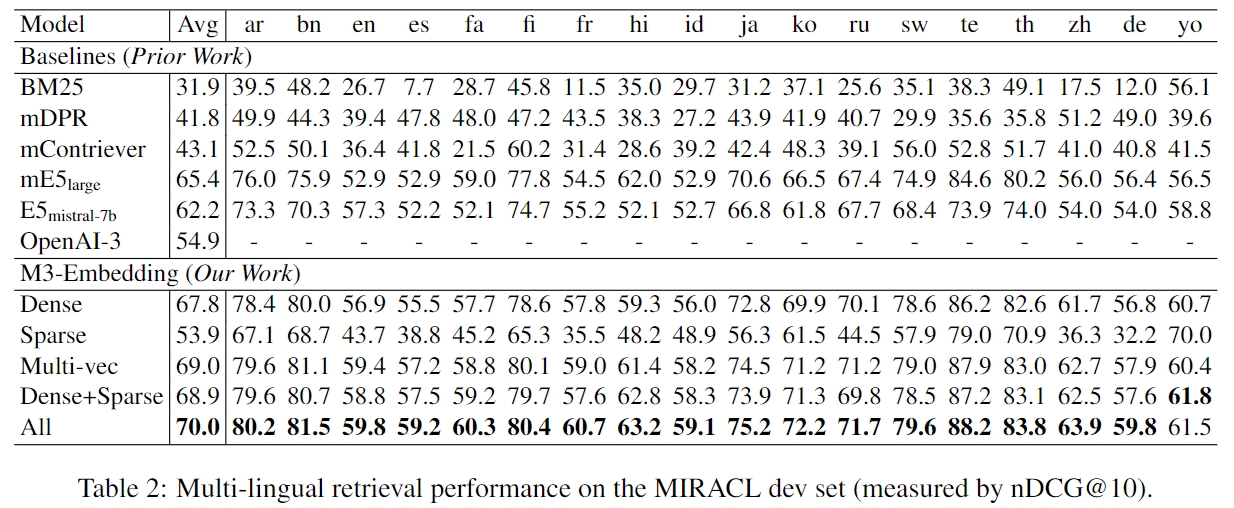
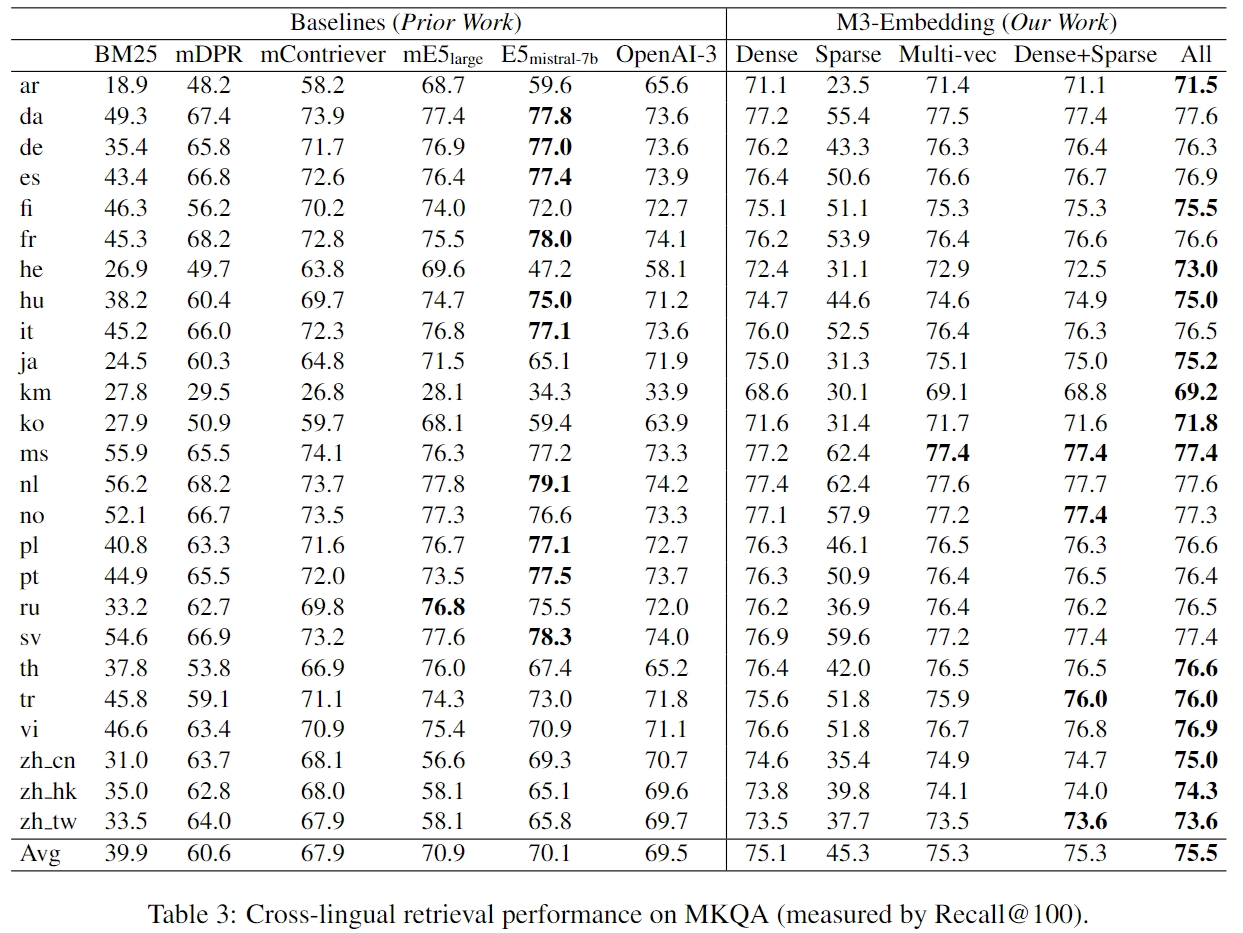
We provide the evaluation script for MKQA and MLDR
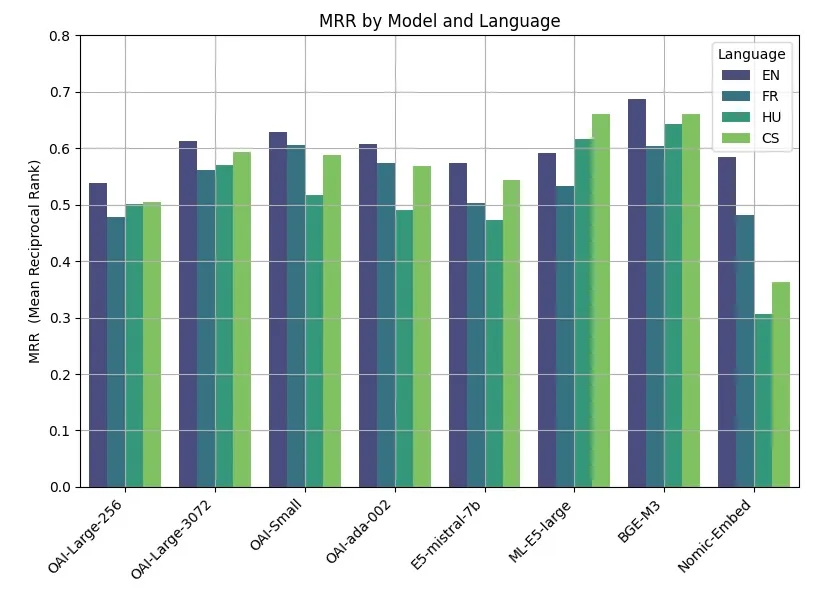 The BGE-M3 model emerged as the top performer on this benchmark (OAI is short for OpenAI).
For more details, please refer to the article and Github Repo
The BGE-M3 model emerged as the top performer on this benchmark (OAI is short for OpenAI).
For more details, please refer to the article and Github Repo
Long Document Retrieval
MLDR:
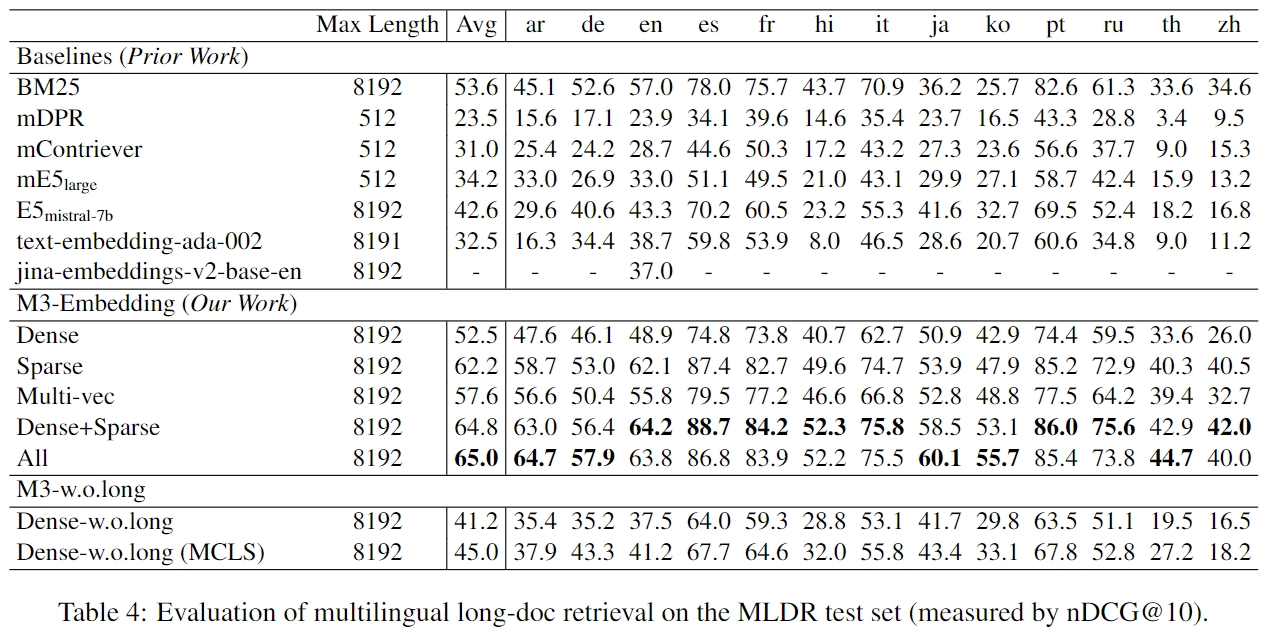 Please note that MLDR is a document retrieval dataset we constructed via LLM,
covering 13 languages, including test set, validation set, and training set.
We utilized the training set from MLDR to enhance the model's long document retrieval capabilities.
Therefore, comparing baselines with
Please note that MLDR is a document retrieval dataset we constructed via LLM,
covering 13 languages, including test set, validation set, and training set.
We utilized the training set from MLDR to enhance the model's long document retrieval capabilities.
Therefore, comparing baselines with Dense w.o.long(fine-tuning without long document dataset) is more equitable.
Additionally, this long document retrieval dataset will be open-sourced to address the current lack of open-source multilingual long text retrieval datasets.
We believe that this data will be helpful for the open-source community in training document retrieval models.
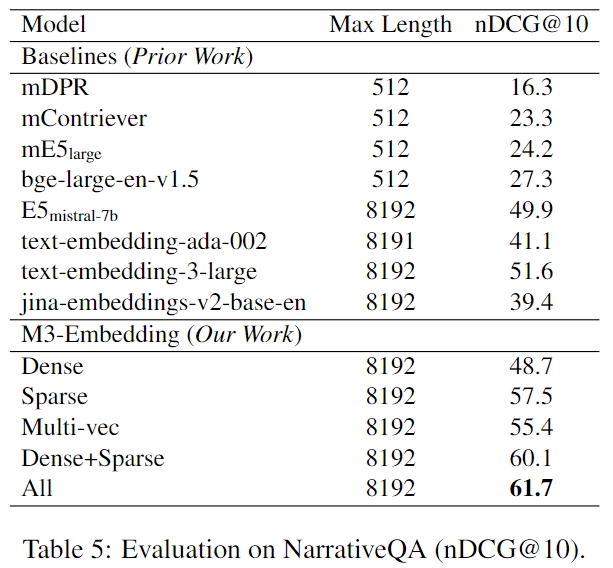
NarritiveQA:
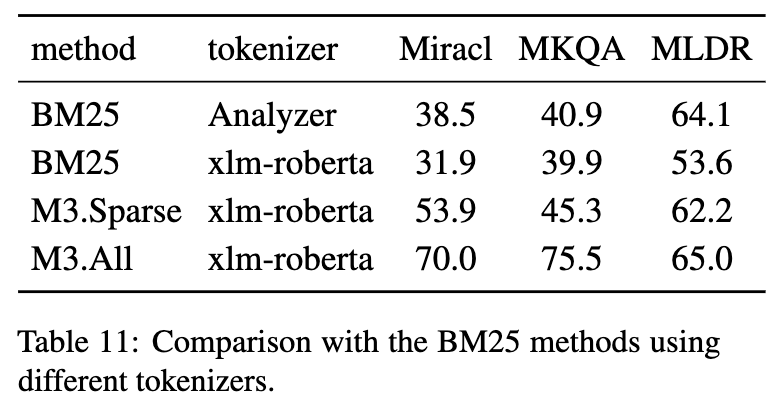
Comparison with BM25
We utilized Pyserini to implement BM25, and the test results can be reproduced by this script. We tested BM25 using two different tokenizers: one using Lucene Analyzer and the other using the same tokenizer as M3 (i.e., the tokenizer of xlm-roberta). The results indicate that BM25 remains a competitive baseline, especially in long document retrieval.
Refer to our report for more details.
Thanks to the authors of open-sourced datasets, including Miracl, MKQA, NarritiveQA, etc. Thanks to the open-sourced libraries like Tevatron, Pyserini.
If you find this repository useful, please consider giving a star :star: and citation
@misc{bge-m3,
      title={BGE M3-Embedding: Multi-Lingual, Multi-Functionality, Multi-Granularity Text Embeddings Through Self-Knowledge Distillation},
      author={Jianlv Chen and Shitao Xiao and Peitian Zhang and Kun Luo and Defu Lian and Zheng Liu},
      year={2024},
      eprint={2402.03216},
      archivePrefix={arXiv},
      primaryClass={cs.CL}
}