
Downloads · 30 days
0
Xorbits/chatglm2-6B-GGML
chatglm2-6B-GGML is a machine learning model from Xorbits. Use it for the machine learning task on the model card, and read the license before you ship it in a product. The card lists the license as apache-2.0.
These files are GGML format model files for THUDM's chatglm2 6B.
Downloads · 30 days
0
Access
Public
Updated Jul 11, 2023
Repo size
29.6 GB
Likes
23
Public
Click a slice to open those files.
.bin23 GB · 100%
From the Hugging Face model README
These files are GGML format model files for THUDM's chatglm2 6B.
GGML files are for CPU + GPU inference using chatglm.cpp and Xorbits Inference.
NOTE: prompt template is not available yet since the system prompt is hard coded in chatglm.cpp for now.
| Name | Quant method | Bits | Size |
|---|---|---|---|
| chatglm2-ggml-q4_0.bin | q4_0 | 4 | 3.5 GB |
| chatglm2-ggml-q4_1.bin | q4_1 | 4 | 3.9 GB |
| chatglm2-ggml-q5_0.bin | q5_0 | 5 | 4.3 GB |
| chatglm2-ggml-q5_1.bin | q5_1 | 5 | 4.7 GB |
| chatglm2-ggml-q8_0.bin | q8_0 | 8 | 6.6 GB |
Xinference can be installed via pip from PyPI. It is highly recommended to create a new virtual environment to avoid conflicts.
$ pip install "xinference[all]"
$ pip install chatglm-cpp
To start a local instance of Xinference, run the following command:
$ xinference
Once Xinference is running, an endpoint will be accessible for model management via CLI or Xinference client. The default endpoint is http://localhost:9997. You can also view a web UI using the Xinference endpoint to chat with all the builtin models. You can even chat with two cutting-edge AI models side-by-side to compare their performance!
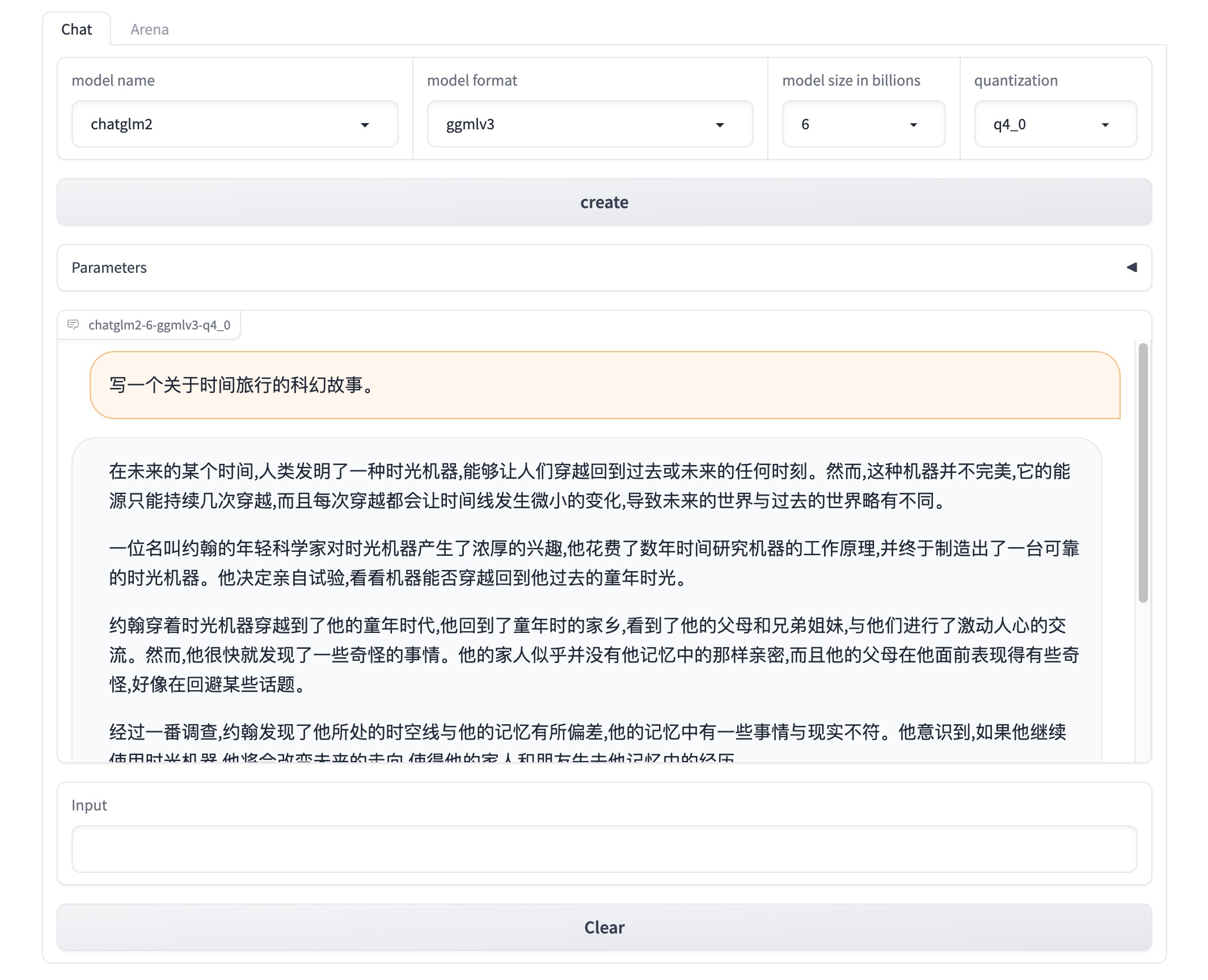
For further support, and discussions on these models and AI in general, join our slack channel!
ChatGLM2-6B is the second-generation version of the open-source bilingual (Chinese-English) chat model ChatGLM-6B. It retains the smooth conversation flow and low deployment threshold of the first-generation model, while introducing the following new features:
For more instructions, including how to run CLI and web demos, and model quantization, please refer to our Github Repo.