
Downloads · 30 days
0
Xorbits/chatglm-6B-GGML
chatglm-6B-GGML is a machine learning model from Xorbits. Use it for the machine learning task on the model card, and read the license before you ship it in a product. The card lists the license as apache-2.0.
These files are GGML format model files for THUDM's chatglm 6B.
Downloads · 30 days
0
Access
Public
Updated Jul 11, 2023
Repo size
22.8 GB
Likes
4
Public
Click a slice to open those files.
.bin22.8 GB · 100%
From the Hugging Face model README
These files are GGML format model files for THUDM's chatglm 6B.
GGML files are for CPU + GPU inference using chatglm.cpp and Xorbits Inference.
NOTE: prompt template is not available yet since the system prompt is hard coded in chatglm.cpp for now.
| Name | Quant method | Bits | Size |
|---|---|---|---|
| chatglm-ggml-q4_0.bin | q4_0 | 4 | 3.5 GB |
| chatglm-ggml-q4_1.bin | q4_1 | 4 | 3.9 GB |
| chatglm-ggml-q5_0.bin | q5_0 | 5 | 4.3 GB |
| chatglm-ggml-q5_1.bin | q5_1 | 5 | 4.6 GB |
| chatglm-ggml-q5_1.bin | q8_0 | 8 | 6.6 GB |
Xinference can be installed via pip from PyPI. It is highly recommended to create a new virtual environment to avoid conflicts.
$ pip install "xinference[all]"
$ pip install chatglm-cpp
To start a local instance of Xinference, run the following command:
$ xinference
Once Xinference is running, an endpoint will be accessible for model management via CLI or Xinference client. The default endpoint is http://localhost:9997. You can also view a web UI using the Xinference endpoint to chat with all the builtin models. You can even chat with two cutting-edge AI models side-by-side to compare their performance!
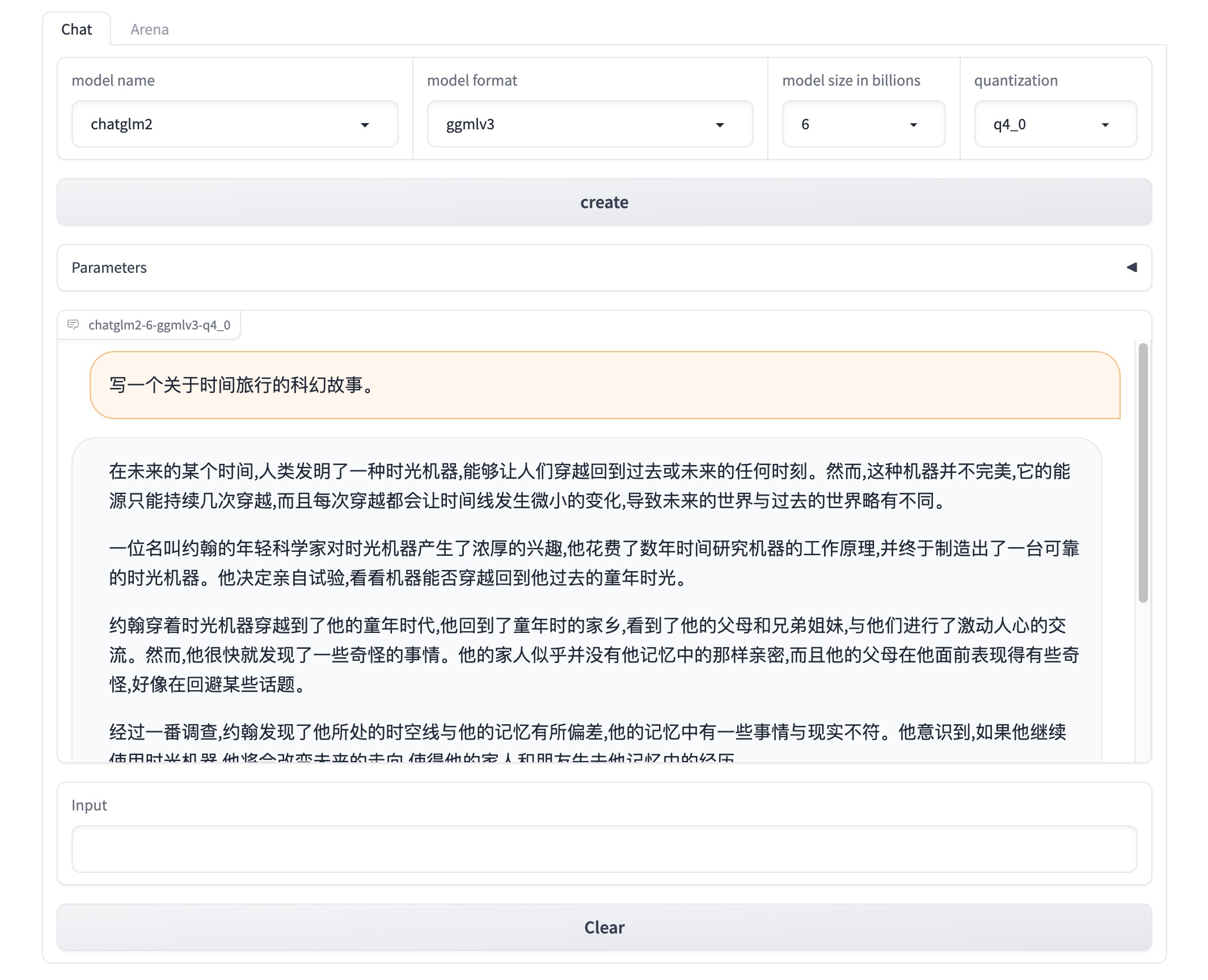
For further support, and discussions on these models and AI in general, join our slack channel!
ChatGLM-6B is an open bilingual language model based on General Language Model (GLM) framework, with 6.2 billion parameters. With the quantization technique, users can deploy locally on consumer-grade graphics cards (only 6GB of GPU memory is required at the INT4 quantization level). ChatGLM-6B uses technology similar to ChatGPT, optimized for Chinese QA and dialogue. The model is trained for about 1T tokens of Chinese and English corpus, supplemented by supervised fine-tuning, feedback bootstrap, and reinforcement learning with human feedback. With only about 6.2 billion parameters, the model is able to generate answers that are in line with human preference.
For more instructions, including how to run CLI and web demos, and model quantization, please refer to our Github Repo.