
Downloads · 30 days
21
5% of all-time downloads
TonyStark003/speaker-diarization-3.0
speaker-diarization-3.0 is a voice activity detection model from TonyStark003. Use it for the voice activity detection task on the model card, and read the license before you ship it in a product. It is set up for pyannote-audio. The card lists the license as mit.
Using this open-source model in production? Consider switching to pyannoteAI for better and faster options.
Downloads · 30 days
21
5% of all-time downloads
All-time downloads
445
Public
Repo size
5.9 MB
Likes
4
Public
Click a slice to open those files.
.bin5.9 MB · 99%
From the Hugging Face model README
Using this open-source model in production?
Consider switching to pyannoteAI for better and faster options.
This model ingests 10 seconds of mono audio sampled at 16kHz and outputs speaker diarization as a (num_frames, num_classes) matrix where the 7 classes are non-speech, speaker #1, speaker #2, speaker #3, speakers #1 and #2, speakers #1 and #3, and speakers #2 and #3.
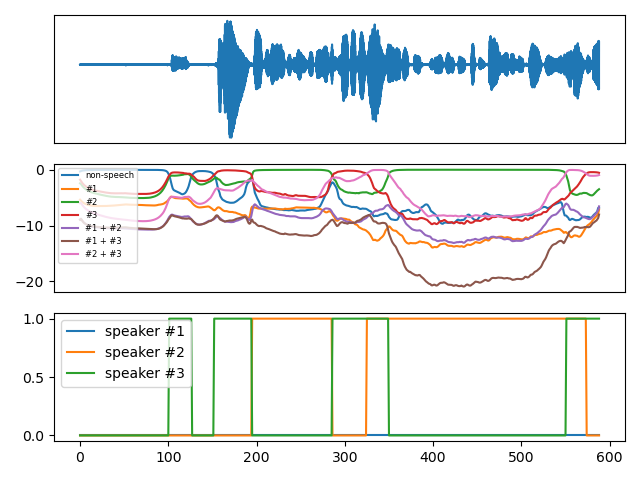
# waveform (first row)
duration, sample_rate, num_channels = 10, 16000, 1
waveform = torch.randn(batch_size, num_channels, duration * sample_rate)

# powerset multi-class encoding (second row)
powerset_encoding = model(waveform)

# multi-label encoding (third row)
from pyannote.audio.utils.powerset import Powerset
max_speakers_per_chunk, max_speakers_per_frame = 3, 2
to_multilabel = Powerset(
    max_speakers_per_chunk,
    max_speakers_per_frame).to_multilabel
multilabel_encoding = to_multilabel(powerset_encoding)
The various concepts behind this model are described in details in this paper.
It has been trained by Séverin Baroudi with pyannote.audio 3.0.0 using the combination of the training sets of AISHELL, AliMeeting, AMI, AVA-AVD, DIHARD, Ego4D, MSDWild, REPERE, and VoxConverse.
This companion repository by Alexis Plaquet also provides instructions on how to train or finetune such a model on your own data.
pyannote.audio 3.0 with pip install pyannote.audiopyannote/segmentation-3.0 user conditionshf.co/settings/tokens.# instantiate the model
from pyannote.audio import Model
model = Model.from_pretrained(
"pyannote/segmentation-3.0",
use_auth_token="HUGGINGFACE_ACCESS_TOKEN_GOES_HERE")
This model cannot be used to perform speaker diarization of full recordings on its own (it only processes 10s chunks).
See pyannote/speaker-diarization-3.0 pipeline that uses an additional speaker embedding model to perform full recording speaker diarization.
from pyannote.audio.pipelines import VoiceActivityDetection
pipeline = VoiceActivityDetection(segmentation=model)
HYPER_PARAMETERS = {
  # remove speech regions shorter than that many seconds.
  "min_duration_on": 0.0,
  # fill non-speech regions shorter than that many seconds.
  "min_duration_off": 0.0
}
pipeline.instantiate(HYPER_PARAMETERS)
vad = pipeline("audio.wav")
# `vad` is a pyannote.core.Annotation instance containing speech regions
from pyannote.audio.pipelines import OverlappedSpeechDetection
pipeline = OverlappedSpeechDetection(segmentation=model)
HYPER_PARAMETERS = {
  # remove overlapped speech regions shorter than that many seconds.
  "min_duration_on": 0.0,
  # fill non-overlapped speech regions shorter than that many seconds.
  "min_duration_off": 0.0
}
pipeline.instantiate(HYPER_PARAMETERS)
osd = pipeline("audio.wav")
# `osd` is a pyannote.core.Annotation instance containing overlapped speech regions
@inproceedings{Plaquet23,
  author={Alexis Plaquet and Hervé Bredin},
  title={{Powerset multi-class cross entropy loss for neural speaker diarization}},
  year=2023,
  booktitle={Proc. INTERSPEECH 2023},
}
@inproceedings{Bredin23,
  author={Hervé Bredin},
  title={{pyannote.audio 2.1 speaker diarization pipeline: principle, benchmark, and recipe}},
  year=2023,
  booktitle={Proc. INTERSPEECH 2023},
}