
Downloads · 30 days
85
6% of all-time downloads
TongjiZhanglab/NuSPIRe
NuSPIRe is a machine learning model from TongjiZhanglab. Use it for the machine learning task on the model card, and read the license before you ship it in a product. The card lists the license as mit.
NuSPIRe (Nuclear Morphology focused Self-supervised Pretrained model for Image Representations) is a deep learning framework designed to extract nuclear morphological features from DAPI-stained images for guiding fiel…
Downloads · 30 days
85
6% of all-time downloads
All-time downloads
1.4K
Public
Parameters
103M
411 MB on disk
Likes
4
Public
Click a slice to open those files.
.safetensors410 MB · 100%
From the Hugging Face model README
NuSPIRe (Nuclear Morphology focused Self-supervised Pretrained model for Image Representations) is a deep learning framework designed to extract nuclear morphological features from DAPI-stained images for guiding field-of-view (FOV) optimization in spatial omics. Trained using self-supervised learning on 15.52 million unlabeled nuclear images from diverse tissues, NuSPIRe leverages pre-existing imaging data to identify biologically informative regions. While primarily developed for FOV selection and layout refinement, it also offers potential for broader morphology-based spatial inference.
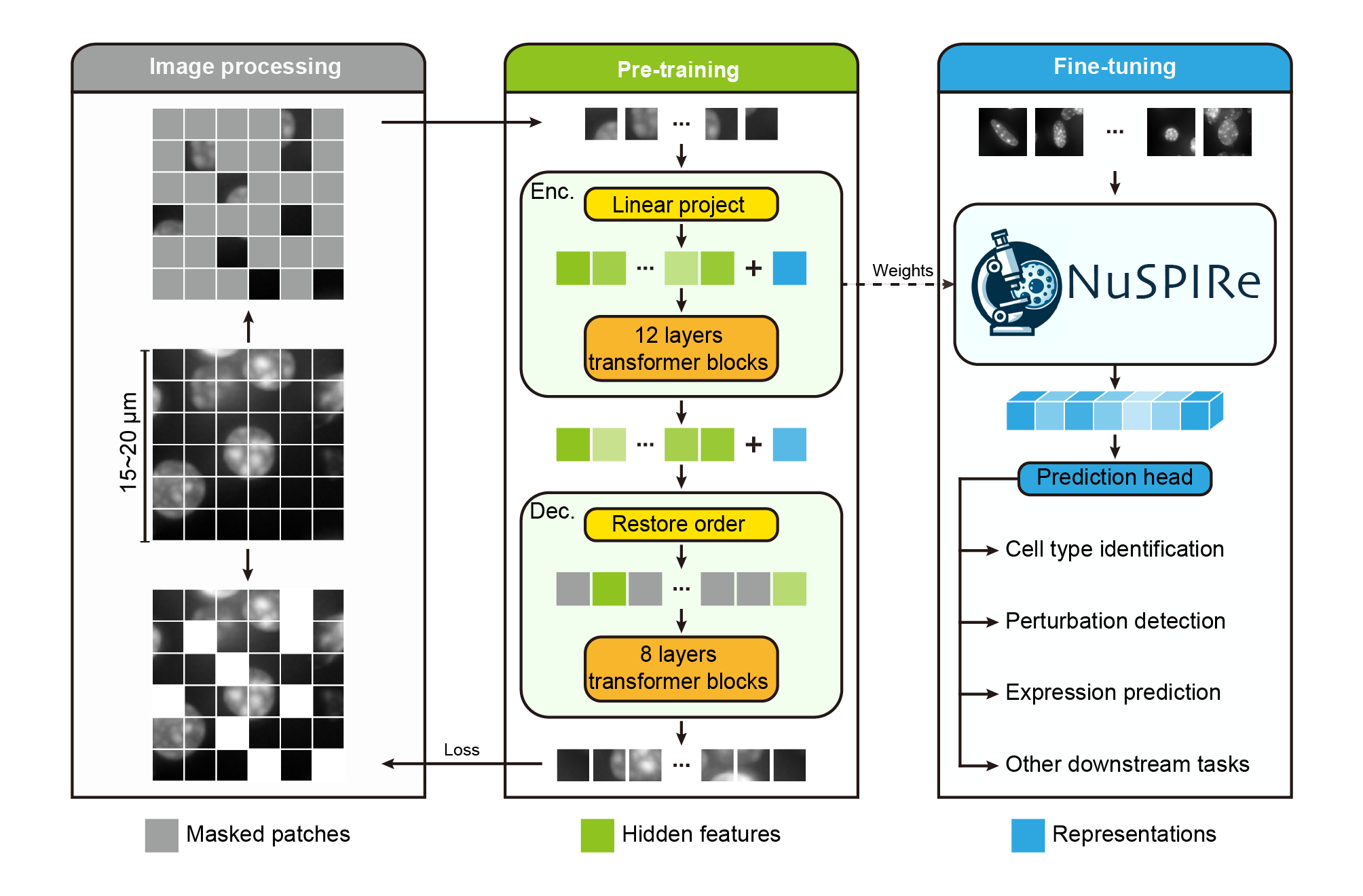
To extract representations using the pre-trained NuSPIRe model, please refer to the code example below:
# Import necessary libraries
import torch
import requests
from PIL import Image
import lightning.pytorch as pl
from transformers import ViTModel
from torchvision import transforms

# Set random seed for reproducibility
pl.seed_everything(0, workers=True)

# Open an example image
url = 'https://huggingface.co/TongjiZhanglab/NuSPIRe/resolve/main/Images/image_aabhacci-1.png'
image = Image.open(requests.get(url, stream=True).raw).convert('L')

# Define the image preprocessing transformations
transform = transforms.Compose([
    transforms.Resize((112, 112)),  # Resize image to 112x112 pixels
    transforms.ToTensor(),          # Convert PIL image to PyTorch tensor
    transforms.Normalize(mean=[0.21869252622127533], std=[0.1809280514717102])  # Normalize single channel
])

# Apply the transformations and add a batch dimension
image_tensor = transform(image).unsqueeze(0)  # Shape: [1, 1, 112, 112]

# Set the device to GPU if available, else CPU
device = torch.device('cuda' if torch.cuda.is_available() else 'cpu')
image_tensor = image_tensor.to(device)

# Load the NuSPIRe model
model = ViTModel.from_pretrained("TongjiZhanglab/NuSPIRe")
model.to(device)
model.eval()  # Set the model to evaluation mode

# Disable gradient calculation for faster inference
with torch.no_grad():
    # Perform forward pass through the model
    outputs = model(pixel_values=image_tensor)
    # Extract the pooled output representation
    representation = outputs.pooler_output

# Move the representation to CPU and convert to NumPy array (if further processing is needed)
representation = representation.cpu().numpy()

# Print the output representation
print(representation)
NuSPIRe can be fine-tuned on smaller labeled datasets for specific tasks:
# Import necessary libraries
import torch
import requests
from PIL import Image
import lightning.pytorch as pl
from torchvision import transforms
from transformers import ViTForImageClassification

# Set random seed for reproducibility
pl.seed_everything(0, workers=True)

# Open an example image
url = 'https://huggingface.co/TongjiZhanglab/NuSPIRe/resolve/main/Images/image_aabhacci-1.png'
image = Image.open(requests.get(url, stream=True).raw).convert('L')

# Define the image preprocessing transformations
transform = transforms.Compose([
    transforms.Resize((112, 112)),  # Resize image to 112x112 pixels
    transforms.ToTensor(),          # Convert PIL image to PyTorch tensor
    transforms.Normalize(mean=[0.21869252622127533], std=[0.1809280514717102])  # Normalize single channel
])

# Apply the transformations and add a batch dimension
image_tensor = transform(image).unsqueeze(0)  # Shape: [1, 1, 112, 112]

# Set the device to GPU if available, else CPU
device = torch.device('cuda' if torch.cuda.is_available() else 'cpu')
image_tensor = image_tensor.to(device)

# Load the NuSPIRe model for image classification
model = ViTForImageClassification.from_pretrained("TongjiZhanglab/NuSPIRe", num_labels=2)
model.to(device)
model.train()  # Set the model to training mode

# Prepare the labels tensor (example with label 0)
labels = torch.tensor([0]).to(device)

# Forward pass: Compute outputs and loss
outputs = model(image_tensor, labels=labels)
logits = outputs.logits
loss = outputs.loss

# Backward pass: Compute gradients
loss.backward()

# Print the outputs for verification
print("Logits:", logits)
print("Loss:", loss.item())