
Downloads · 30 days
0
TheBloke/wizard-vicuna-13B-SuperHOT-8K-GGML
wizard-vicuna-13B-SuperHOT-8K-GGML is a machine learning model from TheBloke. Use it for the machine learning task on the model card, and read the license before you ship it in a product. The card lists the license as other.
<div style="width: 100%;" <img src="https://i.imgur.com/EBdldam.jpg" alt="TheBlokeAI" style="width: 100%; min-width: 400px; display: block; margin: auto;" </div <div style="display: flex; justify-content: space-betwee…
Downloads · 30 days
0
Access
Public
Updated Jun 30, 2023
Repo size
68.5 GB
Likes
8
Public
Click a slice to open those files.
.bin68.5 GB · 100%
From the Hugging Face model README
These files are GGML format model files for June Lee's Wizard Vicuna 13B.
These are SuperHOT GGMLs with an increased context length. SuperHOT is a new system that employs RoPE to expand context beyond what was originally possible for a model. It was discovered and developed by kaiokendev.
In order to use the increased context length, you can presently use:
Support is also expected to come to llama.cpp, however it is still being worked on and there is currently no ETA for that.
To use the increased context with KoboldCpp and (when supported) llama.cpp, simply use --contextsize to set the desired context, eg --contextsize 4096 or --contextsize 8192.
These GGMLs will work with any llama.cpp-compatible GGML client that supports k-quants.
However the increased context length won't work without specific support. See the note in the introduction for details on using increased context.
The new methods available are:
Refer to the Provided Files table below to see what files use which methods, and how.
<!-- compatibility_ggml end -->| Name | Quant method | Bits | Size | Max RAM required | Use case |
|---|---|---|---|---|---|
| wizard-vicuna-13b-superhot-8k.ggmlv3.q2_K.bin | q2_K | 2 | 5.51 GB | 8.01 GB | New k-quant method. Uses GGML_TYPE_Q4_K for the attention.vw and feed_forward.w2 tensors, GGML_TYPE_Q2_K for the other tensors. |
| wizard-vicuna-13b-superhot-8k.ggmlv3.q3_K_L.bin | q3_K_L | 3 | 6.93 GB | 9.43 GB | New k-quant method. Uses GGML_TYPE_Q5_K for the attention.wv, attention.wo, and feed_forward.w2 tensors, else GGML_TYPE_Q3_K |
| wizard-vicuna-13b-superhot-8k.ggmlv3.q3_K_M.bin | q3_K_M | 3 | 6.31 GB | 8.81 GB | New k-quant method. Uses GGML_TYPE_Q4_K for the attention.wv, attention.wo, and feed_forward.w2 tensors, else GGML_TYPE_Q3_K |
| wizard-vicuna-13b-superhot-8k.ggmlv3.q3_K_S.bin | q3_K_S | 3 | 5.66 GB | 8.16 GB | New k-quant method. Uses GGML_TYPE_Q3_K for all tensors |
| wizard-vicuna-13b-superhot-8k.ggmlv3.q4_K_M.bin | q4_K_M | 4 | 7.87 GB | 10.37 GB | New k-quant method. Uses GGML_TYPE_Q6_K for half of the attention.wv and feed_forward.w2 tensors, else GGML_TYPE_Q4_K |
| wizard-vicuna-13b-superhot-8k.ggmlv3.q4_K_S.bin | q4_K_S | 4 | 7.37 GB | 9.87 GB | New k-quant method. Uses GGML_TYPE_Q4_K for all tensors |
| wizard-vicuna-13b-superhot-8k.ggmlv3.q5_K_M.bin | q5_K_M | 5 | 9.23 GB | 11.73 GB | New k-quant method. Uses GGML_TYPE_Q6_K for half of the attention.wv and feed_forward.w2 tensors, else GGML_TYPE_Q5_K |
| wizard-vicuna-13b-superhot-8k.ggmlv3.q5_K_S.bin | q5_K_S | 5 | 8.97 GB | 11.47 GB | New k-quant method. Uses GGML_TYPE_Q5_K for all tensors |
| wizard-vicuna-13b-superhot-8k.ggmlv3.q6_K.bin | q6_K | 6 | 10.68 GB | 13.18 GB | New k-quant method. Uses GGML_TYPE_Q8_K - 6-bit quantization - for all tensors |
Note: the above RAM figures assume no GPU offloading. If layers are offloaded to the GPU, this will reduce RAM usage and use VRAM instead.
koboldcppOn Linux I use the following command line to launch the KoboldCpp UI with OpenCL aceleration and a context size of 4096:
python ./koboldcpp.py --stream --unbantokens --threads 8 --usecublas 100 wizard-vicuna-13b-superhot-8k.ggmlv3.q5_0.bin
Change --gpulayers 100 to the number of layers you want/are able to offload to the GPU. Remove it if you don't have GPU acceleration.
For OpenCL acceleration, change --usecublas to --useclblast 0 0. You may need to change the second 0 to 1 if you have both an iGPU and a discrete GPU.
For further support, and discussions on these models and AI in general, join us at:
Thanks to the chirper.ai team!
I've had a lot of people ask if they can contribute. I enjoy providing models and helping people, and would love to be able to spend even more time doing it, as well as expanding into new projects like fine tuning/training.
If you're able and willing to contribute it will be most gratefully received and will help me to keep providing more models, and to start work on new AI projects.
Donaters will get priority support on any and all AI/LLM/model questions and requests, access to a private Discord room, plus other benefits.
Special thanks to: Luke from CarbonQuill, Aemon Algiz, Dmitriy Samsonov.
Patreon special mentions: zynix , ya boyyy, Trenton Dambrowitz, Imad Khwaja, Alps Aficionado, chris gileta, John Detwiler, Willem Michiel, RoA, Mano Prime, Rainer Wilmers, Fred von Graf, Matthew Berman, Ghost , Nathan LeClaire, Iucharbius , Ai Maven, Illia Dulskyi, Joseph William Delisle, Space Cruiser, Lone Striker, Karl Bernard, Eugene Pentland, Greatston Gnanesh, Jonathan Leane, Randy H, Pierre Kircher, Willian Hasse, Stephen Murray, Alex , terasurfer , Edmond Seymore, Oscar Rangel, Luke Pendergrass, Asp the Wyvern, Junyu Yang, David Flickinger, Luke, Spiking Neurons AB, subjectnull, Pyrater, Nikolai Manek, senxiiz, Ajan Kanaga, Johann-Peter Hartmann, Artur Olbinski, Kevin Schuppel, Derek Yates, Kalila, K, Talal Aujan, Khalefa Al-Ahmad, Gabriel Puliatti, John Villwock, WelcomeToTheClub, Daniel P. Andersen, Preetika Verma, Deep Realms, Fen Risland, trip7s trip, webtim, Sean Connelly, Michael Levine, Chris McCloskey, biorpg, vamX, Viktor Bowallius, Cory Kujawski.
Thank you to all my generous patrons and donaters!
<!-- footer end -->This is a second prototype of SuperHOT, this time 30B with 8K context and no RLHF, using the same technique described in the github blog. Tests have shown that the model does indeed leverage the extended context at 8K.
You will need to use either the monkeypatch or, if you are already using the monkeypatch, change the scaling factor to 0.25 and the maximum sequence length to 8192
I trained the LoRA with the following configuration:
This is a float16 HF format repo for junelee's wizard-vicuna 13B.
June Lee's repo was also HF format. The reason I've made this is that the original repo was in float32, meaning it required 52GB disk space, VRAM and RAM.
This model was converted to float16 to make it easier to load and manage.
For further support, and discussions on these models and AI in general, join us at:
Thanks to the chirper.ai team!
I've had a lot of people ask if they can contribute. I enjoy providing models and helping people, and would love to be able to spend even more time doing it, as well as expanding into new projects like fine tuning/training.
If you're able and willing to contribute it will be most gratefully received and will help me to keep providing more models, and to start work on new AI projects.
Donaters will get priority support on any and all AI/LLM/model questions and requests, access to a private Discord room, plus other benefits.
Patreon special mentions: Aemon Algiz, Dmitriy Samsonov, Nathan LeClaire, Trenton Dambrowitz, Mano Prime, David Flickinger, vamX, Nikolai Manek, senxiiz, Khalefa Al-Ahmad, Illia Dulskyi, Jonathan Leane, Talal Aujan, V. Lukas, Joseph William Delisle, Pyrater, Oscar Rangel, Lone Striker, Luke Pendergrass, Eugene Pentland, Sebastain Graf, Johann-Peter Hartman.
Thank you to all my generous patrons and donaters!
<!-- footer end -->Github page: https://github.com/melodysdreamj/WizardVicunaLM
I am a big fan of the ideas behind WizardLM and VicunaLM. I particularly like the idea of WizardLM handling the dataset itself more deeply and broadly, as well as VicunaLM overcoming the limitations of single-turn conversations by introducing multi-round conversations. As a result, I combined these two ideas to create WizardVicunaLM. This project is highly experimental and designed for proof of concept, not for actual usage.
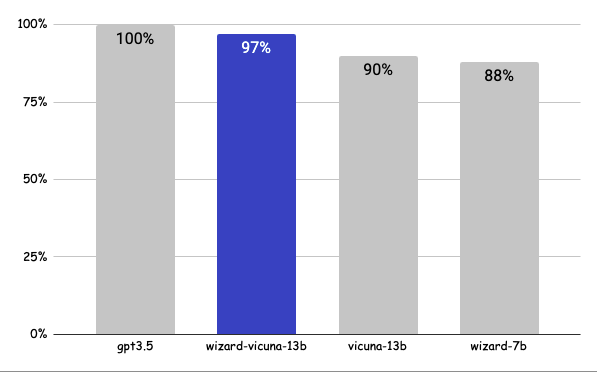
The questions presented here are not from rigorous tests, but rather, I asked a few questions and requested GPT-4 to score them. The models compared were ChatGPT 3.5, WizardVicunaLM, VicunaLM, and WizardLM, in that order.
| gpt3.5 | wizard-vicuna-13b | vicuna-13b | wizard-7b | link | |
|---|---|---|---|---|---|
| Q1 | 95 | 90 | 85 | 88 | link |
| Q2 | 95 | 97 | 90 | 89 | link |
| Q3 | 85 | 90 | 80 | 65 | link |
| Q4 | 90 | 85 | 80 | 75 | link |
| Q5 | 90 | 85 | 80 | 75 | link |
| Q6 | 92 | 85 | 87 | 88 | link |
| Q7 | 95 | 90 | 85 | 92 | link |
| Q8 | 90 | 85 | 75 | 70 | link |
| Q9 | 92 | 85 | 70 | 60 | link |
| Q10 | 90 | 80 | 75 | 85 | link |
| Q11 | 90 | 85 | 75 | 65 | link |
| Q12 | 85 | 90 | 80 | 88 | link |
| Q13 | 90 | 95 | 88 | 85 | link |
| Q14 | 94 | 89 | 90 | 91 | link |
| Q15 | 90 | 85 | 88 | 87 | link |
| 91 | 88 | 82 | 80 |
We adopted the approach of WizardLM, which is to extend a single problem more in-depth. However, instead of using individual instructions, we expanded it using Vicuna's conversation format and applied Vicuna's fine-tuning techniques.
Turning a single command into a rich conversation is what we've done here.
After creating the training data, I later trained it according to the Vicuna v1.1 training method.
First, we explore and expand various areas in the same topic using the 7K conversations created by WizardLM. However, we made it in a continuous conversation format instead of the instruction format. That is, it starts with WizardLM's instruction, and then expands into various areas in one conversation using ChatGPT 3.5.
After that, we applied the following model using Vicuna's fine-tuning format.
Trained with 8 A100 GPUs for 35 hours.
You can see the dataset we used for training and the 13b model in the huggingface.
If we extend the conversation to gpt4 32K, we can expect a dramatic improvement, as we can generate 8x more, more accurate and richer conversations.
The model is licensed under the LLaMA model, and the dataset is licensed under the terms of OpenAI because it uses ChatGPT. Everything else is free.
JUNE LEE - He is active in Songdo Artificial Intelligence Study and GDG Songdo.