
Downloads · 30 days
69
23% of all-time downloads
TheBloke/MythoLogic-13B-GGML
MythoLogic-13B-GGML is a machine learning model from TheBloke. Use it for the machine learning task on the model card, and read the license before you ship it in a product. It is set up for transformers. The card lists the license as other.
<div style="width: 100%;" <img src="https://i.imgur.com/EBdldam.jpg" alt="TheBlokeAI" style="width: 100%; min-width: 400px; display: block; margin: auto;" </div <div style="display: flex; justify-content: space-betwee…
Downloads · 30 days
69
23% of all-time downloads
All-time downloads
302
Public
Repo size
117 GB
Likes
14
Public
Click a slice to open those files.
.bin117 GB · 100%
From the Hugging Face model README
These files are GGML format model files for Gryphe's MythoLogic 13B.
GGML files are for CPU + GPU inference using llama.cpp and libraries and UIs which support this format, such as:
These files were quantised using hardware kindly provided by Latitude.sh.
Below is an instruction that describes a task. Write a response that appropriately completes the request.

### Instruction: {prompt}

### Response:
q4_0, q4_1, q5_0, q5_1, q8_0These are guaranteed to be compatible with any UIs, tools and libraries released since late May. They may be phased out soon, as they are largely superseded by the new k-quant methods.
q2_K, q3_K_S, q3_K_M, q3_K_L, q4_K_S, q4_K_M, q5_K_S, q6_KThese new quantisation methods are compatible with llama.cpp as of June 6th, commit 2d43387.
They are now also compatible with recent releases of text-generation-webui, KoboldCpp, llama-cpp-python, ctransformers, rustformers and most others. For compatibility with other tools and libraries, please check their documentation.
The new methods available are:
Refer to the Provided Files table below to see what files use which methods, and how.
</details> <!-- compatibility_ggml end -->| Name | Quant method | Bits | Size | Max RAM required | Use case |
|---|---|---|---|---|---|
| mythologic-13b.ggmlv3.q2_K.bin | q2_K | 2 | 5.51 GB | 8.01 GB | New k-quant method. Uses GGML_TYPE_Q4_K for the attention.vw and feed_forward.w2 tensors, GGML_TYPE_Q2_K for the other tensors. |
| mythologic-13b.ggmlv3.q3_K_S.bin | q3_K_S | 3 | 5.66 GB | 8.16 GB | New k-quant method. Uses GGML_TYPE_Q3_K for all tensors |
| mythologic-13b.ggmlv3.q3_K_M.bin | q3_K_M | 3 | 6.31 GB | 8.81 GB | New k-quant method. Uses GGML_TYPE_Q4_K for the attention.wv, attention.wo, and feed_forward.w2 tensors, else GGML_TYPE_Q3_K |
| mythologic-13b.ggmlv3.q3_K_L.bin | q3_K_L | 3 | 6.93 GB | 9.43 GB | New k-quant method. Uses GGML_TYPE_Q5_K for the attention.wv, attention.wo, and feed_forward.w2 tensors, else GGML_TYPE_Q3_K |
| mythologic-13b.ggmlv3.q4_K_S.bin | q4_K_S | 4 | 7.37 GB | 9.87 GB | New k-quant method. Uses GGML_TYPE_Q4_K for all tensors |
| mythologic-13b.ggmlv3.q4_K_M.bin | q4_K_M | 4 | 7.87 GB | 10.37 GB | New k-quant method. Uses GGML_TYPE_Q6_K for half of the attention.wv and feed_forward.w2 tensors, else GGML_TYPE_Q4_K |
| mythologic-13b.ggmlv3.q4_0.bin | q4_0 | 4 | 7.32 GB | 9.82 GB | Original quant method, 4-bit. |
| mythologic-13b.ggmlv3.q4_1.bin | q4_1 | 4 | 8.14 GB | 10.64 GB | Original quant method, 4-bit. Higher accuracy than q4_0 but not as high as q5_0. However has quicker inference than q5 models. |
| mythologic-13b.ggmlv3.q5_K_S.bin | q5_K_S | 5 | 8.97 GB | 11.47 GB | New k-quant method. Uses GGML_TYPE_Q5_K for all tensors |
| mythologic-13b.ggmlv3.q5_K_M.bin | q5_K_M | 5 | 9.23 GB | 11.73 GB | New k-quant method. Uses GGML_TYPE_Q6_K for half of the attention.wv and feed_forward.w2 tensors, else GGML_TYPE_Q5_K |
| mythologic-13b.ggmlv3.q5_0.bin | q5_0 | 5 | 8.95 GB | 11.45 GB | Original quant method, 5-bit. Higher accuracy, higher resource usage and slower inference. |
| mythologic-13b.ggmlv3.q5_1.bin | q5_1 | 5 | 9.76 GB | 12.26 GB | Original quant method, 5-bit. Even higher accuracy, resource usage and slower inference. |
| mythologic-13b.ggmlv3.q6_K.bin | q6_K | 6 | 10.68 GB | 13.18 GB | New k-quant method. Uses GGML_TYPE_Q8_K for all tensors - 6-bit quantization |
| mythologic-13b.ggmlv3.q8_0.bin | q8_0 | 8 | 13.83 GB | 16.33 GB | Original quant method, 8-bit. Almost indistinguishable from float16. High resource use and slow. Not recommended for most users. |
Note: the above RAM figures assume no GPU offloading. If layers are offloaded to the GPU, this will reduce RAM usage and use VRAM instead.
llama.cppI use the following command line; adjust for your tastes and needs:
./main -t 10 -ngl 32 -m mythologic-13b.ggmlv3.q4_0.bin --color -c 2048 --temp 0.7 --repeat_penalty 1.1 -n -1 -p "### Instruction: Write a story about llamas\n### Response:"
Change -t 10 to the number of physical CPU cores you have. For example if your system has 8 cores/16 threads, use -t 8.
Change -ngl 32 to the number of layers to offload to GPU. Remove it if you don't have GPU acceleration.
If you want to have a chat-style conversation, replace the -p <PROMPT> argument with -i -ins
text-generation-webuiFurther instructions here: text-generation-webui/docs/llama.cpp-models.md.
<!-- footer start -->For further support, and discussions on these models and AI in general, join us at:
Thanks to the chirper.ai team!
I've had a lot of people ask if they can contribute. I enjoy providing models and helping people, and would love to be able to spend even more time doing it, as well as expanding into new projects like fine tuning/training.
If you're able and willing to contribute it will be most gratefully received and will help me to keep providing more models, and to start work on new AI projects.
Donaters will get priority support on any and all AI/LLM/model questions and requests, access to a private Discord room, plus other benefits.
Special thanks to: Luke from CarbonQuill, Aemon Algiz.
Patreon special mentions: Space Cruiser, Nikolai Manek, Sam, Chris McCloskey, Rishabh Srivastava, Kalila, Spiking Neurons AB, Khalefa Al-Ahmad, WelcomeToTheClub, Chadd, Lone Striker, Viktor Bowallius, Edmond Seymore, Ai Maven, Chris Smitley, Dave, Alexandros Triantafyllidis, Luke @flexchar, Elle, ya boyyy, Talal Aujan, Alex , Jonathan Leane, Deep Realms, Randy H, subjectnull, Preetika Verma, Joseph William Delisle, Michael Levine, chris gileta, K, Oscar Rangel, LangChain4j, Trenton Dambrowitz, Eugene Pentland, Johann-Peter Hartmann, Femi Adebogun, Illia Dulskyi, senxiiz, Daniel P. Andersen, Sean Connelly, Artur Olbinski, RoA, Mano Prime, Derek Yates, Raven Klaugh, David Flickinger, Willem Michiel, Pieter, Willian Hasse, vamX, Luke Pendergrass, webtim, Ghost , Rainer Wilmers, Nathan LeClaire, Will Dee, Cory Kujawski, John Detwiler, Fred von Graf, biorpg, Iucharbius , Imad Khwaja, Pierre Kircher, terasurfer , Asp the Wyvern, John Villwock, theTransient, zynix , Gabriel Tamborski, Fen Risland, Gabriel Puliatti, Matthew Berman, Pyrater, SuperWojo, Stephen Murray, Karl Bernard, Ajan Kanaga, Greatston Gnanesh, Junyu Yang.
Thank you to all my generous patrons and donaters!
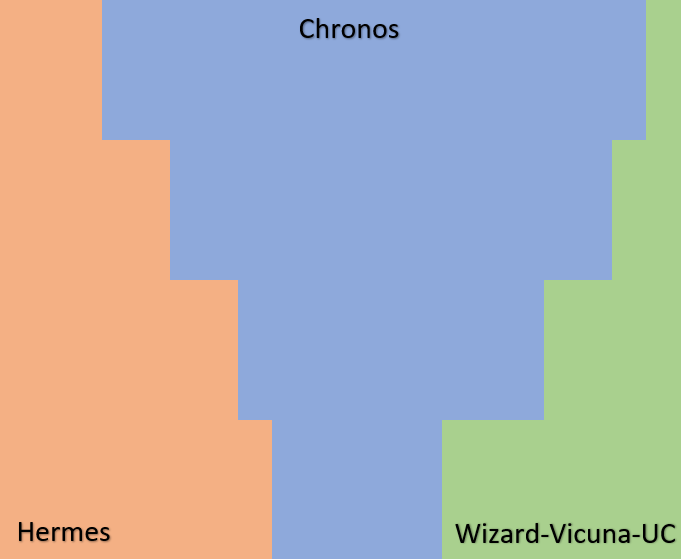
<!-- footer end -->An experiment with gradient merges using the following script, with Chronos as its primary model, augmented by Hermes and Wizard-Vicuna Uncensored.
Chronos is a wonderfully verbose model, though it definitely seems to lack in the logic department. Hermes and WizardLM have been merged gradually, primarily in the higher layers (10+) in an attempt to rectify some of this behaviour.
The main objective was to create an all-round model with improved story generation and roleplaying capabilities.
Below is an illustration to showcase a rough approximation of the gradients I used to create MythoLogic:
This model primarily uses Alpaca formatting, so for optimal model performance, use:
### Instruction:
Your instruction or question here.
### Response:
For chat/roleplay conversations, I suggest the following structure instead:
You are <AI NAME>, a friendly and supportive AI language model. We discuss all subjects freely and without bias or restrictions.
I am <YOUR NAME>, the user interacting with you through a chat conversation. Start with greeting me.

### Instruction:
Write <AI NAME>'s next reply in a chat between <YOUR NAME> and <AI NAME>. Write a single reply only.

### Chat History:
<AI NAME>: Good day, <YOUR NAME>! How can I assist you today?
(Etc, etc)

### Response:
<AI NAME>: