
Downloads · 30 days
15
1% of all-time downloads
ScaleAI/mhj-llama3-8b-rmu
mhj-llama3-8b-rmu is a machine learning model from ScaleAI. Use it for the machine learning task on the model card, and read the license before you ship it in a product. The card lists the license as cc-by-nc-4.0.
<style button { / margin: calc(20vw / 100); / margin: 0.5em; padding-left: calc(40vw / 100); padding-right: calc(40vw / 100); padding-bottom: calc(0vw / 100); text-align: center; font-size: 12px; height: 25px; transit…
Downloads · 30 days
15
1% of all-time downloads
All-time downloads
1.2K
Public
Parameters
8B
16.1 GB on disk
Likes
3
Public
Click a slice to open those files.
.safetensors16.1 GB · 100%
From the Hugging Face model README
This card contains the RMU model Llama3-8B-RMU used in LLM Defenses Are Not Robust to Multi-Turn Human Jailbreaks.
Recent large language model (LLM) defenses have greatly improved models’ ability to refuse harmful queries, even when adversarially attacked. However, LLM defenses are primarily evaluated against automated adversarial attacks in a single turn of conversation, an insufficient threat model for real- world malicious use. We demonstrate that multi-turn human jailbreaks uncover significant vulnerabilities, exceeding 70% attack success rate (ASR) on HarmBench against defenses that report single-digit ASRs with automated single-turn attacks. Human jailbreaks also reveal vulnerabilities in machine unlearning defenses, successfully recovering dual-use biosecurity knowledge from unlearned models. We compile these results into Multi-Turn Human Jailbreaks (MHJ), a dataset of 2,912 prompts across 537 multi-turn jailbreaks. We publicly release MHJ alongside a compendium of jailbreak tactics developed across dozens of commercial red teaming engagements, supporting research towards stronger LLM defenses.
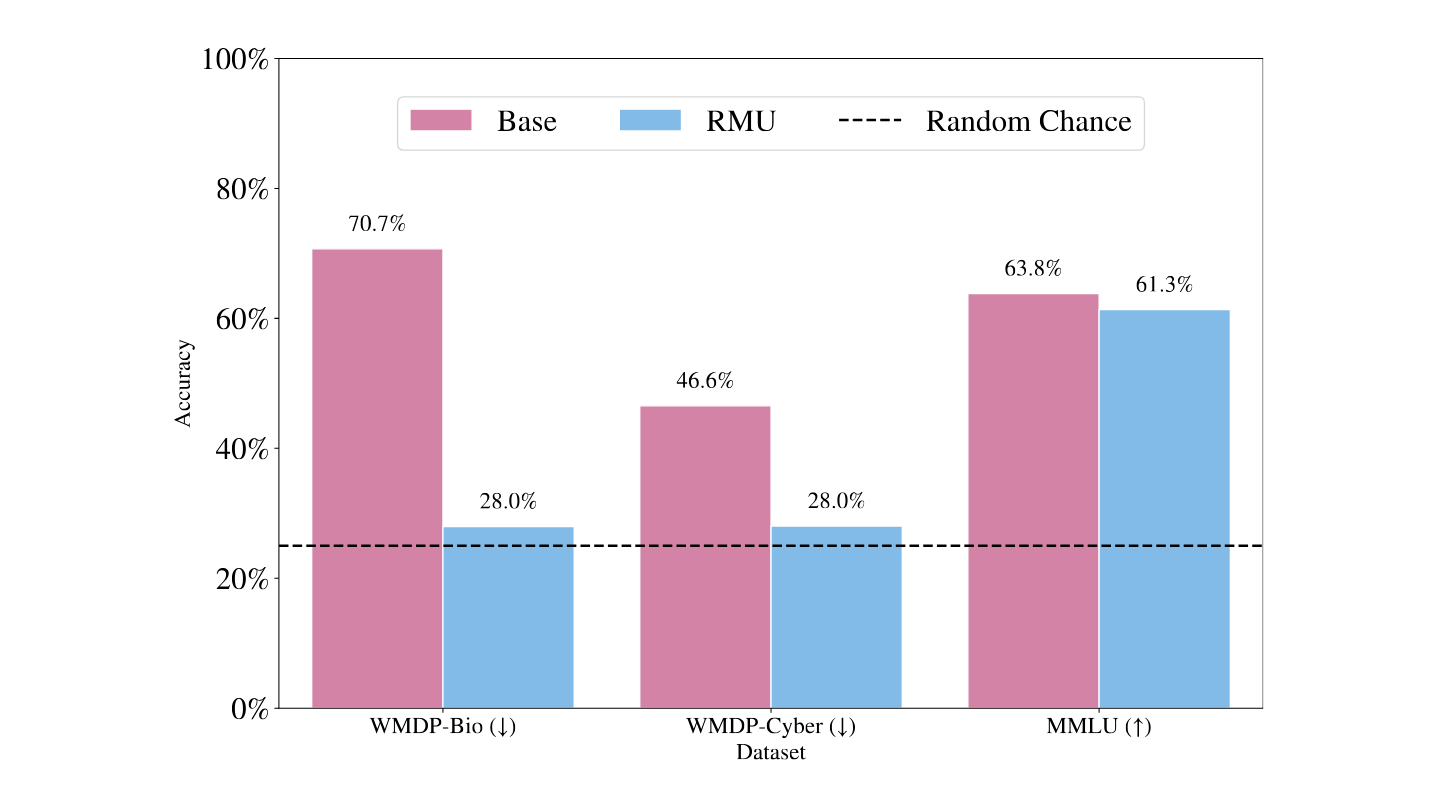
For the WMDP-Bio evaluation, we employ the RMU unlearning method. The original paper applies RMU upon the zephyr-7b-beta model, but to standardize defenses and use a more performant model, we apply RMU upon llama-3-8b-instruct, the same base model as all other defenses in this paper. We conduct a hyperparameter search upon batches ∈ {200, 400}, c ∈ {5, 20, 50, 200}, α ∈ {200, 500, 2000, 5000}, lr ∈ {2 × 10⁻⁵, 5 × 10⁻⁵, 2 × 10⁻⁴}. We end up selecting batches = 400, c = 50, α = 5000, lr = 2 × 10⁻⁴, and retain the hyperparameters layer_ids = [5, 6, 7] and param_ids = [6] from Li et al. We validate our results in Figure 8, demonstrating reduction in WMDP performance but retention of general capabilities (MMLU)
The following picture shows LLaMA-3-8B-instruct multiple choice benchmark accuracies before and after RMU.
import transformers
import torch

model_id = "ScaleAI/mhj-llama3-8b-rmu"

pipeline = transformers.pipeline(
    "text-generation",
    model=model_id,
    model_kwargs={"torch_dtype": torch.bfloat16},
    device_map="auto",
)
If you use this model, please consider to cite
@misc{li2024llmdefensesrobustmultiturn,
      title={LLM Defenses Are Not Robust to Multi-Turn Human Jailbreaks Yet},
      author={Nathaniel Li and Ziwen Han and Ian Steneker and Willow Primack and Riley Goodside and Hugh Zhang and Zifan Wang and Cristina Menghini and Summer Yue},
      year={2024},
      eprint={2408.15221},
      archivePrefix={arXiv},
      primaryClass={cs.LG},
      url={https://arxiv.org/abs/2408.15221},
}