
Downloads · 30 days
902
11% of all-time downloads
QuantFactory/Qwen2.5-Math-1.5B-Instruct-GGUF
Qwen2.5-Math-1.5B-Instruct-GGUF is a text generation model from QuantFactory. Use it when you need the model to write or continue text. It is set up for transformers. The card lists the license as apache-2.0.
Downloads · 30 days
902
11% of all-time downloads
All-time downloads
8.4K
Public
Repo size
14.4 GB
Likes
1
Public
Click a slice to open those files.
.gguf14.4 GB · 100%
From the Hugging Face model README
This is quantized version of Qwen/Qwen2.5-Math-1.5B-Instruct created using llama.cpp
[!Warning]
<div align="center"> <b> 🚨 Qwen2.5-Math mainly supports solving English and Chinese math problems through CoT and TIR. We do not recommend using this series of models for other tasks. </b> </div>
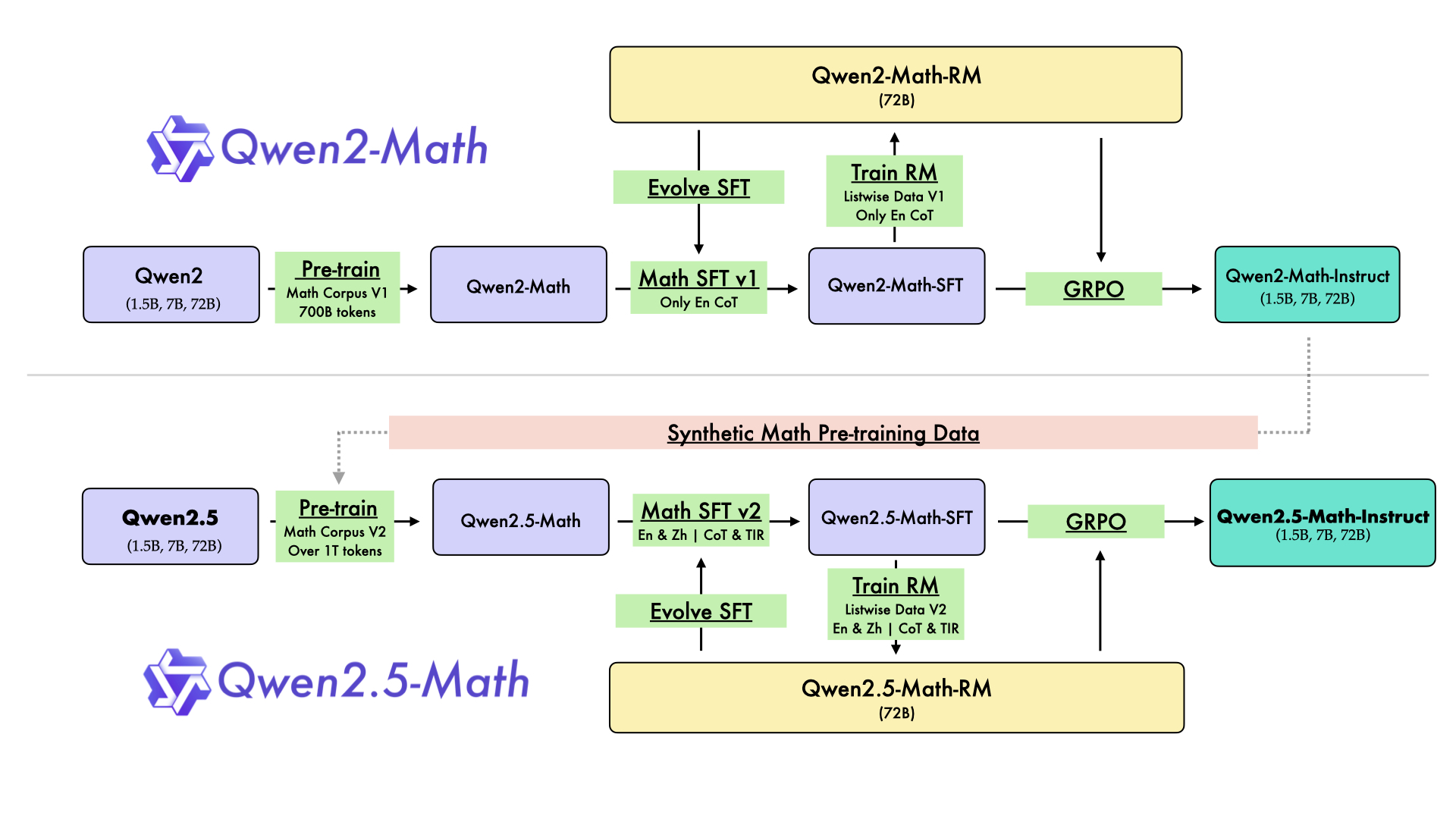
In August 2024, we released the first series of mathematical LLMs - Qwen2-Math - of our Qwen family. A month later, we have upgraded it and open-sourced Qwen2.5-Math series, including base models Qwen2.5-Math-1.5B/7B/72B, instruction-tuned models Qwen2.5-Math-1.5B/7B/72B-Instruct, and mathematical reward model Qwen2.5-Math-RM-72B.
Unlike Qwen2-Math series which only supports using Chain-of-Thught (CoT) to solve English math problems, Qwen2.5-Math series is expanded to support using both CoT and Tool-integrated Reasoning (TIR) to solve math problems in both Chinese and English. The Qwen2.5-Math series models have achieved significant performance improvements compared to the Qwen2-Math series models on the Chinese and English mathematics benchmarks with CoT.
While CoT plays a vital role in enhancing the reasoning capabilities of LLMs, it faces challenges in achieving computational accuracy and handling complex mathematical or algorithmic reasoning tasks, such as finding the roots of a quadratic equation or computing the eigenvalues of a matrix. TIR can further improve the model's proficiency in precise computation, symbolic manipulation, and algorithmic manipulation. Qwen2.5-Math-1.5B/7B/72B-Instruct achieve 79.7, 85.3, and 87.8 respectively on the MATH benchmark using TIR.
For more details, please refer to our blog post and GitHub repo.
transformers>=4.37.0 for Qwen2.5-Math models. The latest version is recommended.[!Warning]
<div align="center"> <b> 🚨 This is a must because <code>transformers</code> integrated Qwen2 codes since <code>4.37.0</code>. </b> </div>
For requirements on GPU memory and the respective throughput, see similar results of Qwen2 here.
[!Important]
Qwen2.5-Math-1.5B-Instruct is an instruction model for chatting;
Qwen2.5-Math-1.5B is a base model typically used for completion and few-shot inference, serving as a better starting point for fine-tuning.
Qwen2.5-Math can be deployed and infered in the same way as Qwen2.5. Here we show a code snippet to show you how to use the chat model with transformers:
from transformers import AutoModelForCausalLM, AutoTokenizer

model_name = "Qwen/Qwen2.5-Math-1.5B-Instruct"
device = "cuda" # the device to load the model onto

model = AutoModelForCausalLM.from_pretrained(
    model_name,
    torch_dtype="auto",
    device_map="auto"
)
tokenizer = AutoTokenizer.from_pretrained(model_name)

prompt = "Find the value of $x$ that satisfies the equation $4x+5 = 6x+7$."

# CoT
messages = [
    {"role": "system", "content": "Please reason step by step, and put your final answer within \\boxed{}."},
    {"role": "user", "content": prompt}
]

# TIR
messages = [
    {"role": "system", "content": "Please integrate natural language reasoning with programs to solve the problem above, and put your final answer within \\boxed{}."},
    {"role": "user", "content": prompt}
]

text = tokenizer.apply_chat_template(
    messages,
    tokenize=False,
    add_generation_prompt=True
)
model_inputs = tokenizer([text], return_tensors="pt").to(device)

generated_ids = model.generate(
    **model_inputs,
    max_new_tokens=512
)
generated_ids = [
    output_ids[len(input_ids):] for input_ids, output_ids in zip(model_inputs.input_ids, generated_ids)
]

response = tokenizer.batch_decode(generated_ids, skip_special_tokens=True)[0]
If you find our work helpful, feel free to give us a citation.
@article{yang2024qwen2,
  title={Qwen2 technical report},
  author={Yang, An and Yang, Baosong and Hui, Binyuan and Zheng, Bo and Yu, Bowen and Zhou, Chang and Li, Chengpeng and Li, Chengyuan and Liu, Dayiheng and Huang, Fei and others},
  journal={arXiv preprint arXiv:2407.10671},
  year={2024}
}
