
Downloads · 30 days
16
8% of all-time downloads
LoneStriker/HelixNet-actor-8.0bpw-h8-exl2
HelixNet-actor-8.0bpw-h8-exl2 is a text generation model from LoneStriker. Use it when you need the model to write or continue text. It is set up for transformers. The card lists the license as apache-2.0.
- Model creator: migtissera - Original model: HelixNet
Downloads · 30 days
16
8% of all-time downloads
All-time downloads
210
Public
Repo size
7.4 GB
Likes
0
Public
Click a slice to open those files.
.safetensors7.4 GB · 100%
From the Hugging Face model README
import time
import sys, os
import dataclasses
sys.path.append(os.path.dirname(os.path.dirname(os.path.abspath(__file__))))

from exllamav2 import(
    ExLlamaV2,
    ExLlamaV2Config,
    ExLlamaV2Cache,
    ExLlamaV2Tokenizer,
)

from exllamav2.generator import (
    ExLlamaV2BaseGenerator,
    ExLlamaV2Sampler
)

@dataclasses.dataclass
class ModelClass:
    generator: ExLlamaV2BaseGenerator
    tokenizer: ExLlamaV2Tokenizer

DEBUG = os.environ.get("DEBUG") and True or False

# Initialize model and cache
def load_model(model_directory, max_seq_len=8192):
    """
    Loads a model from a directory and return the generator and tokenizer
    """
    config = ExLlamaV2Config()
    config.model_dir = model_directory
    config.max_seq_len = max_seq_len
    config.prepare()

    model = ExLlamaV2(config)
    print("Loading model: " + model_directory)

    cache = ExLlamaV2Cache(model, lazy = True, max_seq_len=max_seq_len)
    model.load_autosplit(cache)

    tokenizer = ExLlamaV2Tokenizer(config)
    generator = ExLlamaV2BaseGenerator(model, cache, tokenizer)
    model = ModelClass(generator=generator, tokenizer=tokenizer)
    generator.warmup()
    return model

def generate_text(prompt, model, settings, max_new_tokens):
    time_begin = time.time()
    response = model.generator.generate_simple(prompt, settings, max_new_tokens)
    response = response[len(prompt):]
    time_end = time.time()
    time_total = time_end - time_begin
    tokens = model.tokenizer.encode(response)
    count = tokens.shape[-1]
    print(f"Response generated in {time_total:.2f} seconds, {count} tokens, {count / time_total:.2f} tokens/second, character len: {len(response)}")
    return response

model_actor = load_model("/models/HelixNet-actor-6.0bpw-h6-exl2")
model_critic = load_model("/models/HelixNet-critic-6.0bpw-h6-exl2")
model_regenerator = load_model("/models/HelixNet-regenerator-6.0bpw-h6-exl2")

settings = ExLlamaV2Sampler.Settings()
settings.temperature = 0.75
settings.top_k = 50
settings.top_p = 1.0
max_new_tokens = 2000

system_prompt = "You are HelixNet. Elaborate on the topic using a Tree of Thoughts and backtrack when necessary to construct a clear, cohesive Chain of Thought reasoning. Always answer without hesitation."

while True:
    user_input = input("You: ")

    prompt_actor = f"SYSTEM: {system_prompt}\nUSER: {user_input}\nASSISTANT: "
    if DEBUG: print(f"{prompt_actor}\n\n")
    print("ACTOR:")
    response_actor = generate_text(prompt_actor, model_actor, settings, max_new_tokens)
    if DEBUG: print(f"{response_actor}\n\n")
    print("="*132)

    prompt_critic = f"SYSTEM: {system_prompt}\nUSER: {user_input}\nRESPONSE: {response_actor}\nCRITIQUE: "
    if DEBUG: print(f"{prompt_critic}\n\n")
    print("CRITIQUE:")
    response_critic = generate_text(prompt_critic, model_critic, settings, max_new_tokens)
    if DEBUG: print(f"{response_critic}\n\n")
    print("="*132)

    prompt_regenerator = f"SYSTEM: {system_prompt}\nUSER: {user_input}\nRESPONSE: {response_actor}\nCRITIQUE: {response_critic}\nREGENERATOR: "
    if DEBUG: print(f"{prompt_regenerator}\n\n")
    print("REGENERATION:")
    response_regenerator = generate_text(prompt_regenerator, model_regenerator, settings, max_new_tokens)
    print("="*132)
    conversation = f"SYSTEM: {system_prompt}\nUSER: {user_input}\nASSISTANT: {response_regenerator}"
    print(conversation)

HelixNet is a Deep Learning architecture consisting of 3 x Mistral-7B LLMs. It has an actor, a critic, and a regenerator. The actor LLM produces an initial response to a given system-context and a question. The critic then takes in as input, a tuple of (system-context, question, response) and provides a critique based on the provided answer to the given system-context and the question. Its job is not to criticize, but to provide an intelligent critique so that the answer can be modified/regenerated to address the question better. Finally, the regenerator takes in a tuple of (system-context, question, response, critique) and regenerates the answer.
HelixNet is insprired from an actor-critic architecture most prominent in Reinforcement Learning algorithms. The name derives from Helix, referring to the spiral structure of a DNA molecule. It symbolizes the intertwined nature of the three networks, working in tandem, much like the strands of a DNA molecule.
HelixNet regenerates very pleasing and accurate responses, due to the entropy preservation of the regenerator. The regenerator was only trained on a dataset of 1000 samples, similar to Meta's LIMA. The actor network here was trained on about 250K very high-quality samples, and the critic network was trained on further 10K samples.
The actor network was trained with Supervised Fine-Tuning, on 250K very high-quality samples. It has 75K of Open-Orca's Chain-of-Thought data, and a mixture of Dolphin (GPT-4), SynthIA's Tree-of-Thought data.
Here are the results for the Actor network on metrics used by HuggingFaceH4 Open LLM Leaderboard
| Task | Metric | Value |
| arc_challenge | acc_norm | 62.28 |
| hellaswag | acc_norm | 83.22 |
| mmlu | acc_norm | 63.10 |
| truthfulqa_mc | mc2 | 50.10 |
| Total Average | - | 0.64675 |
To train the critic, the following process was followed:
Using the above training dataset, a Mistral-7B was fine-tuned.
A thrid LLM was fine-tuned using the above data.
The critic and the regenerator was tested not only on the accopanying actor model, but 13B and 70B SynthIA models as well. They seem to be readily transferrable, as the function that it has learnt is to provide an intelligent critique and then a regeneration of the original response. Please feel free to try out other models as the actor. However, the architecture works best with all three as presented here in HelixNet.
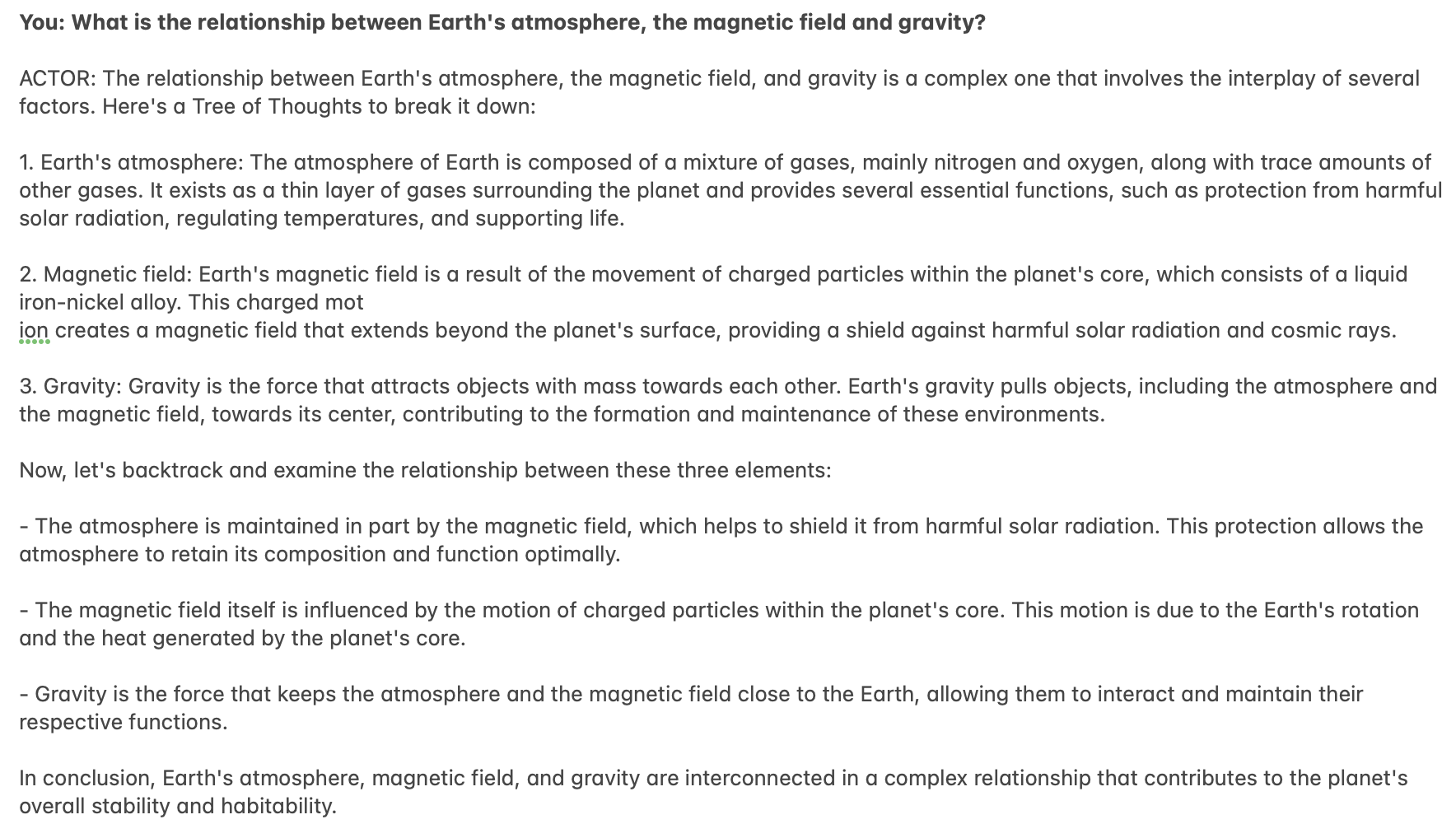
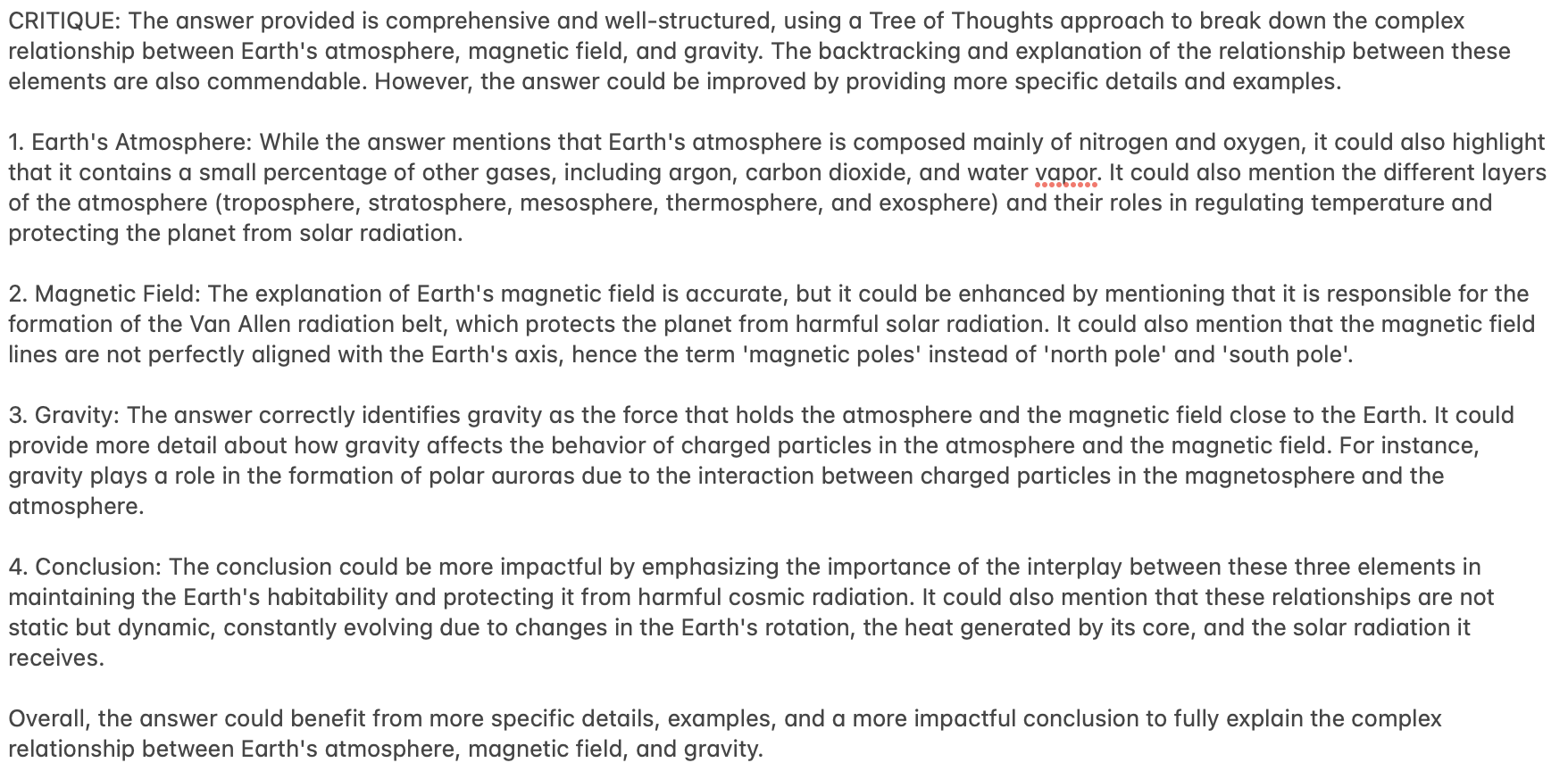
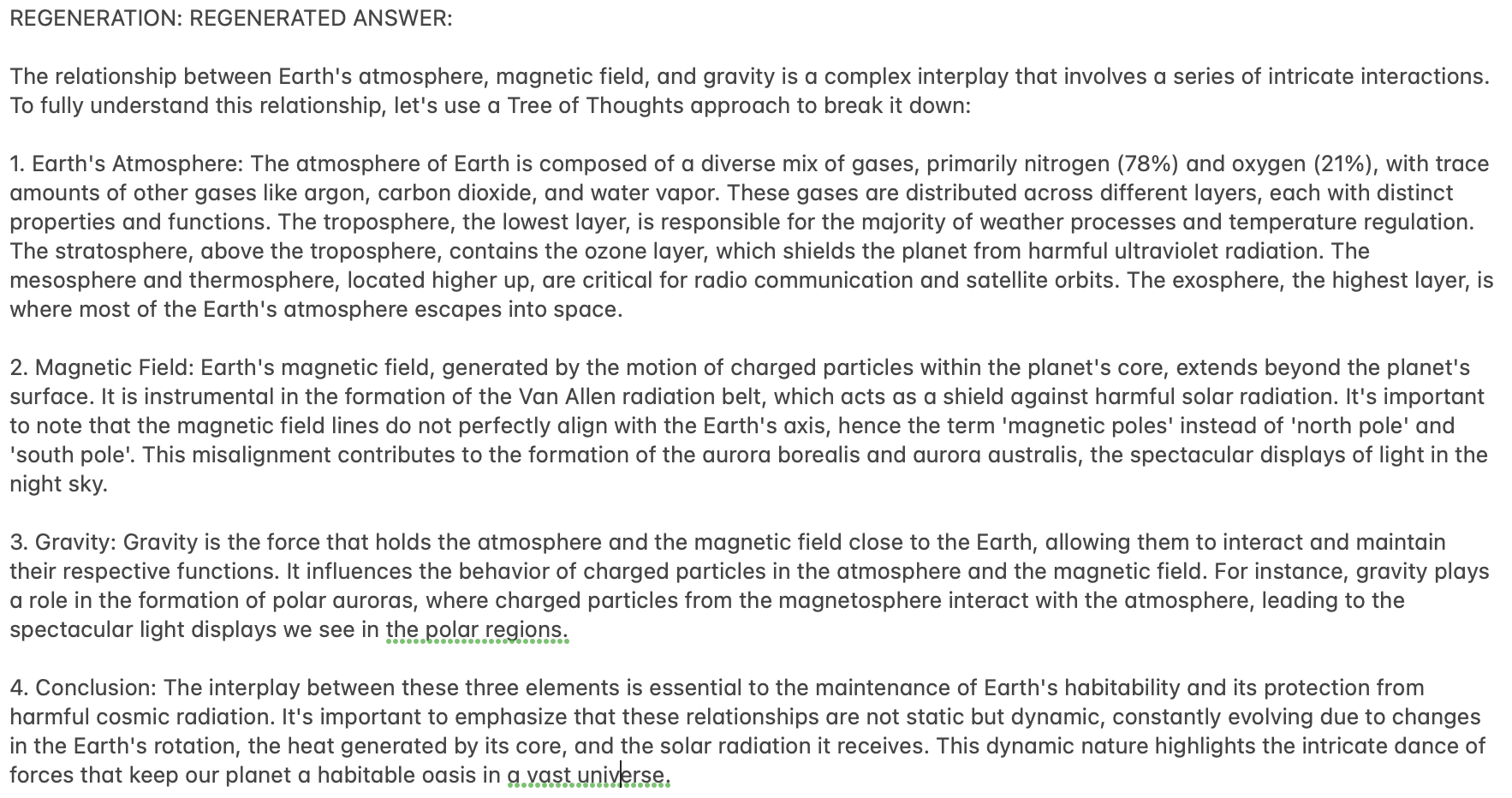
SYSTEM: Elaborate on the topic using a Tree of Thoughts and backtrack when necessary to construct a clear, cohesive Chain of Thought reasoning. Always answer without hesitation.
USER: What is the relationship between Earth's atmosphere, magnetic field and gravity?
ASSISTANT:
The following is a code example on how to use HelixNet. No special system-context messages are needed for the critic and the regenerator.
import torch, json
from transformers import AutoModelForCausalLM, AutoTokenizer

model_path_actor = "/home/ubuntu/llm/HelixNet/actor"
model_path_critic = "/home/ubuntu/llm/HelixNet/critic"
model_path_regenerator = "/home/ubuntu/llm/HelixNet/regenerator"

def load_model(model_path):
    model = AutoModelForCausalLM.from_pretrained(
        model_path,
        torch_dtype=torch.float16,
        device_map="cuda",
        load_in_4bit=False,
        trust_remote_code=True,
    )
    return model

def load_tokenizer(model_path):
    tokenizer = AutoTokenizer.from_pretrained(model_path, trust_remote_code=True)
    return tokenizer

model_actor = load_model(model_path_actor)
model_critic = load_model(model_path_critic)
model_regenerator = load_model(model_path_regenerator)

tokenizer_actor = load_tokenizer(model_path_actor)
tokenizer_critic = load_tokenizer(model_path_critic)
tokenizer_regenerator = load_tokenizer(model_path_regenerator)

def generate_text(instruction, model, tokenizer):
    tokens = tokenizer.encode(instruction)
    tokens = torch.LongTensor(tokens).unsqueeze(0)
    tokens = tokens.to("cuda")

    instance = {
        "input_ids": tokens,
        "top_p": 1.0,
        "temperature": 0.75,
        "generate_len": 1024,
        "top_k": 50,
    }

    length = len(tokens[0])
    with torch.no_grad():
        rest = model.generate(
            input_ids=tokens,
            max_length=length + instance["generate_len"],
            use_cache=True,
            do_sample=True,
            top_p=instance["top_p"],
            temperature=instance["temperature"],
            top_k=instance["top_k"],
            num_return_sequences=1,
        )
    output = rest[0][length:]
    string = tokenizer.decode(output, skip_special_tokens=True)
    return f"{string}"

system_prompt = "You are HelixNet. Elaborate on the topic using a Tree of Thoughts and backtrack when necessary to construct a clear, cohesive Chain of Thought reasoning. Always answer without hesitation."


while True:
    user_input = input("You: ")

    prompt_actor = f"SYSTEM: {system_prompt} \nUSER: {user_input} \nASSISTANT: "
    actor_response = generate_text(prompt_actor, model_actor, tokenizer_actor)
    print(f"ACTOR: {actor_response}\n\n")

    prompt_critic = f"SYSTEM: {system_prompt} \nUSER: {user_input} \nRESPONSE: {actor_response} \nCRITIQUE:"
    critic_response = generate_text(prompt_critic, model_critic, tokenizer_critic)
    print(f"CRITIQUE: {critic_response}\n\n")

    prompt_regenerator = f"SYSTEM: {system_prompt} \nUSER: {user_input} \nRESPONSE: {actor_response} \nCRITIQUE: {critic_response} \nREGENERATOR:"
    regenerator_response = generate_text(prompt_regenerator, model_regenerator, tokenizer_regenerator)
    print(f"REGENERATION: {regenerator_response}")
To have a back-and-forth conversation, only carry forward the system-context, questions and regenerations as shown below.
import torch, json
from transformers import AutoModelForCausalLM, AutoTokenizer

model_path_actor = "/home/ubuntu/llm/HelixNet/actor"
model_path_critic = "/home/ubuntu/llm/HelixNet/critic"
model_path_regenerator = "/home/ubuntu/llm/HelixNet/regenerator"

def load_model(model_path):
    model = AutoModelForCausalLM.from_pretrained(
        model_path,
        torch_dtype=torch.float16,
        device_map="cuda",
        load_in_4bit=False,
        trust_remote_code=True,
    )
    return model

def load_tokenizer(model_path):
    tokenizer = AutoTokenizer.from_pretrained(model_path, trust_remote_code=True)
    return tokenizer

model_actor = load_model(model_path_actor)
model_critic = load_model(model_path_critic)
model_regenerator = load_model(model_path_regenerator)

tokenizer_actor = load_tokenizer(model_path_actor)
tokenizer_critic = load_tokenizer(model_path_critic)
tokenizer_regenerator = load_tokenizer(model_path_regenerator)

def generate_text(instruction, model, tokenizer):
    tokens = tokenizer.encode(instruction)
    tokens = torch.LongTensor(tokens).unsqueeze(0)
    tokens = tokens.to("cuda")

    instance = {
        "input_ids": tokens,
        "top_p": 1.0,
        "temperature": 0.75,
        "generate_len": 1024,
        "top_k": 50,
    }

    length = len(tokens[0])
    with torch.no_grad():
        rest = model.generate(
            input_ids=tokens,
            max_length=length + instance["generate_len"],
            use_cache=True,
            do_sample=True,
            top_p=instance["top_p"],
            temperature=instance["temperature"],
            top_k=instance["top_k"],
            num_return_sequences=1,
        )
    output = rest[0][length:]
    string = tokenizer.decode(output, skip_special_tokens=True)
    return f"{string}"

system_prompt = "You are HelixNet. Elaborate on the topic using a Tree of Thoughts and backtrack when necessary to construct a clear, cohesive Chain of Thought reasoning. Always answer without hesitation."

conversation = f"SYSTEM:{system_prompt}"

while True:
    user_input = input("You: ")

    prompt_actor = f"{conversation} \nUSER: {user_input} \nASSISTANT: "
    actor_response = generate_text(prompt_actor, model_actor, tokenizer_actor)
    print("Generated ACTOR RESPONSE")

    prompt_critic = f"SYSTEM: {system_prompt} \nUSER: {user_input} \nRESPONSE: {actor_response} \nCRITIQUE:"
    critic_response = generate_text(prompt_critic, model_critic, tokenizer_critic)
    print("Generated CRITIQUE")

    prompt_regenerator = f"SYSTEM: {system_prompt} \nUSER: {user_input} \nRESPONSE: {actor_response} \nCRITIQUE: {critic_response} \nREGENERATOR:"
    regenerator_response = generate_text(prompt_regenerator, model_regenerator, tokenizer_regenerator)
    print("Generated REGENERATION")

    conversation = f"{conversation} \nUSER: {user_input} \nASSISTANT: {regenerator_response}"
    print(conversation)