Downloads · 30 days
140
2% of all-time downloads
FredZhang7/distilgpt2-stable-diffusion
distilgpt2-stable-diffusion is a text generation model from FredZhang7. Use it when you need the model to write or continue text. It is set up for transformers. The card lists the license as creativeml-openrail-m.
<a href="https://huggingface.co/FredZhang7/distilgpt2-stable-diffusion-v2" <font size="4" <bold Version 2 is here! </bold </font </a
Downloads · 30 days
140
2% of all-time downloads
All-time downloads
9.3K
Public
Parameters
88.2M
1 GB on disk
Likes
9
Public
Click a slice to open those files.
.bin334 MB · 50%
How the weights are stored.
F3281.9M · 93%
From the Hugging Face model README
<a href="https://huggingface.co/FredZhang7/distilgpt2-stable-diffusion-v2"> <font size="4"> <bold> Version 2 is here! </bold> </font> </a>
DistilGPT2 Stable Diffusion is a text generation model used to generate creative and coherent prompts for text-to-image models, given any text. This model was finetuned on 2.03 million descriptive stable diffusion prompts from Stable Diffusion discord, Lexica.art, and (my hand-picked) Krea.ai. I filtered the hand-picked prompts based on the output results from Stable Diffusion v1.4.
Compared to other prompt generation models using GPT2, this one runs with 50% faster forwardpropagation and 40% less disk space & RAM.
pip install --upgrade transformers
from transformers import GPT2Tokenizer, GPT2LMHeadModel

# load the pretrained tokenizer
tokenizer = GPT2Tokenizer.from_pretrained('distilgpt2')
tokenizer.add_special_tokens({'pad_token': '[PAD]'})
tokenizer.max_len = 512

# load the fine-tuned model
model = GPT2LMHeadModel.from_pretrained('FredZhang7/distilgpt2-stable-diffusion')

# generate text using fine-tuned model
from transformers import pipeline
nlp = pipeline('text-generation', model=model, tokenizer=tokenizer)
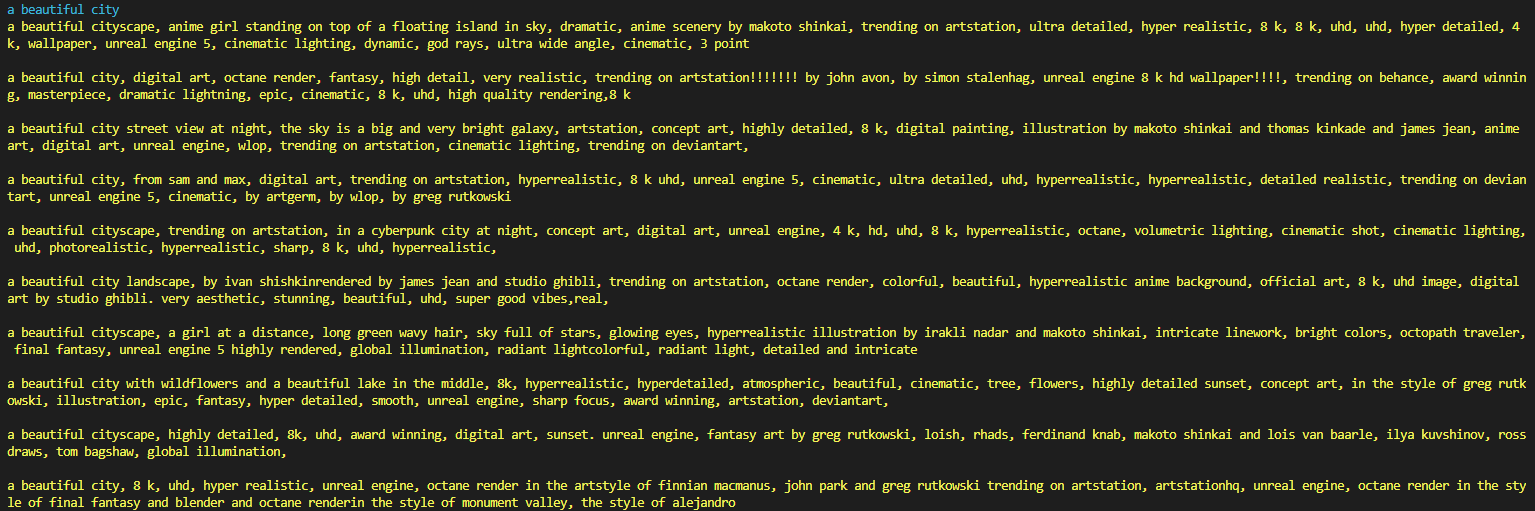
ins = "a beautiful city"

# generate 10 samples
outs = nlp(ins, max_length=80, num_return_sequences=10)

# print the 10 samples
for i in range(len(outs)):
    outs[i] = str(outs[i]['generated_text']).replace('  ', '')
print('\033[96m' + ins + '\033[0m')
print('\033[93m' + '\n\n'.join(outs) + '\033[0m')
Example Output: