
Downloads · 30 days
146
17% of all-time downloads
DavidAU/Qwen3-53B-A3B-2507-TOTAL-RECALL-v2-MASTER-CODER
Qwen3-53B-A3B-2507-TOTAL-RECALL-v2-MASTER-CODER is a text generation model from DavidAU. Use it when you need the model to write or continue text. It is set up for transformers. The card lists the license as apache-2.0.
<small<B style="font-family: 'Arial Black', sans-serif; font-weight: 900; color: f1c40f; text-decoration: none; text-shadow: 1px 1px 0 d35400, 2px 2px 0 d35400, 3px 3px 0 d35400, 4px 4px 0 d35400, 5px 5px 0 d35400, 6p…
Downloads · 30 days
146
17% of all-time downloads
All-time downloads
871
Public
Parameters
53B
106 GB on disk
Likes
16
Public
Click a slice to open those files.
.safetensors106 GB · 100%
From the Hugging Face model README
<small><B style="font-family: 'Arial Black', sans-serif; font-weight: 900; color: #f1c40f; text-decoration: none; text-shadow: 1px 1px 0 #d35400, 2px 2px 0 #d35400, 3px 3px 0 #d35400, 4px 4px 0 #d35400, 5px 5px 0 #d35400, 6px 6px 7px rgba(0,0,0,0.4);">[DavidAU]</B> <a href="https://huggingface.co/DavidAU" target="_blank" style="padding-left:5px">FOLLOW</a> | <a href="https://huggingface.co/DavidAU" target="_blank">ALL MODELS</a> | <a href="https://huggingface.co/DavidAU/collections" target="_blank">COLLECTIONS</a> | <a href="https://huggingface.co/models?sort=trending&search=DavidAU" target="_blank">TRENDING</a> | <a href="https://huggingface.co/DavidAU/support" target="_blank">FAQs</a> | <a href="https://huggingface.co/DavidAU/support" target="_blank">SUPPORT</a> | <a href="https://buymeacoffee.com/davidbelton" target="_blank">Buy Me A Coffee (😁)</a></small>
<h2>Qwen3-53B-A3B-2507-TOTAL-RECALL-v2-MASTER-CODER [256k context]</h2> <img src="qwen3-total-recall.gif" style="float:right; width:300px; height:300px; padding:10px;">This repo contains the full precision source code, in "safe tensors" format to generate GGUFs, GPTQ, EXL2, AWQ, HQQ and other formats. The source code can also be used directly.
This model is for all use cases, but excels in CODING and programming in all major programming languages and many minor ones too.
This model is based on Qwen3-30B-A3B-Instruct-2507 (MOE, 128 experts, 8 activated), with Brainstorm 40X (by DavidAU) - details at bottom of this page.
The Brainstorm adapter will improve general performance and "out of the box" thinking.
This creates a model of 53B parameters, 84 layers and 1011 tensors.
This version has the NATIVE context of 256k.
This is a non-reasoning/non-thinking block model.
I have included an optional system prompt to invoke "thinking" in this model, if you want to activate it.
For coding, programming set expert to:
Recommended settings:
This is the refined version -V1.4- from this project (see this repo for all settings, details, system prompts, example generations etc etc):
https://huggingface.co/DavidAU/Qwen3-55B-A3B-TOTAL-RECALL-Deep-40X-GGUF/
This version 2 is slightly smaller, with further refinements to the Brainstorm adapter and uses the new "Qwen3-30B-A3B-Instruct-2507".
Review and Specialized Settings for this model (V 1.4):
https://www.linkedin.com/posts/gchesler_haskell-postgres-agentic-activity-7347103276141596672-_zbo/
You may also want to see (root model of Total Recall series - Version 1):
https://huggingface.co/Qwen/Qwen3-30B-A3B
AND Version 2 root model:
https://huggingface.co/Qwen/Qwen3-30B-A3B-Instruct-2507
For additional settings, tool use, and other model settings.
Summary of root model below, followed by FULL HELP SECTION, then info on Brainstorm 40x.
OPTIONAL SYSTEM PROMPT - INVOKE "Thinking":
Enable deep thinking subroutine. You are a deep thinking AI, you may use extremely long chains of thought to deeply consider the problem and deliberate with yourself via systematic reasoning processes to help come to a correct solution prior to answering. You should enclose your thoughts and internal monologue inside ###ponder### ###/ponder### tags, and then provide your solution or response to the problem.
Use this to INVOKE "thinking" block(s) in the model. These will be a lot shorter than 1000s of tokens generally in most "thinking" models.
In you use this prompt, you may need to raise "rep pen" to 1.08 to 1.1, to prevent "loops" in the "thought block(s)" ; especially in lower quants.
If you change "ponder" to a different word/phrase this will affect model "thinking" too.
QUANTS
Special Thanks to Team Mradermacher, and Nightmedia for the quants:
GGUF:
https://huggingface.co/mradermacher/Qwen3-53B-A3B-2507-TOTAL-RECALL-v2-MASTER-CODER-GGUF
GGUF-IMATRIX:
https://huggingface.co/mradermacher/Qwen3-53B-A3B-2507-TOTAL-RECALL-v2-MASTER-CODER-i1-GGUF
MLX:
https://huggingface.co/nightmedia/Qwen3-55B-A3B-2507-TOTAL-RECALL-v2-MASTER-CODER-q6-hi-mlx
https://huggingface.co/nightmedia/Qwen3-55B-A3B-2507-TOTAL-RECALL-v2-MASTER-CODER-1m-q4-hi-mlx
We introduce the updated version of the Qwen3-30B-A3B non-thinking mode, named Qwen3-30B-A3B-Instruct-2507, featuring the following key enhancements:
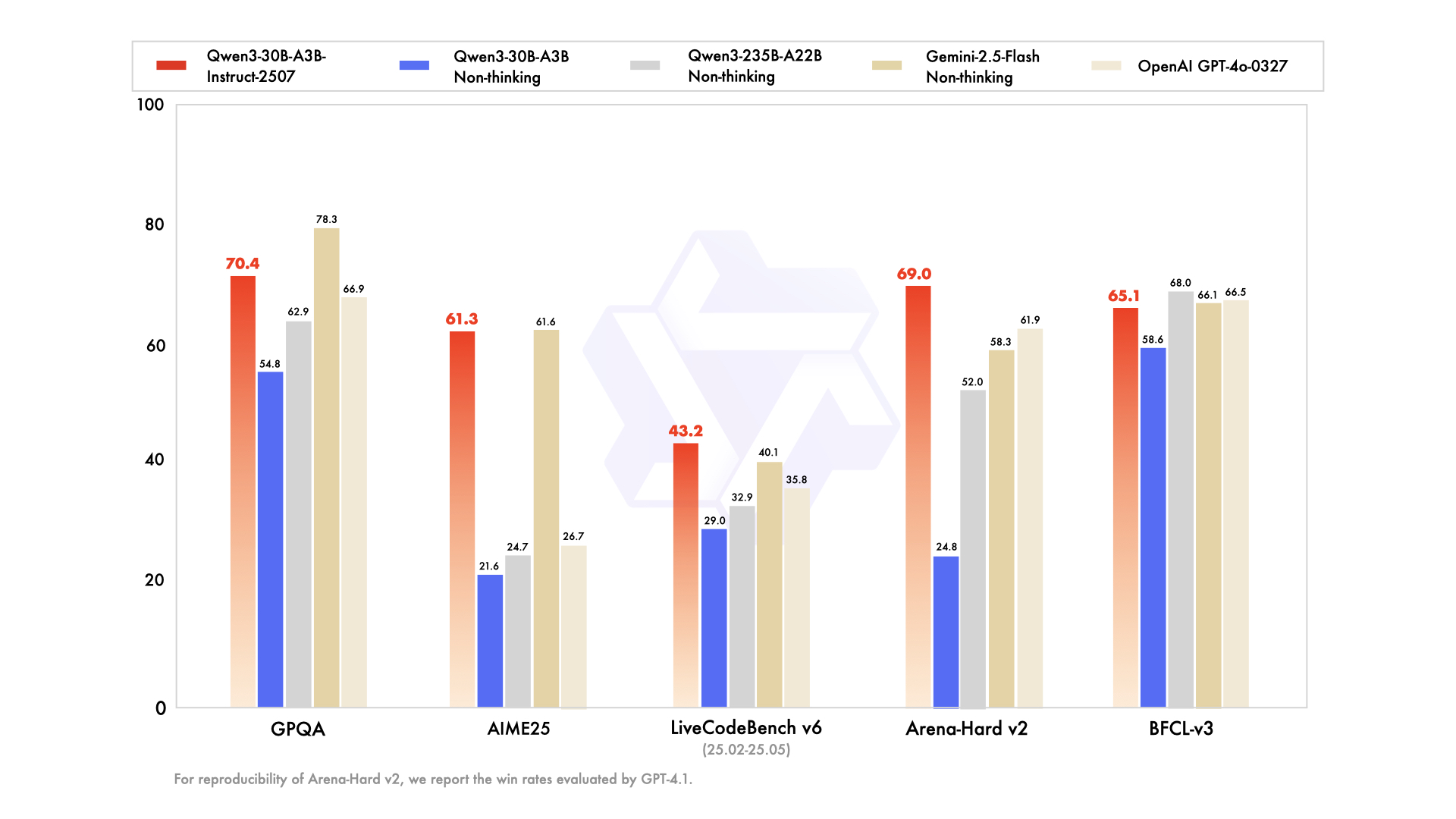
Qwen3-30B-A3B-Instruct-2507 has the following features:
NOTE: This model supports only non-thinking mode and does not generate <think></think> blocks in its output. Meanwhile, specifying enable_thinking=False is no longer required.
For more details, including benchmark evaluation, hardware requirements, and inference performance, please refer to our blog, GitHub, and Documentation.
| Deepseek-V3-0324 | GPT-4o-0327 | Gemini-2.5-Flash Non-Thinking | Qwen3-235B-A22B Non-Thinking | Qwen3-30B-A3B Non-Thinking | Qwen3-30B-A3B-Instruct-2507 | |
|---|---|---|---|---|---|---|
| Knowledge | ||||||
| MMLU-Pro | 81.2 | 79.8 | 81.1 | 75.2 | 69.1 | 78.4 |
| MMLU-Redux | 90.4 | 91.3 | 90.6 | 89.2 | 84.1 | 89.3 |
| GPQA | 68.4 | 66.9 | 78.3 | 62.9 | 54.8 | 70.4 |
| SuperGPQA | 57.3 | 51.0 | 54.6 | 48.2 | 42.2 | 53.4 |
| Reasoning | ||||||
| AIME25 | 46.6 | 26.7 | 61.6 | 24.7 | 21.6 | 61.3 |
| HMMT25 | 27.5 | 7.9 | 45.8 | 10.0 | 12.0 | 43.0 |
| ZebraLogic | 83.4 | 52.6 | 57.9 | 37.7 | 33.2 | 90.0 |
| LiveBench 20241125 | 66.9 | 63.7 | 69.1 | 62.5 | 59.4 | 69.0 |
| Coding | ||||||
| LiveCodeBench v6 (25.02-25.05) | 45.2 | 35.8 | 40.1 | 32.9 | 29.0 | 43.2 |
| MultiPL-E | 82.2 | 82.7 | 77.7 | 79.3 | 74.6 | 83.8 |
| Aider-Polyglot | 55.1 | 45.3 | 44.0 | 59.6 | 24.4 | 35.6 |
| Alignment | ||||||
| IFEval | 82.3 | 83.9 | 84.3 | 83.2 | 83.7 | 84.7 |
| Arena-Hard v2* | 45.6 | 61.9 | 58.3 | 52.0 | 24.8 | 69.0 |
| Creative Writing v3 | 81.6 | 84.9 | 84.6 | 80.4 | 68.1 | 86.0 |
| WritingBench | 74.5 | 75.5 | 80.5 | 77.0 | 72.2 | 85.5 |
| Agent | ||||||
| BFCL-v3 | 64.7 | 66.5 | 66.1 | 68.0 | 58.6 | 65.1 |
| TAU1-Retail | 49.6 | 60.3# | 65.2 | 65.2 | 38.3 | 59.1 |
| TAU1-Airline | 32.0 | 42.8# | 48.0 | 32.0 | 18.0 | 40.0 |
| TAU2-Retail | 71.1 | 66.7# | 64.3 | 64.9 | 31.6 | 57.0 |
| TAU2-Airline | 36.0 | 42.0# | 42.5 | 36.0 | 18.0 | 38.0 |
| TAU2-Telecom | 34.0 | 29.8# | 16.9 | 24.6 | 18.4 | 12.3 |
| Multilingualism | ||||||
| MultiIF | 66.5 | 70.4 | 69.4 | 70.2 | 70.8 | 67.9 |
| MMLU-ProX | 75.8 | 76.2 | 78.3 | 73.2 | 65.1 | 72.0 |
| INCLUDE | 80.1 | 82.1 | 83.8 | 75.6 | 67.8 | 71.9 |
| PolyMATH | 32.2 | 25.5 | 41.9 | 27.0 | 23.3 | 43.1 |
*: For reproducibility, we report the win rates evaluated by GPT-4.1.
#: Results were generated using GPT-4o-20241120, as access to the native function calling API of GPT-4o-0327 was unavailable.
The code of Qwen3-MoE has been in the latest Hugging Face transformers and we advise you to use the latest version of transformers.
With transformers<4.51.0, you will encounter the following error:
KeyError: 'qwen3_moe'
The following contains a code snippet illustrating how to use the model generate content based on given inputs.
from transformers import AutoModelForCausalLM, AutoTokenizer

model_name = "Qwen/Qwen3-30B-A3B-Instruct-2507"

# load the tokenizer and the model
tokenizer = AutoTokenizer.from_pretrained(model_name)
model = AutoModelForCausalLM.from_pretrained(
    model_name,
    torch_dtype="auto",
    device_map="auto"
)

# prepare the model input
prompt = "Give me a short introduction to large language model."
messages = [
    {"role": "user", "content": prompt}
]
text = tokenizer.apply_chat_template(
    messages,
    tokenize=False,
    add_generation_prompt=True,
)
model_inputs = tokenizer([text], return_tensors="pt").to(model.device)

# conduct text completion
generated_ids = model.generate(
    **model_inputs,
    max_new_tokens=16384
)
output_ids = generated_ids[0][len(model_inputs.input_ids[0]):].tolist()

content = tokenizer.decode(output_ids, skip_special_tokens=True)

print("content:", content)
For deployment, you can use sglang>=0.4.6.post1 or vllm>=0.8.5 or to create an OpenAI-compatible API endpoint:
python -m sglang.launch_server --model-path Qwen/Qwen3-30B-A3B-Instruct-2507 --context-length 262144
vllm serve Qwen/Qwen3-30B-A3B-Instruct-2507 --max-model-len 262144
Note: If you encounter out-of-memory (OOM) issues, consider reducing the context length to a shorter value, such as 32,768.
For local use, applications such as Ollama, LMStudio, MLX-LM, llama.cpp, and KTransformers have also supported Qwen3.
Qwen3 excels in tool calling capabilities. We recommend using Qwen-Agent to make the best use of agentic ability of Qwen3. Qwen-Agent encapsulates tool-calling templates and tool-calling parsers internally, greatly reducing coding complexity.
To define the available tools, you can use the MCP configuration file, use the integrated tool of Qwen-Agent, or integrate other tools by yourself.
from qwen_agent.agents import Assistant

# Define LLM
llm_cfg = {
    'model': 'Qwen3-30B-A3B-Instruct-2507',

    # Use a custom endpoint compatible with OpenAI API:
    'model_server': 'http://localhost:8000/v1',  # api_base
    'api_key': 'EMPTY',
}

# Define Tools
tools = [
    {'mcpServers': {  # You can specify the MCP configuration file
            'time': {
                'command': 'uvx',
                'args': ['mcp-server-time', '--local-timezone=Asia/Shanghai']
            },
            "fetch": {
                "command": "uvx",
                "args": ["mcp-server-fetch"]
            }
        }
    },
  'code_interpreter',  # Built-in tools
]

# Define Agent
bot = Assistant(llm=llm_cfg, function_list=tools)

# Streaming generation
messages = [{'role': 'user', 'content': 'https://qwenlm.github.io/blog/ Introduce the latest developments of Qwen'}]
for responses in bot.run(messages=messages):
    pass
print(responses)
To achieve optimal performance, we recommend the following settings:
Sampling Parameters:
Temperature=0.7, TopP=0.8, TopK=20, and MinP=0.presence_penalty parameter between 0 and 2 to reduce endless repetitions. However, using a higher value may occasionally result in language mixing and a slight decrease in model performance.Adequate Output Length: We recommend using an output length of 16,384 tokens for most queries, which is adequate for instruct models.
Standardize Output Format: We recommend using prompts to standardize model outputs when benchmarking.
answer field with only the choice letter, e.g., "answer": "C"."<B>CHANGE THE NUMBER OF ACTIVE EXPERTS:</B>
See this document:
https://huggingface.co/DavidAU/How-To-Set-and-Manage-MOE-Mix-of-Experts-Model-Activation-of-Experts
<B>Settings: CHAT / ROLEPLAY and/or SMOOTHER operation of this model:</B>
In "KoboldCpp" or "oobabooga/text-generation-webui" or "Silly Tavern" ;
Set the "Smoothing_factor" to 1.5
: in KoboldCpp -> Settings->Samplers->Advanced-> "Smooth_F"
: in text-generation-webui -> parameters -> lower right.
: In Silly Tavern this is called: "Smoothing"
NOTE: For "text-generation-webui"
-> if using GGUFs you need to use "llama_HF" (which involves downloading some config files from the SOURCE version of this model)
Source versions (and config files) of my models are here:
OTHER OPTIONS:
Increase rep pen to 1.1 to 1.15 (you don't need to do this if you use "smoothing_factor")
If the interface/program you are using to run AI MODELS supports "Quadratic Sampling" ("smoothing") just make the adjustment as noted.
<B>Highest Quality Settings / Optimal Operation Guide / Parameters and Samplers</B>
This a "Class 1" model:
For all settings used for this model (including specifics for its "class"), including example generation(s) and for advanced settings guide (which many times addresses any model issue(s)), including methods to improve model performance for all use case(s) as well as chat, roleplay and other use case(s) please see:
You can see all parameters used for generation, in addition to advanced parameters and samplers to get the most out of this model here:
<B>Brainstorm 40x</B>
The BRAINSTORM process was developed by David_AU.
Some of the core principals behind this process are discussed in this <a href="https://arxiv.org/pdf/2401.02415"> scientific paper : Progressive LLaMA with Block Expansion </a>.
However I went in a completely different direction from what was outlined in this paper.
What is "Brainstorm" ?
The reasoning center of an LLM is taken apart, reassembled, and expanded.
In this case for this model: 40 times
Then these centers are individually calibrated. These "centers" also interact with each other. This introduces subtle changes into the reasoning process. The calibrations further adjust - dial up or down - these "changes" further. The number of centers (5x,10x etc) allow more "tuning points" to further customize how the model reasons so to speak.
The core aim of this process is to increase the model's detail, concept and connection to the "world", general concept connections, prose quality and prose length without affecting instruction following.
This will also enhance any creative use case(s) of any kind, including "brainstorming", creative art form(s) and like case uses.
Here are some of the enhancements this process brings to the model's performance:
Other "lab" observations:
The process to modify the model occurs at the root level - source files level. The model can quanted as a GGUF, EXL2, AWQ etc etc.