
Downloads · 30 days
0
BriLLM/BriLLM0.5
BriLLM0.5 is a machine learning model from BriLLM. Use it for the machine learning task on the model card, and read the license before you ship it in a product.
We release BriLLM-Chinese and BriLLM-English.
Downloads · 30 days
0
Access
Public
Updated Aug 7, 2025
Repo size
25.7 GB
Likes
36
Public
Click a slice to open those files.
.bin12.6 GB · 96%
From the Hugging Face model README
We release BriLLM-Chinese and BriLLM-English.
Our paper: https://arxiv.org/pdf/2503.11299
Our Github: https://github.com/brillm05/BriLLM0.5
Our huggingface: https://huggingface.co/BriLLM/BriLLM0.5
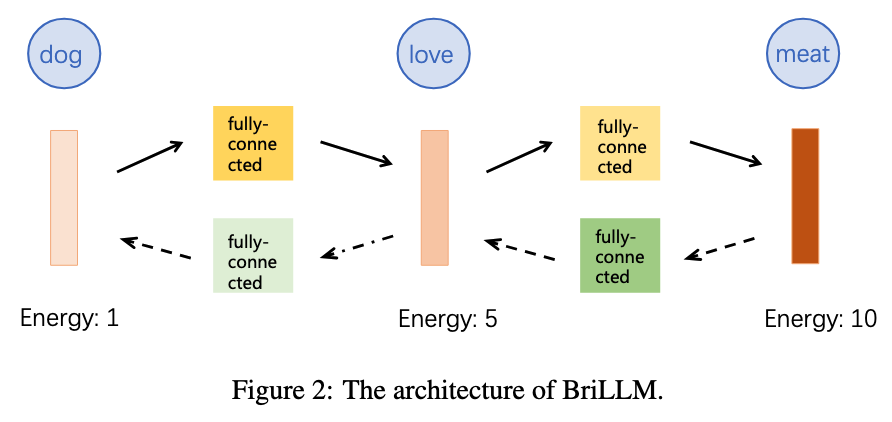
BriLLM redefines the foundations of generative language modeling by departing from Transformer architectures, GPT frameworks, and traditional input-output constrained paradigms. Built on the Signal Fully-connected flowing (SiFu) mechanism—a directed graph-based neural network design—BriLLM enables full interpretability across all nodes, in contrast to conventional models limited to input-output interpretability.
In this framework, tokens are represented as graph nodes, with signal flows—either randomly initialized or user-defined—propagating along paths following a "least resistance" principle. The next token to be generated emerges as the target of this signal flow. Theoretically, BriLLM supports infinitely long n-gram modeling, with model size decoupled from input and prediction length. Its signal propagation dynamics mimic human-like cognitive patterns, enabling recall activation and inherent multi-modal compatibility.


The SiFu (Signal Fully-connected Flowing) mechanism addresses fundamental limitations of current machine learning frameworks. Unlike traditional models that process discrete input streams through opaque computations, SiFu operates on a fully connected directed graph where:
Signal propagation follows the principle: $v_i = \arg\max_{v'} \left| r \oplus v_1 \otimes e_{12} \oplus v_2 \ldots \oplus v' \right|$
where $\oplus$ and $\otimes$ denote tensor operations for node and edge interactions, and $|\cdot|$ represents signal energy.
Overall, SiFu's design as a directed fully connected graph with signal propagation confers two key advantages:

BriLLM implements the SiFu mechanism where each vocabulary token corresponds to a node defined by a GeLU-activated neuron layer with bias $b \in \mathbb{R}^{d_{node}}$. Edges between nodes are modeled as fully connected matrices $W_{u,v} \in \mathbb{R}^{d_{node} \times d_{node}}$, enabling bidirectional signaling.
Signal propagation begins with initial tensor $e_0 = [1, 1, \ldots, 1]^T \in \mathbb{R}^{d_{node}}$ and follows:
$e_{i+1} = \text{GeLU}(W_{u_i,u_{i+1}} e_i + b_{u_i,u_{i+1}} + PE_i)$
The final prediction maximizes the L2 norm: $v_{predict} = \arg\max_v |E_{u,v}|_2$

Training BriLLM involves constructing a dedicated neural network for each sequence sample. The network connects input nodes sequentially, with all potential paths integrated into a final softmax layer that identifies the correct path via cross-entropy loss optimization.
BriLLM is implemented using PyTorch. It uses sinusoidal positional encoding, GeLU as the activation function, cross-entropy loss for next-token prediction, and an embedding size of $d_{model} = 32$. We used the AdamW optimizer with $\beta_1 = 0.9$, $\beta_2 = 0.999$ and $\epsilon = 10^{-8}$. The model size is about $512 + 4000 * 4000 * (32 * 32 + 32) \approx 16B$. We trained our models on one machine with 8 NVIDIA A800 GPUs for 1.5k steps.

BriLLM leverages sparse token co-occurrence: most bigrams are low-frequency or absent, allowing shared parameters for inactive edges. Low-frequency bigrams use a fixed, non-updated matrix, reducing model size to 2B (Chinese) and 1B (English)—13.0% and 5.7% of the original size, respectively. This reduces parameters by ~90% while accelerating training.


pip install torch
bash run_zh.sh
bash run_en.sh
import json
import torch
from model import BraLM, Vocab

with open("vocab_wiki_4k.json") as f:
     node_dict = json.load(f)
vocab = Vocab.from_node_dict(node_dict)

with open('word_frequency.json', 'r') as f:
    freq_dict = json.load(f)

zero_freq_edges = {}
for s in freq_dict:
    zero_freq_edges[s] = []
    for t in freq_dict[s]:
        if freq_dict[s][t] == 0:
            zero_freq_edges[s].append(t)

model = BraLM(hidden_size=32, zero_freq_edges=zero_freq_edges, vocab=vocab)
model.prepare_network(vocab)

state_dict = torch.load("model_zh.bin", weights_only=True)
model.load_state_dict(state_dict)
model.to_device("cuda:6")

head = "《罗马》描述了"
max_token = 32 - len(head)

start = [vocab((head[i]+ '->' +head[i+1])) for i in range(len(head)-1)]
ret = model.decode(start, vocab, max_token)
decode_tuple_list = [vocab.decode(p) for p in ret]
decode_sentence = decode_tuple_list[0][0] + "".join([p[-1] for p in decode_tuple_list])

print(decode_sentence)
import json
import torch
from model import BraLM, Vocab
from tokenizers import Tokenizer

bpe_tokenizer = Tokenizer.from_file("wiki_bpe_tokenizer_4000_bytelevel.json")

def decode_en_sentence(head, max_token=32, do_sample=False):
    bpe_tokens = bpe_tokenizer.encode(head).tokens
    if len(bpe_tokens) < 2:
        return head
    start = [vocab((bpe_tokens[i] + '->' + bpe_tokens[i+1])) for i in range(len(bpe_tokens)-1)]
    ret = model.decode(start, vocab, max_token, do_sample)
    decode_tuple_list = [vocab.decode(p).split('->') for p in ret]
    decode_sentence = decode_tuple_list[0][0] + "".join([p[-1] for p in decode_tuple_list])
    return decode_sentence

with open("./vocab_wiki_4k_en.json") as f:
     node_dict = json.load(f)
vocab = Vocab.from_node_dict(node_dict)

model = BraLM(hidden_size=32)
model.prepare_network(vocab)

state_dict = torch.load("model_en.bin", weights_only=True)
model.load_state_dict(state_dict)
model.to_device("cuda:6")

head = "In frogs, the hind legs are larger"
encoding = bpe_tokenizer.encode(head)
token_len = len(encoding.ids)
max_token = 32 - token_len
decode_sentence = decode_en_sentence(head, max_token).replace("Ġ", " ")

print(decode_sentence)